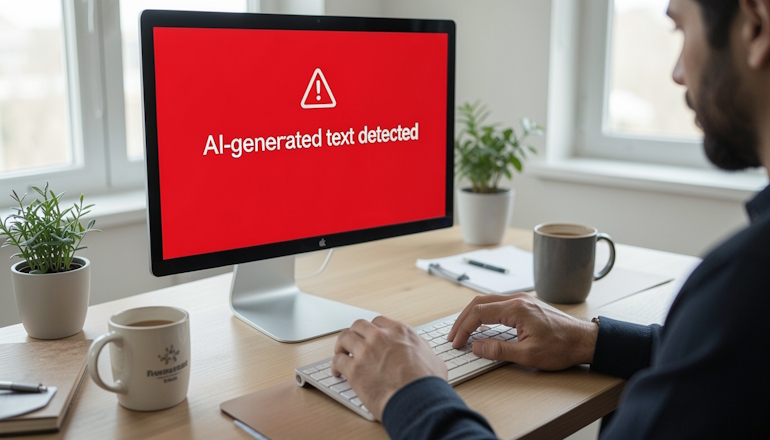
AI text detectors are everywhere now, with dozens of free and paid tools claiming to tell human writing from machine writing. But do they actually work? My experience says the opposite: the same text can be labeled “human” or “AI-generated” depending on which detector you use and even which browser you open it in.
In this article, I will explain in plain language why relying on these tools is not just pointless, but often harmful, and I will share real examples of bad detections, including my own case with carefully polished SEO copy.
In Simple Terms: Why AI Detectors Are a Lottery
Imagine you wrote a letter to a friend, edited it, removed the extra words, made the structure clean, and then some website tells you, “A robot wrote this.”
Annoying, right? That is basically how modern AI detectors work. They do not “understand” text. They look for statistical patterns instead — for example, unusually even word frequency or the absence of supposedly “wrong” phrasing that they think only humans use.
The problem is that a good writer who writes cleanly and in a structured way gets pushed into the same risk zone as a neural network.
The detector looks at form, not meaning. And that is its biggest flaw.
Why AI Text Detectors Make No Sense ?
Here are a few points we arrived at through our own experiments:
They are trained on limited and often biased data. Most detectors are trained on mixes of public-source text: Wikipedia, news articles, forums, technical documentation. But they almost never include truly good, polished SEO copy written by experts for commercial websites. As a result, the algorithm learns that “too smooth” text must be bad. In reality, that smoothness may simply be the result of careful editing and revision.
False positives are the rule, not the exception. Research shows that even the best detectors are wrong in 30–40% of cases when they analyze text written by native speakers with strong language skills. If you write in English as a second language but work hard to avoid mistakes, the chance of a false accusation gets even higher. Detectors do not understand context, do not catch irony, and do not distinguish professional jargon from AI-like patterns. They just calculate probabilities.
Detectors can be fooled easily, both on purpose and by accident. Add a couple of intentionally “off” words, make one sentence very short and another one more tangled, and the detector starts turning green. That means the tool is not measuring where the text came from. It is only measuring how closely it matches some average style. For an SEO writer who writes for real people, that is not just useless — it is counterproductive, because it pushes you to make the text worse just to satisfy an algorithm.
No detector can prove authorship. Even if a program says there is a 99% chance the text was generated by AI, that is still just a statistical estimate. In court, in academia, or during hiring, that kind of “evidence” is not accepted. There are already cases where students were disciplined based on detector results, only for it to turn out later that they had written the text themselves. The technology is simply not ready for real life, and pretending otherwise is dangerous.
Three Real Examples of Wrong Detection
Here are examples from my own experience. I work on this site, but I also run my own Amazon landing pages, meaning targeted pages built to promote products, along with other competitive projects.
Example 1. My own polished SEO texts for the U.S. market.
Some time ago I wrote content for a website about finance, real estate, and insurance in the United States.
Every paragraph was tightened up, uniqueness was checked, repetition was removed, and the structure was made as easy to read as possible.
No AI — just hands, brain, and specialized terminology dictionaries.
The lead editor, just for fun, ran those texts through three popular detectors back to back. The result everywhere was red: “high probability of AI-generated text.” The reason was “too clean” grammar, no conversational filler, and very even sentence length. The detector could not tell a professional writer from a neural network.
This case is telling: when you know the language well, write in a structured way, and avoid mistakes, you automatically become suspicious.
So it turns out the worse you write, the better your odds of passing a detector. Absurd. I could have added a couple of typos on purpose and the result would have turned green. But why would I damage my own text just to please a questionable algorithm?
That is exactly why we stopped using such services — they do not help. They only get in the way.
Example 2. An academic paper by a linguistics professor.
In 2023, a professor I know wrote a paper on English syntax and, just as an experiment, ran it through a detector. The result was a 98% chance that AI wrote it. The paper had actually been published in a peer-reviewed journal two years before AI tools became mainstream. The professor simply wrote clearly, logically, and without unnecessary detours. The detector treated that extra level of correctness as a machine signal.
So much for a “reliable tool.” If a top-level expert with 20 years of experience cannot be distinguished from a neural network by a detector’s criteria, then what are we even talking about? These systems do not measure humanity. They measure the “average text,” where mistakes, casual words, and imperfect rhythm are assumed to be normal.
Anyone who writes better than average ends up in the danger zone.
Example 3. A tech company press release.
A copywriter on our team wrote a press release for an AI startup.
The text was dry, factual, full of dates, numbers, and technical terms — exactly what a good press release should be. The detector gave it an 87% AI score. The copywriter showed the result to the client, and the client… edited the text by adding a few exclamation points and shortening one sentence. After that, the detector showed only a 20% AI probability. The meaning did not change, but the quality got worse.
That is the classic problem: detectors push people to write worse. They punish clarity, logic, and professionalism. And they reward “human” sloppiness.
In a world that values accuracy and expertise, these tools are a step backward. They do not solve the real spam problem. They just create new problems for people who are actually trying to produce quality content.
I’m Ethan Carter, an American developer and technical writer with more than 20 years of experience in systems and application programming. My core specialty is low-level development in Assembler: 22 years of hands-on work, including deep experience in code optimization, CPU architecture, and performance-critical solutions. I also hold a PhD in Assembler and have spent more than 18 years working with ASP.NET, building enterprise web systems, APIs, and scalable backend solutions.
In addition, I have 9 years of experience in C++ and C#, along with 7 years of hands-on microcontroller programming in Assembler. Thanks to this mix of academic background and practical engineering experience, I can write about software architecture, low-level optimization, and modern development in a way that makes complex technical topics clear for a professional audience.