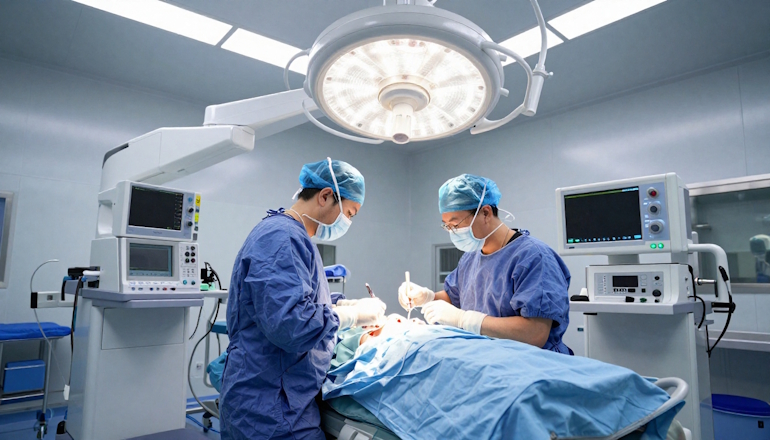
Human head transplantation is not a working clinical procedure yet. It remains a highly controversial concept known as body-to-head transplantation, or cephalosomatic anastomosis. Recent reviews make it clear that the operation has not been performed on a living person, and fresh 2026 material shows that Sergio Canavero still insists it is inevitable. In practice, this is not a “future surgery that is ready to go” but a field where neurosurgery, transplant medicine, bioethics, and the very hard limits of real-world medicine collide.
What Is Head Transplantation in Simple Terms?
Put simply, the idea is to move a person’s head onto another body and keep the brain alive.
The problem is that the head is not a separate organ in the normal sense. It is part of a system where blood flow, breathing, nerve function, and the connection to the spinal cord all have to be restored at once. That is why reviews on the subject describe it not as an ordinary transplant, but as a task with several almost insurmountable layers of complexity.
Interest in this idea did not appear out of nowhere. It is tied to attempts to find ways to help people with severe neuromuscular diseases and to search for solutions for spinal cord injuries.
But even supporters of the concept talk about it as something very far from real clinical use. In the scientific literature, it still looks more like a hypothetical reconstruction of the body than a procedure that could be safely moved into a hospital.
Why Is This Operation So Difficult?

Let us break down why human head transplantation is currently impossible, at least in theory:
- The hardest problem is the spinal cord. It would not just need to be connected. It would need to be restored so signals could again pass between the brain and the body, and today there is no convincing evidence that a fully severed human spinal cord can be successfully rejoined with full function. Reviews call this the key technical barrier, without which the entire operation loses its meaning.
- The second barrier is time without blood flow and the risk of brain ischemia. The head and the new body would have to survive an extremely short window while surgeons connect the blood vessels, or the tissue damage becomes irreversible. That is why hypothermia and neuroprotection methods keep coming up in papers on the subject: they are not there for show, they are there to buy time.
- The third barrier is vascular connection. Surgeons would need to restore blood inflow, venous outflow, and stable perfusion quickly, or the brain would not survive even with perfect operating-room technique. On paper, this sounds like “just stitch the vessels together,” but in reality it means coordinating dozens of critical steps, where one failure ruins everything else.
- The fourth barrier is immunology. The new body would still be a foreign biological object, which means heavy immunosuppression would be required, and that by itself raises the risk of infection, rejection, and complications. In ordinary transplant medicine, that is already a major issue. In head transplantation, it becomes even more severe because of the scale of the procedure.
- The fifth barrier is autonomous nervous system regulation. Even if the brain survives the surgery, breathing, vascular tone, movement control, and the many reflexes needed for the body to function normally still have to be restored. That is why experts talk not only about “connecting the head,” but about whether the whole neurophysiological system can survive the operation.
- The sixth barrier is pain, sensation, and motor function. Spinal cord damage almost inevitably means severe neurological consequences, which means that even a technically successful stage does not automatically lead to a normal life afterward. In the literature, this is treated as an entire category of problems, not just a side effect.
- The seventh barrier is postoperative recovery. Even if the surgery worked in theory, the patient would still need a long period of rehabilitation, immunosuppression, pain control, complication prevention, and adaptation to the new body. In practice, that makes the project not just a surgical challenge, but a months-long biomedical test with extremely high risk.
- The eighth barrier is personality, psychology, and ethics. Reviews separately discuss how a person would experience the new body, how identity would change, and why such operations raise serious moral and legal questions even before the first incision. That is why even people who discuss the technical side usually conclude that surgical skill alone is not enough here.
What Methods Are Even Being Discussed, and What Could Theoretically Help?
- The best-known line of thought is attempts to restore the spinal cord using so-called spinal cord fusion.
Papers on the subject mention animal experiments and reconstruction models that look at whether it is possible to restore at least partial conductivity after a complete injury. But this is still experimental territory: there is scientific interest, but no clinical proof for humans.
- The second line is the use of polyethylene glycol, or PEG, as a substance that could theoretically help membranes fuse and damaged nerve structures recover.
In spinal cord injury reviews, PEG is seen as a promising but not sufficient tool on its own. In the context of head transplantation, it remains part of a hypothesis, not a proven protocol.
- The third line is hypothermia and protection of tissue from ischemic damage.
The logic is straightforward: if you can cool the tissue and lower its metabolic needs, you gain a little more time for vascular work and reduce the risk of irreversible destruction. But even this is still discussed as a support measure, not as the answer to the main problem — how to preserve and reconnect the spinal cord.
- The fourth line is a combination of neuroprotective drugs, cell technologies, scaffolds, tissue-growth matrices, and long-term rehabilitation.
These approaches are being developed in spinal cord injury research, but for head transplantation they can only be supporting tools, because no single technology solves the whole problem.
That is why the modern consensus is this: even if individual pieces eventually work, the road to a full human operation is still enormous.
Legality in the U.S., China, and Russia
In the United States, transplant medicine is tightly regulated at both the federal and state levels. HRSA oversees the system, and the National Organ Transplant Act created OPTN as the national organ distribution network. But head transplantation is not a recognized ordinary procedure in that system, and under the current rules such an operation cannot simply “appear” as standard clinical practice. That is an inference from the existing regulatory framework, not a separate authorization.
In China, the current rules on organ donation and transplantation apply directly to human organ transplantation inside the country and define it as the removal and implantation of specific organs, such as the heart, lungs, liver, kidneys, or pancreas. The updated rules that took effect in 2024 strengthened regulation of procedures, qualifications, and responsibility, and organ trafficking remains forbidden. In that legal environment, head transplantation does not look like a permitted or defined procedure.
In Russia, Law No. 4180-I regulates the transplantation of human organs and tissues and allows it only when no other medical means can save the patient’s life or restore health. The law separately forbids the buying and selling of organs and tissues. That means there is no direct legal mechanism for head transplantation in the current Russian transplant framework, and the operation is not treated as a normal permitted practice.
Current Information and Rumors

In a fresh 2026 piece about Sergio Canavero (photo above), he is described as someone who still insists that the first human head transplant is inevitable and even tied to the idea of radical life extension. So this is not a closed topic. It is a surgeon who still keeps it in the public conversation.
But the older story around his claims is still the same: in 2015, he publicly talked about the operation being possible soon, and later, in 2017, he said there had been a “rehearsal” on cadavers. At the same time, reviews on the topic still confirm that no such operation has ever been performed on a living human and that there is still no proof of full success.
Because of that, today’s discussion is no longer about when the first operation will happen. It is about whether the idea is even feasible at all.
Most of the expert literature still describes the project as technically extremely problematic, scientifically unproven, and, in its current form, almost impossible legally, ethically, and clinically.
Here is the real picture: head transplantation has never been performed on a living person
The claimed “successes” are:
- either animal experiments (and those had failures too)
- or claims without evidence
- or operations on cadavers
And even in fresh 2026 material, they still write:
- Canavero says he has done such operations
- but this is not proven and not accepted by the scientific community
The media presents it like this: “they performed a head transplant.”
But in reality:
- the spinal cord was not restored
- body functions were not restored
- there was no living patient
So it is roughly like saying: “the car was assembled” — but it does not drive.
About the “cadaver surgery” that keeps circulating online: yes, those stories did exist. The claim was that the team had “successfully transplanted” on a cadaver.
But:
- that is not a clinical operation
- that is not proof the method works
- it is not even a full experiment in the scientific sense
In practice, it was a rehearsal or a technical demonstration, not a medical outcome. Even the scientific reviews say such claims are not backed by proper publications and deserve serious skepticism.
The key point is this: with a cadaver, you cannot test the main thing — whether the spinal cord works after the connection. And that is the whole point of the operation.
As for Spiridonov, that story got a lot of hype for a while. The situation there is simpler:
- he really was a candidate
- the surgery was planned
- then he backed out
That is confirmed: he left the project, later got married, and continued living a normal life. And most importantly, no surgery was ever performed on him.

Welcome to Poznayu.com!
My name is Alex, and I founded this project together with a team of like-minded professionals. At Poznayu.com, we create in-depth reviews, explore fascinating facts, and share well-researched, reliable knowledge that helps you navigate complex topics with confidence.
Our mission is simple: to explain complicated ideas in clear, accessible language. We believe that high-quality information should be available to everyone. Every article we publish is designed to provide practical value, actionable insights, and trustworthy analysis you can rely on.
Join our growing community of curious readers. Your feedback matters — share your thoughts in the comments, ask questions, and suggest topics you’d like us to cover next.


