The first recorded celebration of Christopher Columbus’s landing took place long before the federal government got involved. In 1792, the Columbian Order, better known as Tammany Hall, organized an event in New York City to mark the 300th anniversary of the historic voyage.
At that time, the young United States was actively looking for national symbols that didn’t involve the British crown. The story of an independent explorer discovering a “New World” fit perfectly into the early republic’s developing identity.
However, for the next century, it wasn’t a widespread public holiday; it was mostly observed through localized ceremonies, banquets, and historical society meetings.
The push for broader national recognition gained serious momentum in the late 19th century, driven heavily by the Italian-American community. During this era, Italian immigrants faced severe discrimination and violence, culminating in the tragic 1891 lynching of 11 Italians in New Orleans.
Attempting to ease diplomatic tensions with Italy and appease outraged Italian-Americans, President Benjamin Harrison issued a proclamation in 1892 urging Americans to mark the 400th anniversary of Columbus’s voyage.
For Italian immigrants, aligning themselves with the man credited with discovering the Americas became a vital public relations strategy for assimilation and proving their patriotism to a skeptical public.
The transition from a one-off presidential proclamation to a permanent fixture on the national calendar was the work of the Knights of Columbus, an influential Catholic fraternal organization. They spent decades lobbying state legislatures and Congress to officially recognize the day, framing it as an acknowledgment of Catholic and immigrant contributions to the nation. Their efforts finally paid off when President Franklin D. Roosevelt signed a proclamation in 1934 designating Columbus Day as a federal holiday.
What started as a localized historical anniversary had officially transformed into a federally recognized celebration of Italian-American heritage in the United States.
How Different States Observe the Holiday
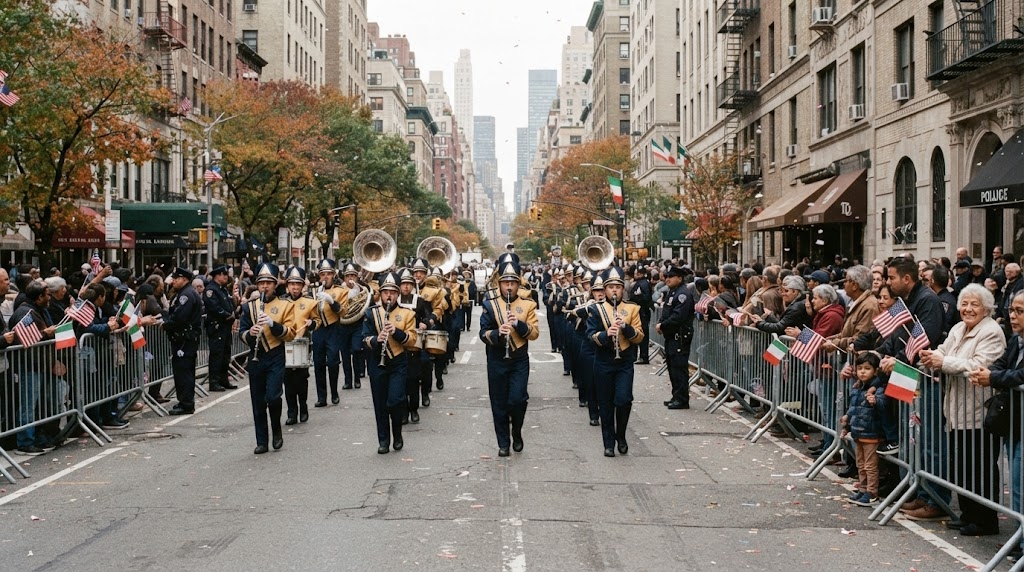
New York hosts the country’s largest and most traditional Columbus Day celebration, turning the event into a massive display of Italian-American pride.
The annual parade on Fifth Avenue in Manhattan draws around 35,000 marchers, including high school marching bands, police and fire contingents, and elaborate floats, while over a million spectators line the streets. For New Yorkers, the day is less about the historical voyage itself and more about celebrating the cultural contributions, food, and history of the Italian diaspora in the city. The governor and the mayor traditionally march in the parade, cementing its status as a major political and cultural event in the Empire State.
South Dakota took a completely different approach, becoming the first state to formally drop Columbus Day in favor of Native American Day.
The state legislature made this change back in 1990, long before the current nationwide movement to rethink the holiday gained mainstream traction. The decision was part of an effort to promote reconciliation between the state’s white and Native American populations, specifically the Lakota, Nakota, and Dakota Sioux tribes. Instead of parades honoring a European explorer, South Dakota uses the second Monday in October to host educational events, traditional powwows, and cultural programs that highlight the history, art, and survival of Indigenous peoples.
Colorado holds a unique and somewhat ironic place in the holiday’s history, as it was the very first state to make Columbus Day an official state holiday in 1907, only to completely abolish it over a century later.
The original law was pushed by Angelo Noce, an Italian immigrant in Denver who wanted a day to honor his heritage. However, due to decades of intense protests from Indigenous rights groups at the Denver parades, the state legislature passed a bill in 2020 replacing it with Frances Xavier Cabrini Day. Mother Cabrini, an Italian-American Catholic nun who founded dozens of schools, orphanages, and hospitals across the U.S., became the new focus. This allowed Colorado to honor Italian-American humanitarian contributions while moving away from the controversial legacy of the explorer.
Federal Holiday Status: Who Gets the Day Off?
Although Columbus actually made landfall in the Bahamas on October 12, 1492, Americans rarely get that specific date off from work anymore.
In 1968, Congress passed the Uniform Monday Holiday Act, a law designed to give federal employees more three-day weekends and, theoretically, boost the travel and retail industries.
When the law took effect in 1971, the observance of Columbus Day officially moved to the second Monday in October.
This legislative shift untethered the holiday from its historical anchor, turning it into a floating long weekend rather than a strict annual anniversary.
Because it is designated as one of the permanent federal holidays, all non-essential federal government offices shut down for the day.
If you need to renew a passport in person, visit a Social Security office, or expect regular mail delivery from the United States Postal Service, you will have to wait until Tuesday. The financial sector also largely grinds to a halt. The Federal Reserve closes its payment processing systems, which prompts the vast majority of commercial banks and credit unions to lock their doors as well, meaning no check clearing or major banking transactions take place.
However, for the average American working in the private sector, the second Monday in October is just a regular workday.
Only a small fraction—roughly 20 to 25 percent—of private businesses actually offer paid time off for this specific holiday. Retailers, tech companies, factories, and most corporate offices keep their normal hours.
The situation with public schools is equally fractured; depending entirely on the local school board’s decisions, kids in one county might have a long weekend, while those in the neighboring district are sitting in class taking a math test. As a result, Columbus Day remains one of the most inconsistently observed public holidays on the American calendar.
Welcome to Poznayu.com!
My name is Alex, and I founded this project together with a team of like-minded professionals. At Poznayu.com, we create in-depth reviews, explore fascinating facts, and share well-researched, reliable knowledge that helps you navigate complex topics with confidence.
Our mission is simple: to explain complicated ideas in clear, accessible language. We believe that high-quality information should be available to everyone. Every article we publish is designed to provide practical value, actionable insights, and trustworthy analysis you can rely on.
Join our growing community of curious readers. Your feedback matters — share your thoughts in the comments, ask questions, and suggest topics you’d like us to cover next.