The rear axle in a car determines not just road stability but the overall driving dynamics, so choosing the right type depends on your driving style and where you’ll be driving. A solid axle is ideal for off-road use due to its simplicity and strength, an independent setup delivers maximum comfort on pavement, and a torsion beam strikes a balance for everyday vehicles.
I’ll break down each design so you can understand how it works in practice and why automakers choose a particular setup for specific models.
So, instead of a lengthy introduction, let’s cover why a rear axle is needed and what its role actually is (don’t confuse it with the differential).
The rear axle plays a key role in handling, comfort, and vehicle stability, and its design directly affects how the car behaves on the road.
There are three main types:
- Dependent rear axle (solid axle), known for its strength and simplicity, commonly found in SUVs and commercial vehicles.
- Independent rear suspension, which provides better ride quality and high-speed stability.
- Semi-independent rear axle, usually a torsion beam design, combining compactness, affordability, and decent comfort for city cars.
The right choice depends on your driving needs: for off-road and heavy loads, go with a solid axle; for performance and comfort, independent suspension wins; for daily urban driving, a torsion beam often hits the sweet spot.
Here’s a quick reference guide:
- Dependent rear axle – strength, simplicity, SUVs and trucks
- Independent rear axle – comfort, handling, passenger cars
- Semi-independent rear axle (torsion beam) – compactness, budget and city models
| Feature | Dependent (Solid Axle) | Independent | Semi-independent (Torsion Beam) |
|---|---|---|---|
| Design | Rigid beam connecting wheels; differential inside the beam | Each wheel on separate arms; differential mounted to chassis | U-shaped or H-shaped beam with integrated torsion bars allowing twist |
| How It Works | Both wheels move together; one wheel’s motion affects the other | Wheels move independently, each adapting to the road | Beam twists when wheels move at different heights, providing partial independence |
| Common Applications | SUVs, trucks, commercial vehicles | Passenger cars, sports sedans, luxury vehicles | Budget sedans, hatchbacks, city cars |
| Advantages | High strength, simplicity, low cost, easy repair, locking differential option | Excellent comfort, high-speed stability, superior cornering grip | Compact, affordable, lightweight, good balance for urban driving |
| Disadvantages | Stiffness reduces comfort, heavy, poorer high-speed handling | Expensive, complex design, vulnerable to damage, lower load capacity | Less comfort on rough roads, limited off-road capability, needs precise alignment |
| Handling | Reliable off-road, but less precise on pavement | Excellent on pavement and track | Adequate for everyday city driving |
| Comfort | Low due to rigidity | High, good vibration isolation | Moderate, acceptable for city use |
| Manufacturing & Repair Cost | Low | High | Low |
Dependent Rear Axle (Solid Axle)
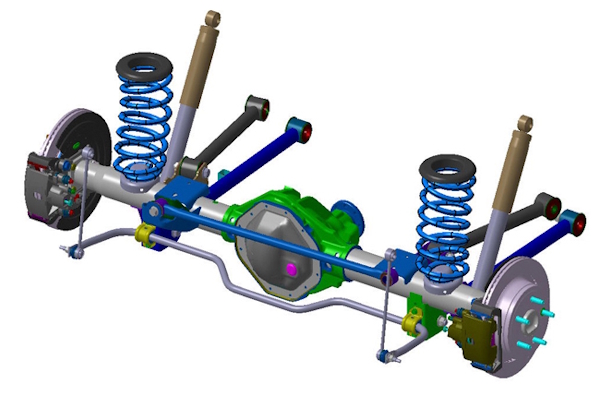
A dependent rear axle uses a rigid beam connecting both wheels, mounted to the body through springs or leaf springs. The design includes a central differential that splits torque between the wheels, with the beam acting as both a support structure and a suspension component. This is the classic setup where one wheel’s movement directly affects the other due to the lack of independence.
The principle is straightforward: the axle consists of a housing containing the differential gears, axle shafts, and bearings, while the outer beam protects everything from damage. This system is common in trucks and SUVs where axle loads are high and repairs need to be quick. The differential can be open or equipped with a locker for better traction.
The axle works as a single unit: when one wheel hits a bump, the entire beam lifts, maintaining geometry and stability under load. This makes it reliable in harsh conditions, though it requires quality shocks to dampen vibrations. In modern vehicles, solid axles have evolved with added sway bars for better roll control.
A solid axle wins on strength and low manufacturing cost, making it an excellent choice for commercial vehicles and off-road use. It handles heavy loads easily and is simple to maintain, plus it allows for heavy-duty differentials for maximum traction. However, its rigidity reduces comfort on pavement, adds weight to the vehicle, and compromises high-speed handling.
Examples include:
-
Toyota Land Cruiser 70
-
Ford F-150
Independent Rear Axle
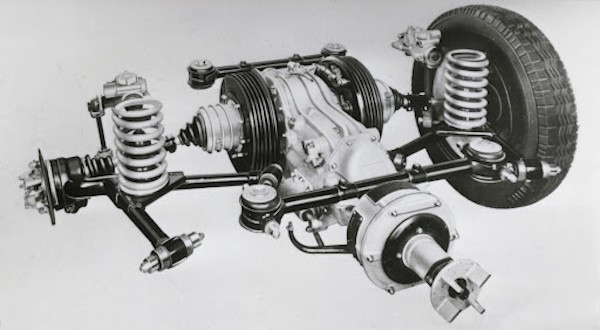
An independent rear axle lets each wheel move independently using separate control arms and joints. The design features a multi-link setup or double wishbones, with the differential mounted to the chassis and wheels connected via half-shafts with CV joints. This minimizes how road imperfections affect the body.
The geometry is complex: control arms manage toe and camber angles, springs and shocks absorb impacts, and a sway bar reduces body roll. This setup is popular in passenger cars and sports sedans where precise handling matters. The differential is often integrated with the transmission to save weight.
The system works through independent suspension: each wheel adapts to the road separately, maintaining contact and improving grip. This is especially noticeable in corners, where the setup prevents wheel lift. Premium models add electronic adjusters for real-time tuning.
Independent suspension delivers superior comfort and high-speed stability, ideal for highways and track use, while reducing vibrations for passengers. It allows better weight distribution and improves fuel economy through lower rolling resistance. Downsides include higher manufacturing and repair costs, complex design vulnerable to damage, and lower strength under heavy loads.
Examples include:
-
BMW 5 Series
-
Mercedes-Benz E-Class
Semi-Independent Rear Axle (Torsion Beam)
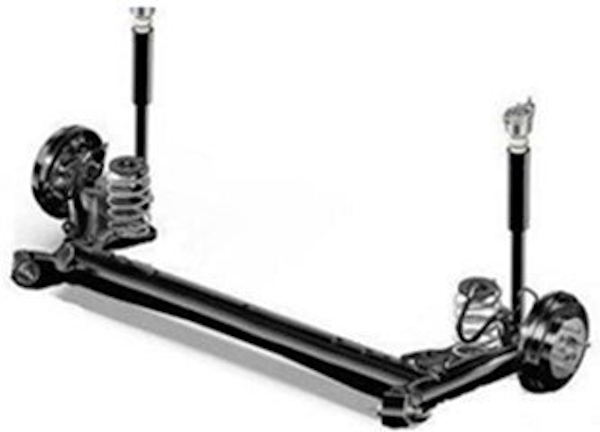
A semi-independent rear axle, also called a torsion beam, combines a beam with torsional elements where wheels connect through a U-shaped or H-shaped beam with built-in torsion bars. The design includes a central differential, axle shafts, and shocks mounted to the body. It’s a compromise between simplicity and comfort for compact cars.
The principle relies on the torsion beam twisting when wheels move at different heights, providing partial independence while maintaining rigidity for stability. The differential sits inside the beam housing, with springs separate from shocks for better kinematics. This system is common in budget sedans and hatchbacks.
The axle works as a hybrid: the beam transmits torque, torsion bars dampen vibrations, and a sway bar controls roll. This saves space and weight, making the car more maneuverable in city driving. Modern versions add hydraulics to adapt to load changes.
A torsion beam saves space and reduces cost, beneficial for mass-market models, while offering a decent balance between comfort and handling on smooth roads. It’s easy to manufacture and repair, with low weight aiding fuel economy. Drawbacks show on rough pavement where it isolates vibrations less effectively than independent setups, and it limits off-road capability while requiring precise tuning to prevent uneven tire wear.
Examples include:
-
Volkswagen Golf
-
Toyota Corolla
I’m Kevin Harper, an American automotive expert and tuner with more than 20 years of hands-on experience.
I graduated from Texas A&M University with a degree in Mechanical Engineering, with a focus on engine development. I started my professional career working in Texas garages, specializing in tuning classic American V8s and modern pushrod engines, including GM LS-series engines, Chrysler HEMI, Ford Coyote, as well as Modular and Big Block platforms.
I’ve worked on the restoration and extensive modernization of 1960s and 1970s Muscle Cars, built high-output LS swaps for daily-driven pickups and track projects, optimized HEMI engines for forced induction, and worked through the technical details of pushrod engine design — from selecting the right camshafts and cylinder heads to dialing in fuel systems and engine cooling.
I now live in Dallas, Texas, where I continue to work hands-on with performance builds, tuning and testing. In my articles, I explain how American and other engines actually work, which modifications genuinely improve power and reliability, and which ideas are nothing more than garage folklore. I keep the language straightforward without leaving out the technical details that matter, so owners of classic cars and modern V8s can make informed decisions.