The differential is a core drivetrain component that controls how torque is split between wheels. Its design decides vehicle behavior in corners, on low-grip surfaces and during hard acceleration — affecting handling, off-road capability and driver confidence. Choosing the right type of differential is a trade-off between simplicity, traction and mechanical or electronic complexity.
This article explains the principal differential types used on modern cars, how each one works in practical terms, where they make sense and what their operational limits are. The focus is practical: you’ll get clear guidance on which solution suits a commuter hatchback, a sport coupe, an AWD crossover or a serious off-roader.
We also cover newer hybrid and electronic approaches — torque vectoring, eLSDs and wheel-motor strategies — because powertrain architecture is changing quickly and some traditional assumptions no longer apply.
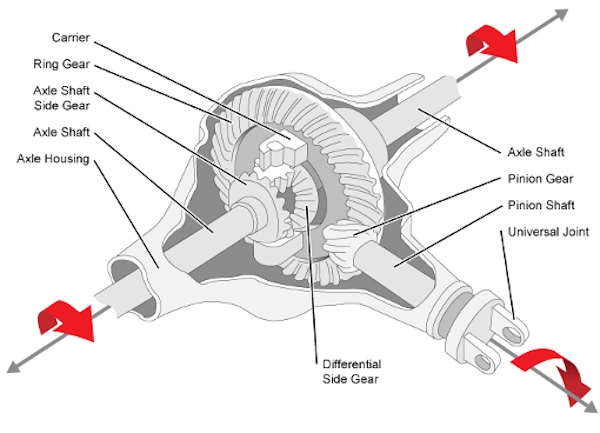
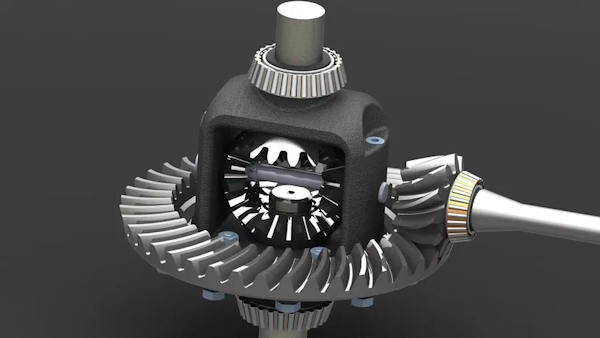
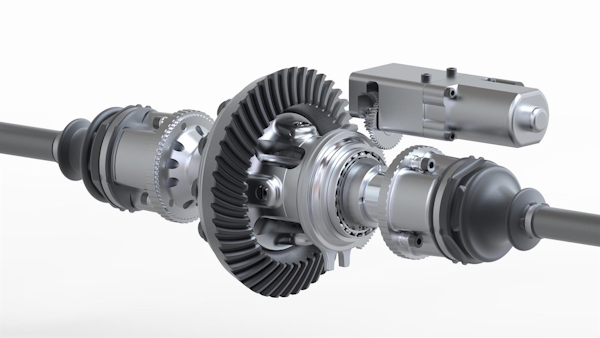
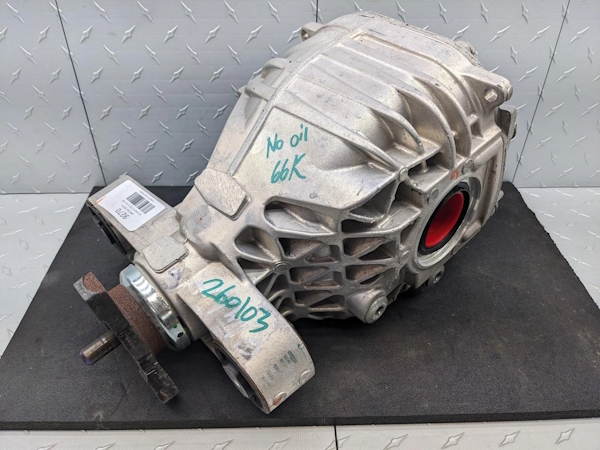
An open differential is the simplest and most common design: planetary-style spider gears (satellites) rotate around sun gears and allow the two half-shafts to spin at different speeds during turns. On a flat, dry road it shares torque evenly between the wheels and prevents tire scrubbing when cornering.
Technically the open diff enforces equality of torque on both outputs. If one wheel loses grip, that wheel takes the bulk of the rotational speed and the drive torque goes to the slipping wheel — the vehicle can’t send extra torque to the wheel that still has traction. That limitation is the fundamental weakness on ice, mud or deep snow.
Because of its simple parts list — housing, gears and half-shafts — the open differential is cheap, reliable and easy to service. It pairs well with ABS/ESP systems that can compensate to some degree by braking the slipping wheel and redirecting torque through traction control interventions.
Pros:
Simple, robust and low cost.
Easy to maintain and repair.
Predictable behavior on dry pavement and low parasitic losses (good fuel economy).
Well suited to most daily-driver city cars.
Cons:
Loses traction as soon as one wheel slips.
Poor off-road or low-grip performance.
Limits dynamic potential for high-power cars.
Limited-slip differential (LSD)
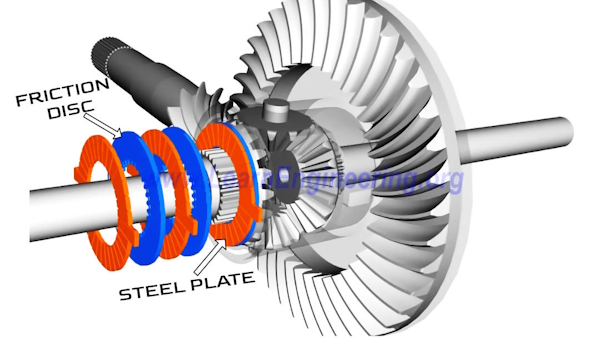
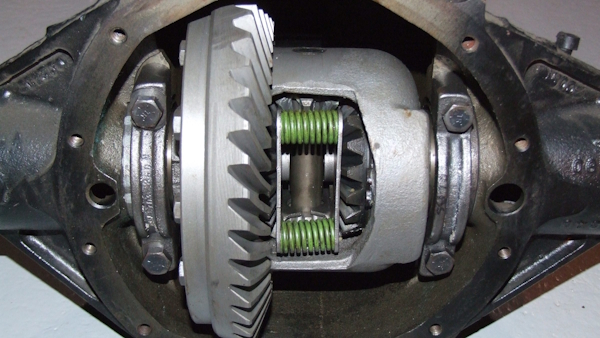
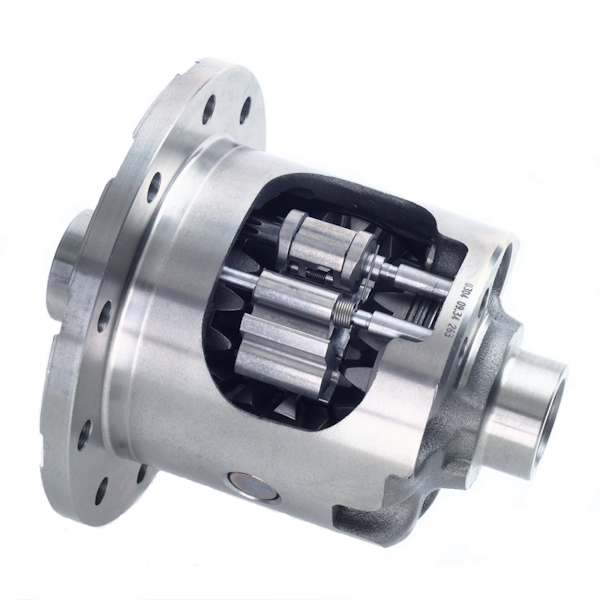
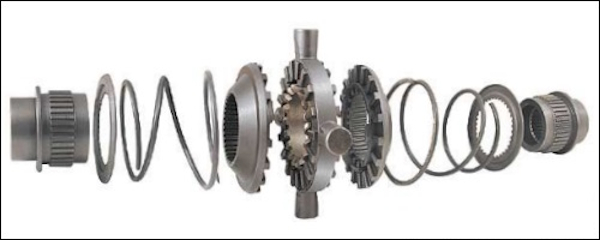
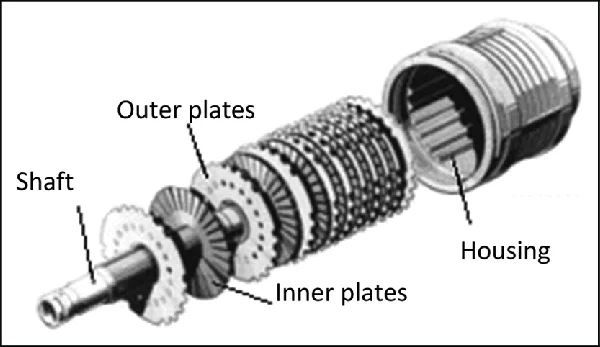
A limited-slip differential (LSD) uses friction plates, cone clutches or geared friction elements to provide a controlled resistance to differential action. Under normal conditions it behaves like an open diff; under torque imbalance it transfers a portion of torque to the wheel with more grip, improving traction.
There are several LSD flavors — clutch-type (multi-plate), clutchless gear-type (e.g., Torsen is a gear-based variant), and torque-sensing cone designs. Clutch-type LSDs rely on preload and friction to create bias; they can be tuned for mild or aggressive locking behavior depending on preload springs and plate stack design.
In daily use an LSD keeps a sporty rear-wheel car more stable on corner exit, improves straight-line acceleration and reduces wheelspin off the line. Maintenance is modest but requires correct friction lubricant (some friction clutch LSDs need specific gear oils). Over time clutch wear can reduce effectiveness and require service.
Pros:
Improved traction and acceleration over open diffs.
Better control and stability exiting corners.
Versatile for performance-oriented street cars and light track use.
Cons:
Higher cost and more complex servicing.
Friction elements wear and need periodic attention.
Can increase tire wear under aggressive driving.
Locking differential (Locker)
A locking differential mechanically ties both wheels to turn at the same speed when engaged. Lockers can be selectable (manual or pneumatic/hydraulic actuation) or automatic (engaging when load conditions call for it). In locked mode the axle behaves as a solid beam, maximizing traction in extreme off-road situations.
Lockers are the go-to solution for rock crawling, deep mud or scenarios where wheelspin on one side would otherwise immobilize the vehicle. On hard surfaces a locked axle makes steering difficult and can induce drivetrain wind-up, so locking must be used selectively and disengaged for normal on-road driving.
User control matters: manual lockers provide the most direct behavior for experienced off-roaders; automatic lockers are convenient but can be abrupt. Modern driveline electronics can also simulate locking with brake-based methods, but nothing beats a mechanical locker for absolute traction in extreme terrain.
Pros:
Maximum traction in extreme off-road conditions.
Reliable and simple principle.
Enables recovery from deep ruts, rocks and very low-grip surfaces.
Cons:
Poor on-road handling when locked.
Increased drivetrain stress and potential tire scrub.
Requires driver discipline or sophisticated control logic.
Torsen (torque-sensing) differential
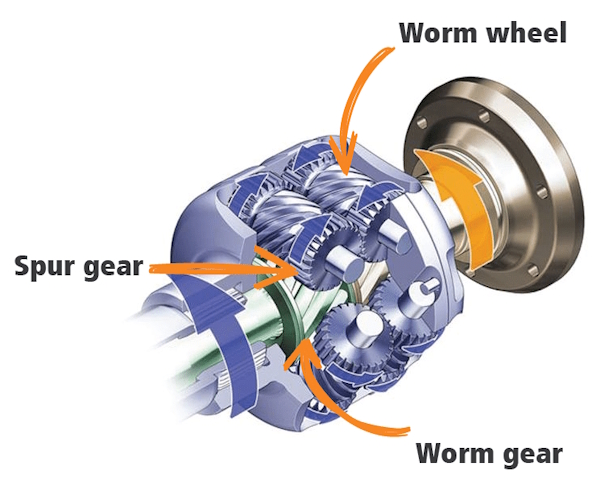
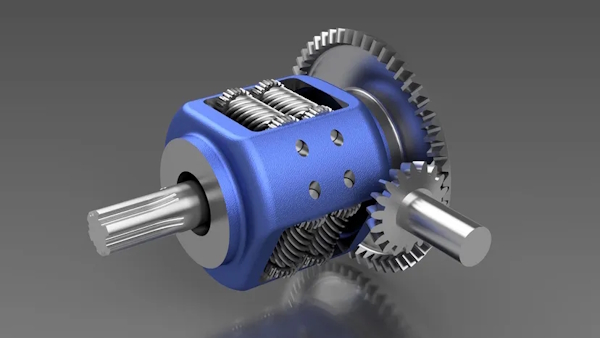
Torsen-type differentials are a subset of gear-based LSDs that use helical gears to produce a torque bias without friction plates. They react instantly to torque demand: when one wheel encounters resistance, the gear geometry directs more torque to the wheel offering greater resistance (i.e., better grip).
Unlike clutch LSDs, Torsen units don’t rely on friction packs and therefore have longer life and more linear behavior. Their bias ratio (the factor by which torque can be multiplied to the high-traction wheel) governs performance: higher bias means more torque transfer before the diff behaves like an open unit.
Torsen diffs are common in performance AWD systems and some high-end RWD sports cars because they blend durability, immediate response and a neutral steering balance. They are less effective when a wheel is completely unloaded (no resistance), in which case some modern systems augment Torsen action with braking or electronic assists.
Pros:
Smooth, instantaneous torque redistribution without friction wear.
Durable and well suited to sustained performance driving.
Natural feel and predictable handling balance.
Cons:
Less effective if a wheel is completely unsupported or in the air.
More complex and costly than simple open diffs.
Bias ratio limitations mean extreme lock behavior isn’t achievable like with lockers.
Electronic differentials and torque-vectoring
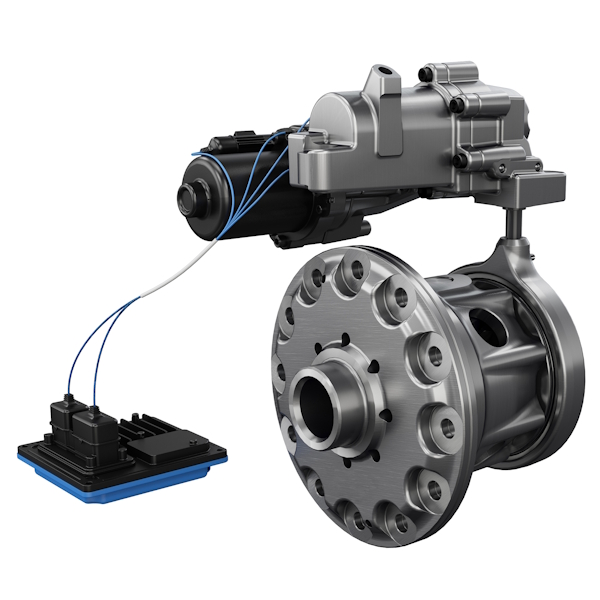
Electronic limited-slip systems (eLSD) and torque-vectoring architectures replace or augment mechanical biasing with electronic control. They use brake intervention, active clutch packs or motor torque control to shift drive force between wheels dynamically, based on inputs from yaw, steering, wheel speed and acceleration sensors.
The advantage is precision: torque vectoring can actively pivot the car through a corner by sending more drive to the outside wheel, reducing understeer and improving turn-in — a capability beyond what passive mechanical diffs can deliver. eLSDs can tune behavior across driving modes, from comfort to sport, and work seamlessly with ESP for stability and safety.
Trade-offs include added cost, system complexity and reliance on software. Failure modes are different: electronics and actuator failures may disable advanced functions but generally leave basic drivability intact. For modern crossovers and performance models, torque vectoring delivers measurable improvements in lap times and everyday control.
Pros:
High adaptability and precise control over torque distribution.
Active performance benefits (cornering, stability, traction).
Integration with vehicle dynamics systems for safety and drivability.
Cons:
Higher design and repair complexity.
Dependent on sensors, actuators and software robustness.
Less mechanical simplicity and “feel” compared to purely mechanical diffs.
Viscous coupling and center differentials (AWD)
Viscous couplings use a shear-thickening fluid between interleaved plates to progressively transfer torque as slip develops between axes. They are simple, automatic and found in older or lower-cost AWD systems as an easy way to bias torque without electronics.
A center differential — whether open, viscous, Torsen or electronically controlled — manages torque split between front and rear axles in AWD systems. Its behavior determines whether the vehicle drives like a front-wheel car with on-demand rear bias, a true full-time AWD unit, or a dynamically variable system.
Viscous couplings are reliable but inherently laggy: they react as slip builds and can be less effective for sudden traction changes compared with active torque-vectoring systems. For general-purpose AWD, however, they provide an economical balance of traction and simplicity.
Pros:
Automatic torque sharing without driver input.
Simple and relatively durable design.
Useful for light AWD needs and slippery road assistance.
Cons:
Slower reaction than electronic systems.
Fluid and plate wear can degrade performance.
Not ideal for rapid or extreme traction transitions.
Other differentials and hybrid approaches
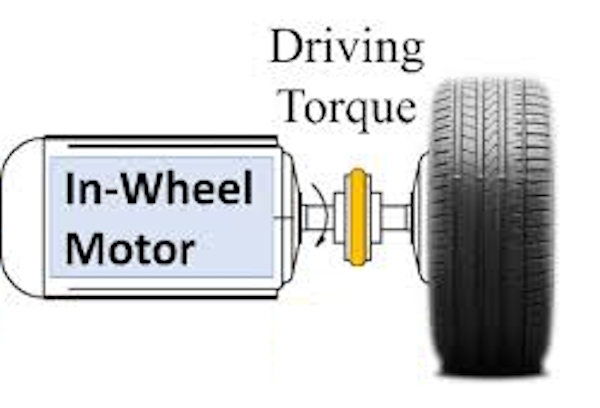
Manufacturers combine mechanical and electronic tools to get the best of both worlds: mechanical biasing with electronic overrides, active multi-plate eClutches in center diffs, or wheel-individual torque control in electric drivetrains. For EVs, per-wheel motors remove the need for a mechanical differential entirely — software manages torque per wheel with extreme fidelity.
Hybrid systems are growing: partial mechanical gearsets for baseline behavior plus electronically actuated clutches for range and control. Racing and high-performance OEMs also use active differentials with independent control to manage yaw moment and traction under extreme loads.
These advances unlock performance and efficiency but raise maintenance, calibration and cybersecurity considerations. The net effect for drivers is improved safety and control, especially when integrated with modern driver-assist systems.
Pros:
Maximum adaptability and next-level control (especially in EVs).
Enables advanced stability, efficiency and performance modes.
Reduces mechanical losses when software can optimize torque delivery.
Cons:
Very high development and repair costs.
Increased dependency on electronics and software updates.
Specialized service tools and parts required.
Why GM fits LSDs to its V8 models
For high-torque, rear-wheel V8 models (think Camaro SS and similar muscle cars), a limited-slip differential is a practical compromise: it allows aggressive launches and corner exits without the one-wheel-spin penalty of an open diff, while avoiding the steering and driveline penalties of a full locker.
GM’s Positraction branding represents that philosophy: a biasing unit (mechanical or clutch-based) that sends power to the wheel with traction, improving acceleration and control without excessive weight or complexity.
In a V8 platform where torque can exceed what a single rear wheel can use, LSDs preserve performance and help maintain tire life compared to uncontrolled spin.
Moreover, LSDs integrate well with modern stability systems — they improve the car’s usable performance on the road and on the track without demanding the mechanical interventions required by lockers or the exacting conditions for Torsen units.
Conclusion
Choosing a differential is always a compromise between simplicity, traction and cost. For everyday urban driving an open differential or a soft LSD is usually optimal; for sport sedans and muscle cars LSDs or Torsen units improve performance; for serious off-road use lockers are essential; and for modern crossovers and premium cars, electronic eLSDs and torque-vectoring deliver the best blend of safety and dynamic capability.
When selecting or modifying driveline hardware, match the differential type to how you actually drive: road surface, climate, expected towing or off-road use and whether you value raw mechanical feel or adaptive electronic control. The right differential will increase safety, reduce wear and make the car more satisfying to drive — the wrong one can compromise handling and create unexpected maintenance costs.
I’m Kevin Harper, an American automotive expert and tuner with more than 20 years of hands-on experience.
I graduated from Texas A&M University with a degree in Mechanical Engineering, with a focus on engine development. I started my professional career working in Texas garages, specializing in tuning classic American V8s and modern pushrod engines, including GM LS-series engines, Chrysler HEMI, Ford Coyote, as well as Modular and Big Block platforms.
I’ve worked on the restoration and extensive modernization of 1960s and 1970s Muscle Cars, built high-output LS swaps for daily-driven pickups and track projects, optimized HEMI engines for forced induction, and worked through the technical details of pushrod engine design — from selecting the right camshafts and cylinder heads to dialing in fuel systems and engine cooling.
I now live in Dallas, Texas, where I continue to work hands-on with performance builds, tuning and testing. In my articles, I explain how American and other engines actually work, which modifications genuinely improve power and reliability, and which ideas are nothing more than garage folklore. I keep the language straightforward without leaving out the technical details that matter, so owners of classic cars and modern V8s can make informed decisions.