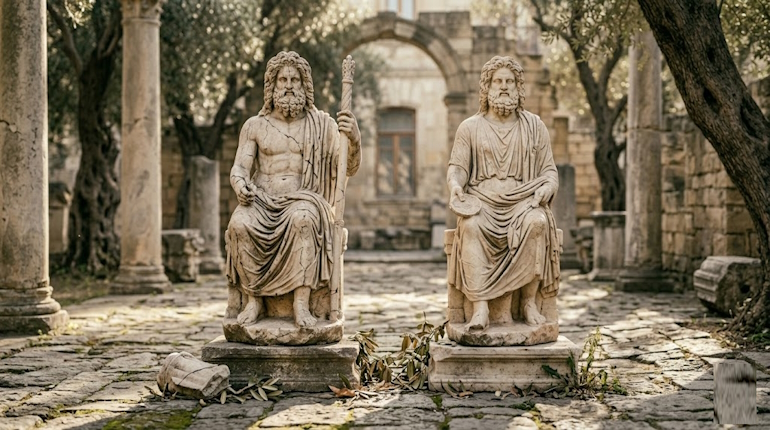
Classical mythology is built upon complex polytheistic systems that took shape long before the advent of writing, born out of human attempts to explain the laws of nature.
The formation of the pantheons of Ancient Greece and Rome was not a single act by a lone creator, but rather a centuries-long process driven by the merging of Proto-Indo-European beliefs, local agricultural cults, and active cultural exchange.
The names of supreme deities, such as Zeus and Jupiter, share a common linguistic origin, even though the religions themselves evolved along different paths, rejecting strict monotheism in favor of a highly practical polytheism.
Ultimately, understanding the roots of these beliefs allows for a deeper appreciation of the foundation of Western civilization, including its laws, culture, and social institutions.
The Ancient Greek Pantheon: Origins and the Causes of Polytheism
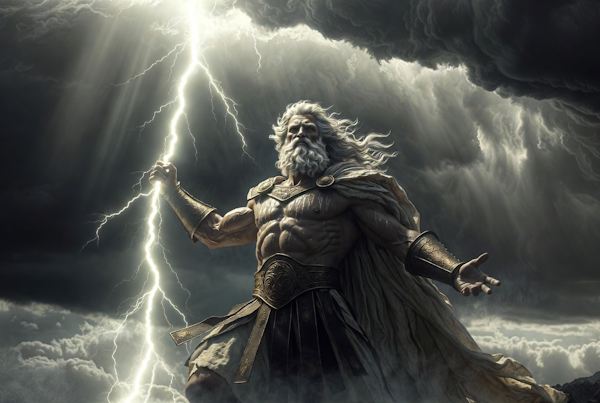
The historical roots of Greek religion trace back to the Minoan-Mycenaean era, roughly around the second millennium BCE, when Achaean tribes brought their primitive animistic beliefs to the Balkan Peninsula.
During that period, humanity depended entirely on the unpredictable forces of nature, making polytheism the most logical way to structure the chaos of the surrounding world. For the ancient Greeks, there was no single omnipotent creator, as a single god could not physically govern such diverse and contradictory phenomena as a destructive sea storm, the ripening of wheat, or a sudden burst of passion.
- Monotheism under such harsh conditions seemed abstract and impractical, whereas dividing spheres of influence among multiple deified figures allowed people to target their appeals to a specific patron based on their immediate real-world problems.
When it comes to who exactly first invented the Olympian gods, historical science provides a clear answer: there was no single prophet or author.
The religion of Hellas formed organically, passed down orally by wandering bards—known as aoidoi—who wove scattered local myths into a unified cosmogonic tapestry. It wasn’t until the 8th to 7th centuries BCE that this oral epic was first codified in writing by the prominent ancient Greek poets Homer and Hesiod. In their foundational poems, the Iliad, Odyssey, and Theogony, they mapped out the genealogy of the deities, giving them human traits, weaknesses, and emotions, effectively turning abstract elemental forces into an anthropomorphic family living on the snow-capped summit of Mount Olympus.
The names of the gods were not just random strings of sounds; they developed from the Proto-Indo-European language and reflected their original elemental nature.
The clearest example of this linguistic evolution is the name of the supreme thunderer, Zeus. This word is rooted in the ancient Proto-Indo-European root *dyeu-, which translates to “to shine” or “bright sky.”
Ancient nomadic tribes literally called their chief deity “Sky Father” (*Dyeus ph₂ter), which over time, through ancient Greek phonetics, shifted into the word “Zeus” (sounding as Dios in the genitive case).
Other names were constructed in a similar fashion: for instance, Hades means “the unseen one,” perfectly describing the ruler of the dark underworld realm of the dead, hidden from human eyes.
The system of Greek deities was a strict hierarchy that mirrored the social structure of ancient society itself. At the top sat the twelve principal Olympians, each governing their own narrow segment of the universe without interfering in the affairs of others without a compelling reason.
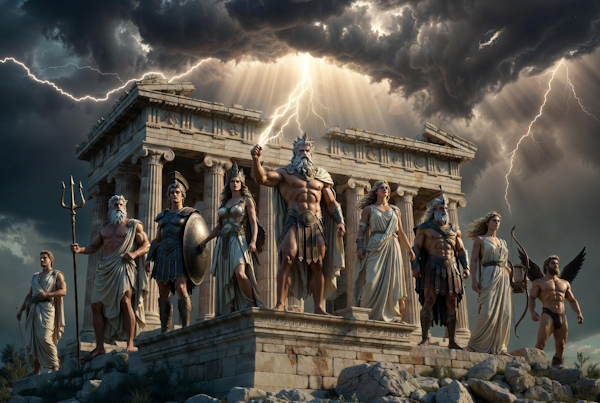
To understand this division of duties, it is worth looking at the primary spheres of influence of the key figures in the Olympian pantheon:
-
Zeus—the supreme ruler, lord of thunder and lightning, and the guarantor of heavenly justice.
-
Poseidon—the ruler of seas and oceans, and the creator of destructive earthquakes.
-
Athena—the patroness of just warfare, wisdom, crafts, and tactical strategy.
-
Apollo—the deity of the arts, prophecy, and healing, who brought sunlight to mankind.
-
Aphrodite—the embodiment of carnal love, physical beauty, and eternal youth.
The choice of specific names and attributes also depended directly on the close influence of neighboring Eastern civilizations.
The Hellenes were active seafarers and colonizers, meaning their mythology was constantly enriched by borrowings from Phoenicia, Egypt, and Babylon. For example, the cult of the beautiful Aphrodite has scientifically proven parallels with the fierce Eastern goddess Ishtar, while the image of Apollo acquired its final classical traits under the influence of Anatolian beliefs.
- Thus, we can see that names and functions were not made up out of thin air, but were the result of a long process of language diffusion and the adaptation of foreign myths to fit the needs of the ancient Greek city-states’ polis systems.
The primary function of this complex polytheistic apparatus was not moral or ethical education, as seen in modern global monotheistic religions, but rather the maintenance of strict cosmic order.
The Greek gods were by no means paragons of morality; they plotted schemes, exacted brutal revenge, fell in love, and made mistakes just like ordinary mortals. This made the religion highly relatable and accessible to every citizen of the polis. The ancient Greeks did not believe in default sinfulness; instead, they believed in the concept of hubris—excessive pride, for which the gods inevitably punished anyone who attempted to place themselves above the cosmic balance established by natural laws.
The Formation of Roman Religion and the Origin of Deities
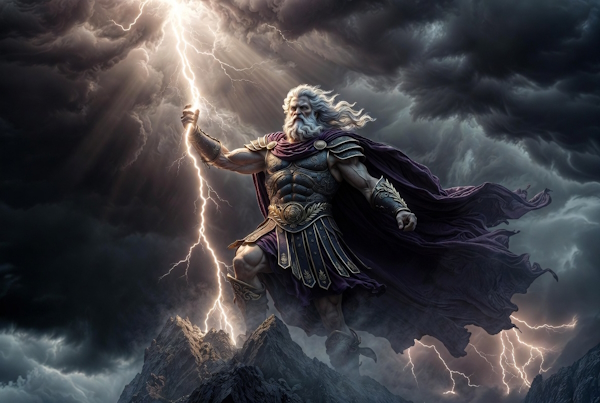
Unlike the philosophically inclined Greeks, the ancient Romans during the early stages of their state’s development (8th to 6th centuries BCE) had a completely different, highly utilitarian view of higher powers.
Initially, their religion was distinctly agricultural and totemic. The Romans did not worship personified individuals with rich biographies and tangled family trees, but rather faceless spirits and disembodied entities they called numina. These spirits inhabited every object and phenomenon: there were spirits of the household hearth (Penates), spirits of doors and beginnings (Janus), and spirits of barns, crops, and even the process of blossoming.
- Monotheism in an agrarian society, where every stage of the planting season depended on dozens of different independent factors, was physically impossible.
As Rome expanded its conquered territories and came into contact with other highly developed civilizations—especially the enigmatic Etruscans and the prosperous Greek colonies in the southern Italian peninsula—Roman religion underwent a radical transformation.
The pragmatic Romans, captivated by the richness of the Greek epic, began actively adopting their mythology through a process of religious syncretism, merging their own faceless spirits with the vivid, human-like gods of Hellas. They didn’t invent a new mythological baseline from scratch; they simply superimposed Greek legends onto their ancient guardians of agriculture and trade, adapting them to the strict needs of a militarized state.
This borrowing process is clearly visible through linguistic analysis, particularly with Rome’s supreme god.
The name “Jupiter” stems from the exact same Proto-Indo-European roots as the Greek “Zeus.” The ancient phrase *Dyeus ph₂ter (Sky Father) gradually merged in Latin due to phonetic shifts into a single word: Iuppiter (Jupiter).
In a semantic sense, Zeus and Jupiter are the exact same ancient phrase, spoken by different Indo-European peoples through the prism of their local linguistic rules. The names of other Roman deities came from Latin roots describing their practical, applied functions: for example, the name of Mars (the primary god of war) was originally connected to protecting fields from frost and pests.
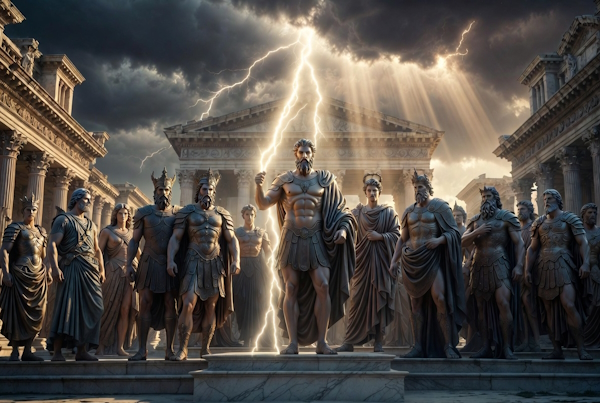
Although the Romans copied the genealogy and mythological plots almost entirely from the Greeks, the functions of many deities shifted significantly toward statehood, law, and unconditional military valor.
The Roman pantheon became more austere, official, and demanding of discipline. To clearly visualize this process of cultural absorption and renaming, the key figures of these two great ancient systems are compared in the table below.
| Greek Deity | Roman Counterpart | Primary Sphere of Influence in Roman Society |
| Zeus | Jupiter | Supreme power, state law, triumph |
| Ares | Mars | Military might, invincibility of the Roman legions |
| Hera | Juno | Lawful marriage, motherhood, protection of women |
| Aphrodite | Venus | Fertility, ancestral mother of the Roman people |
| Hermes | Mercury | Commercial trade, profit, enrichment |
Roman religion was characterized by exceptional formality, cold calculation, and legal precision in relationships between mortals and deities. The primary guiding principle was the famous formula do ut des (“I give so that you might give”).
Interaction with the gods turned into a strict state contract. To ensure its flawless execution, professional colleges of priests (pontifices) developed a precise, non-negotiable algorithm for conducting sacred rites:
- Accurately identifying the specific deity who needed to be addressed for a particular state or strictly personal matter.
- Drafting and reciting the exact text of the prayer, where making a mistake by even a single syllable invalidated the unseen contract.
- Selecting the most appropriate animal for sacrifice, strictly factoring in its gender, coat color, and exact age.
- Conducting the ritual of divination (augury) based on the flight of birds or the entrails of sacrificial animals to obtain official consent from the higher powers for the intended undertaking.
With the historical transition from a democratic Republic to an autocratic Empire, Roman religion took on another vital function—the official deification of rulers.
Beginning with Julius Caesar and Caesar Augustus, deceased—and later, living—emperors were legally added to the pantheon of gods. This served as an effective political tool to maintain absolute control over vast, diverse provinces.
However, it was this excessive formalization, the total lack of spiritual comfort for the common individual, and the turning of faith into a dry bureaucratic machine that paved the way for the inevitable collapse of polytheism. When traditional classical beliefs completely failed to answer the deep moral questions of society, Christianity rapidly spread through the Roman Empire, permanently establishing monotheism in Europe.

Welcome to Poznayu.com!
My name is Alex, and I founded this project together with a team of like-minded professionals. At Poznayu.com, we create in-depth reviews, explore fascinating facts, and share well-researched, reliable knowledge that helps you navigate complex topics with confidence.
Our mission is simple: to explain complicated ideas in clear, accessible language. We believe that high-quality information should be available to everyone. Every article we publish is designed to provide practical value, actionable insights, and trustworthy analysis you can rely on.
Join our growing community of curious readers. Your feedback matters — share your thoughts in the comments, ask questions, and suggest topics you’d like us to cover next.