
Hemangioma is a benign tumor that forms from normal blood vessels.
In simple terms, it is a small “cluster” or excessive growth of capillaries located in the skin, beneath the skin, or in internal organs. It most often appears as a bright red, crimson, or bluish spot, sometimes slightly raised above the surface of the body, which is why it is often mistaken for an ordinary birthmark.
- The key feature of this growth is that it has nothing to do with malignant tumors and does not turn into cancer.
Hemangiomas are found primarily in newborns during the first weeks or months of life, although they can also appear in adults, for example, as localized lesions of the liver or vertebrae. The growth rate of these vascular nodules is unpredictable: they may increase rapidly in size over a short period and then suddenly stop growing.
The truly unique feature of hemangiomas is their tendency to disappear on their own, a process known as involution. As the child grows, the vascular cluster gradually becomes lighter, decreases in volume, and by age 5–7 may completely resolve without even leaving a noticeable scar.
However, this favorable course does not always occur, so any vascular growth requires careful monitoring by a dermatologist or surgeon.
Types, Causes, and Developmental Phases
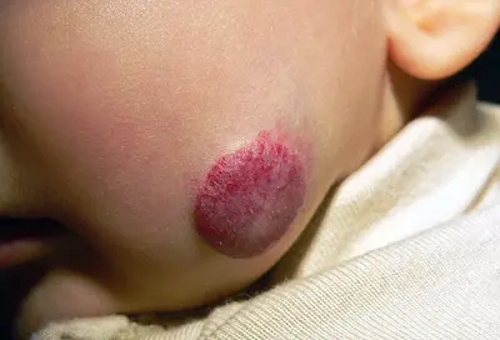
Hemangiomas develop as a result of disruption in vasculogenesis, the formation and growth of the vascular network during embryonic development or under the influence of localized hypoxic factors.
In medical practice, doctors distinguish capillary (simple) hemangiomas, made up of tightly intertwined small capillaries on the skin’s surface; cavernous forms, made up of larger blood-filled spaces in the deeper layers of the dermis; and combined forms. When internal organs are affected, the most commonly diagnosed type is a liver hemangioma, a usually asymptomatic vascular growth that is often discovered incidentally during a routine ultrasound examination.
The life cycle of a classic infantile hemangioma is divided into three consecutive phases: active growth (proliferation), stabilization, and involution. The proliferative phase lasts from several months to a year, when the tumor rapidly increases in size because of intensive endothelial cell division. This is followed by a plateau phase and then by years of natural regression, during which the vascular structures are gradually replaced by normal fatty and connective tissue.
When Treatment Is Needed and Modern Medical Methods
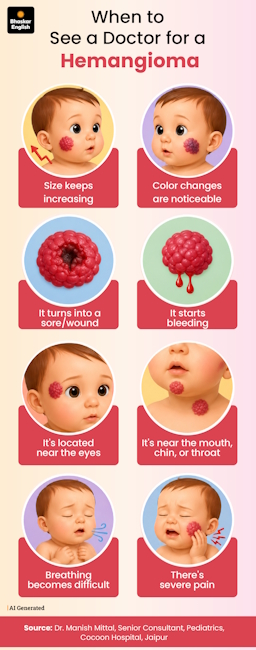
Despite its benign nature, a hemangioma can pose a real health risk when it develops in an unfavorable location or grows excessively aggressively.
If a vascular nodule develops around the eye, in the ear canal, larynx, or anus, it can mechanically interfere with vital functions such as vision, hearing, or breathing. In addition, superficial hemangiomas in areas exposed to friction from clothing often ulcerate, bleed, and become entry points for bacterial infections.
Evaluation and treatment planning begin with diagnostic imaging:
- For superficial skin lesions, a dermatologist can use dermoscopy and Doppler ultrasound to assess the speed and depth of blood flow.
- If a cavernous form or involvement of internal organs is suspected, the patient may undergo magnetic resonance imaging or computed tomography with contrast, which provides a clear view of the growth’s borders and its connection to nearby major blood vessels.
A watch-and-wait approach is appropriate only for small, superficial lesions that are not prone to rapid growth and are gradually regressing on their own. When there is a risk of complications, first-line treatment is medical therapy with beta-blockers (propranolol, timolol), which constrict the blood vessels and block endothelial cell division. Alternative and supportive methods include selective laser coagulation to remove superficial lesions, as well as conventional surgical excision or cryodestruction for isolated deep nodules.

Welcome to Poznayu.com!
My name is Alex, and I founded this project together with a team of like-minded professionals. At Poznayu.com, we create in-depth reviews, explore fascinating facts, and share well-researched, reliable knowledge that helps you navigate complex topics with confidence.
Our mission is simple: to explain complicated ideas in clear, accessible language. We believe that high-quality information should be available to everyone. Every article we publish is designed to provide practical value, actionable insights, and trustworthy analysis you can rely on.
Join our growing community of curious readers. Your feedback matters — share your thoughts in the comments, ask questions, and suggest topics you’d like us to cover next.