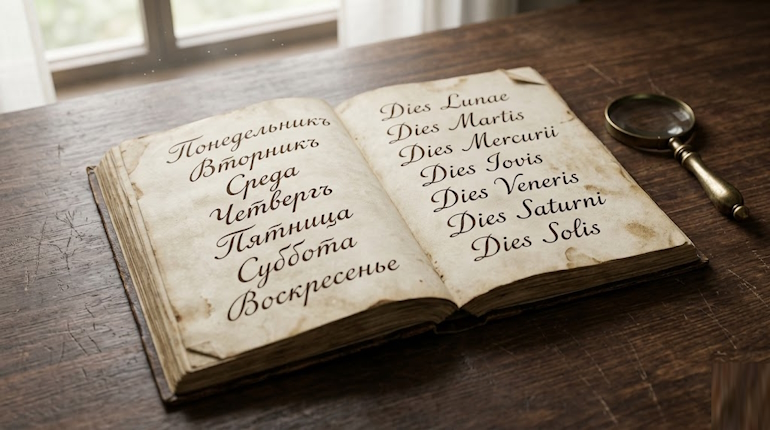
Ever wonder why there are exactly seven days in a week and where their names came from? Let’s break down how these familiar words—Monday, Tuesday, Sunday, and all the rest—actually came to be.
In this article, I will break down the origins of the days of the week in the English language so it becomes clear what meaning was once packed into them. It turns out to be a fascinating story of ancient calendars, planets, pagan gods, and how it all reached us today.
Why Do We Live on a Seven-Day Schedule?
It all started in deep antiquity, back when people tracked time by looking up at the night sky instead of checking smartphones. The ancient Babylonians noticed that a lunar month lasts roughly 28 days, so they divided it into four equal phases from the new moon to the full moon. This created highly practical seven-day blocks that worked perfectly for planning labor and rest. Later on, the Romans adopted this simple system, and the rest of the world followed suit, permanently cementing the rhythm of life we use today.
To fully understand how these names took shape, it helps to look at a few core naming principles. Ancient cultures typically named each day based on the following major factors:
Astronomical objects visible to the naked eye.
The names of supreme deities from local pagan pantheons.
The sequential number of the day within the current cycle.
When looking at the English tradition specifically, there is a clear, direct link to mythology. Its development can be broken down into three distinct historical stages:
Borrowing the original Roman planetary system.
Replacing Roman gods with their Germanic and Norse counterparts.
The phonetic transformation of these words within the Old English language.
To make the logic behind these names easy to visualize, here is a quick reference table matching the days of the week with their corresponding celestial bodies and deities.
Monday marks a distinct shift in our weekly routine, serving as the official kickoff to the standard workweek. For generations across many cultures, this slot has carried the practical purpose of restarting the cycle right after the weekend—the day we jump back into action following a period of rest and downtime.
The actual word “Monday” has a purely astronomical origin. It evolved from the Old English word Mōnandæg, which literally translates to “Moon’s day.” This is a direct translation of the traditional Latin naming convention, as early Germanic tribes adopted the Roman custom of dedicating the very first day of the working week to the silver celestial body ruling the night sky.
Tuesday
Tuesday continues the steady weekly progression as the second step in our routine. From a purely practical standpoint, its placement serves as the second consecutive day following our rest period, keeping our schedule moving forward in a logical, ordered sequence without initially needing complex mythology or stars to define it.
In the English language, “Tuesday” proudly bears the name of the ancient Germanic god Tiw (also known as Týr), the patron of combat, heroic glory, and fair duels. In the old Roman calendar, this day belonged to Mars, the god of war, so Germanic cultures simply swapped the foreign icon for their own deity with identical battle traits, transforming Tiwesdæg into the modern word we use today.
Wednesday
Wednesday marks a specific milestone in our calendar, acting as the literal midpoint of the traditional five-day workweek. It functions as the ultimate mid-week “hump day,” holding down the center of our schedule and anchoring the weekly cycle right in the middle of our routines.
“Wednesday” possesses what is arguably the most fascinating history of the bunch, tracking directly back to the chief god of the powerful Norse pantheon: Odin, whom the Anglo-Saxons called Woden. The Romans originally dedicated this day to Mercury, but Germanic tribes paired Mercury with Woden due to their shared roles as guides of souls and patrons of wisdom, giving rise to Wodnesdæg.
Thursday
Thursday brings us significantly closer to the end of the standard cycle, keeping our weekly rhythm predictable and steady. Operating as the fourth day following our weekend rest, it reinforces a structured timeline that keeps our modern schedules organized and running smoothly.
“Thursday” arrives with the literal roll of thunder, which is far from a coincidence considering it is named after Thor, the Norse god of storms. The Romans assigned this day to Jupiter, who similarly ruled over thunder and lightning; the Anglo-Saxon word Þunresdæg (“Thunder’s Day”) eventually smoothed out into Thursday, keeping the memory of the hammer-wielding god alive.
Friday
Friday marks the highly anticipated conclusion of the standard workweek, filling the slot of the fifth consecutive active day following our weekend rest. Historically, the end of the week frequently carried deep cultural associations with protective feminine energy and domestic folklore long before modern corporate schedules turned it into the ultimate symbol of weekend freedom.
“Friday” took over its theme of feminine protection from the Roman goddess Venus. Germanic tribes dedicated this day to Frigg (or Freya), the supreme goddess of love, marriage, and fertility; the Old English Frigedæg literally translates to “Frigg’s Day,” making Friday the only day of the week named after a female deity.
Saturday
Saturday represents a massive shift away from the standard numbered workdays, drawing on deep historical traditions of absolute rest. The underlying cultural concept of a designated day to completely halt all labor and unwind spread across the globe over centuries, deeply reshaping how we view our weekly downtime.
“Saturday” is unique because it is the only day of the week that kept its direct Roman identity without being swapped out for a Germanic mythological equivalent. Rooted in the Latin dies Saturni (“Saturn’s Day”), this nod to the Roman god of agriculture and time was so deeply embedded in the European calendar that Anglo-Saxons adopted it directly as Sæternesdæg.
Sunday
Sunday stands as a cornerstone of the modern calendar, representing a dedicated space for renewal and rest that replaced older, purely cyclic naming systems. It deeply solidified its place in Western culture through historical and spiritual traditions that celebrated it as a day of ultimate restoration, transforming how society breaks up its time.
“Sunday” preserves the most primal, nature-based logic of all. Just like Monday, this day is explicitly dedicated to a major celestial body—the Sun. The Old English word Sunnandæg is a literal translation of the Latin dies Solis, showing how ancient civilizations naturally handed their most important day over to the brightest beacon of light, warmth, and life.
Welcome to Poznayu.com!
My name is Alex, and I founded this project together with a team of like-minded professionals. At Poznayu.com, we create in-depth reviews, explore fascinating facts, and share well-researched, reliable knowledge that helps you navigate complex topics with confidence.
Our mission is simple: to explain complicated ideas in clear, accessible language. We believe that high-quality information should be available to everyone. Every article we publish is designed to provide practical value, actionable insights, and trustworthy analysis you can rely on.
Join our growing community of curious readers. Your feedback matters — share your thoughts in the comments, ask questions, and suggest topics you’d like us to cover next.