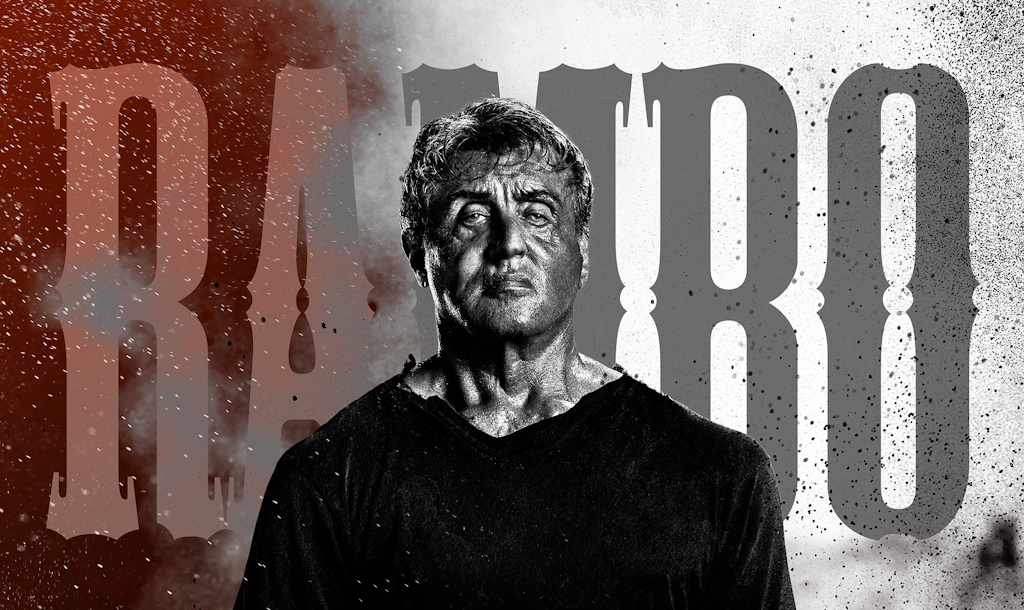
Sylvester Stallone went down in film history not simply as an action star, but as a full-fledged creator of his own screen characters.
His career is built on a rare combination of acting charisma, screenwriting ability, and directorial vision, allowing him to shape major projects around his strengths and help define an entire era of genre filmmaking.
Beyond the films discussed below, Sylvester Stallone’s filmography includes several other notable projects: in the hard-edged crime thriller “Nighthawks” (1981), he played an experienced New York anti-terrorism officer; in the cult action comedy “Tango & Cash” (1989), he formed a memorable duo with Kurt Russell; in the crime drama “Cop Land” (1997), he delivered a strong dramatic performance as a small-town sheriff, demonstrating his range beyond action roles; and in the large-scale “The Expendables” franchise (2010), he brought many of the biggest action stars of previous decades together on the same screen.
“Rocky” Franchise (Rocky, 1976–2006)
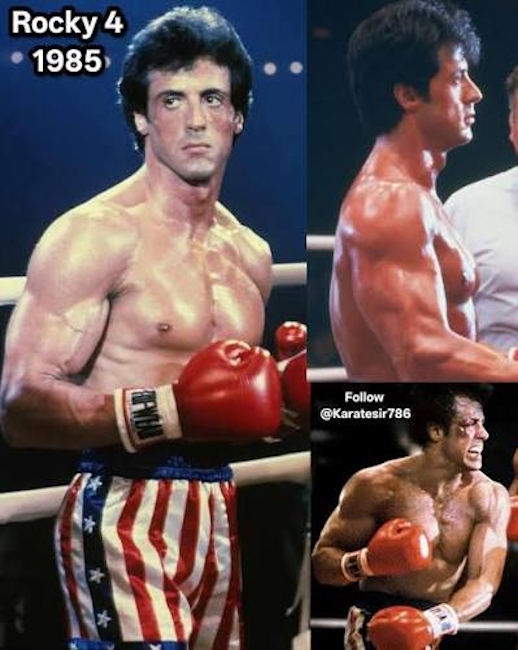
The story of Philadelphia boxer Rocky Balboa unfolded over several decades, evolving from an Oscar-winning independent drama into a sprawling sports saga with six numbered films and a series of spin-offs. If the original 1976 film was an intimate story about finding self-respect against the backdrop of rough Philadelphia streets, its sequels turned into arenas for global confrontations. Rocky survived a brutal showdown with Clubber Lang, avenged a friend, and took down the Soviet powerhouse Ivan Drago during the Cold War, lost his fortune in the fifth film, and returned to the ring later in life in “Rocky Balboa,” proving that determination does not grow old.
This film universe set the gold standard for sports movies and permanently embedded the classic training montage, backed by a motivational soundtrack, in popular culture. Each installment adapted to the expectations of its decade, moving from bleak realism to the glossy, music-video-style spectacle of the 1980s. In the end, the franchise became more than a series about boxing, transforming into an encyclopedia of overcoming personal crises, dealing with loss, and passing experience to a new generation of fighters through Adonis Creed.
The survival and extraordinary success of the series represent an enormous personal achievement for Sylvester Stallone, who wrote all six original films and directed four of them. Taking a major career risk in his youth to secure the lead role, he gave Balboa his own sincerity, vulnerability, and unbreakable stubbornness. The actor carried the character for more than three decades, aging him naturally on screen and establishing himself as the creator of one of the most inspiring characters in Hollywood history.
“Rambo” Franchise (Rambo, 1982–2019)
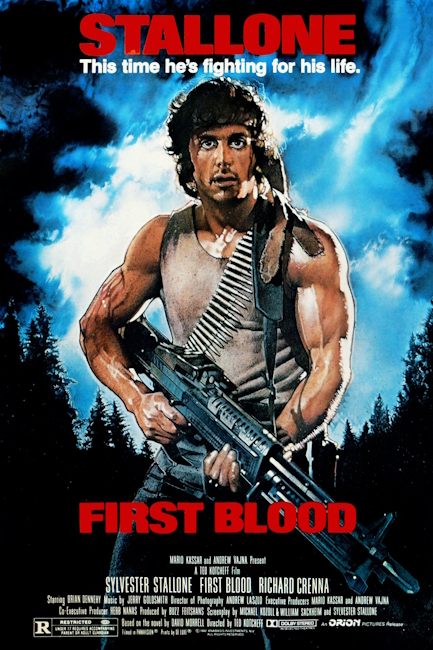
The John Rambo series consists of five films that radically changed their genre and ideological message over nearly four decades. Beginning with “First Blood,” a tense psychological thriller about the post-traumatic trauma of a Vietnam veteran forgotten by his country, the saga quickly evolved into a monumental propaganda action series. In the second and third installments, the character became an unstoppable fighting machine who single-handedly handled conflicts in the jungles of Asia and the mountains of Afghanistan, while the 2008 and 2019 films presented him as an exhausted, merciless avenger tearing enemies apart to protect the last people he had left.
The transformation of the series perfectly reflected changing times and audience expectations. During the 1980s, the character’s exaggerated masculinity and hundreds of on-screen kills became symbols of American revenge, while the red headband and M60 machine gun turned into cultural archetypes. The later films moved away from glossy action, instead embracing raw, almost primal violence and portraying war as a bloody free-for-all. Rambo became a household name, symbolizing the ultimate soldier capable of taking on an army with a bow, a knife, and whatever weapons he could find.
Stallone built this multimillion-dollar franchise largely on his own terms, rewriting the original screenplay for the first film and preserving the life of the character from the novel. He personally shaped the combat choreography, pushed himself to peak physical condition, and took firm control of the most violent fourth installment. His control over the franchise kept John Rambo from remaining merely the unstable killer of David Morrell’s original novel and instead turned him into a tragic antihero whose enduring curse is his extraordinary ability to take lives while desperately wanting peace.
“Cobra” (Cobra, 1986)
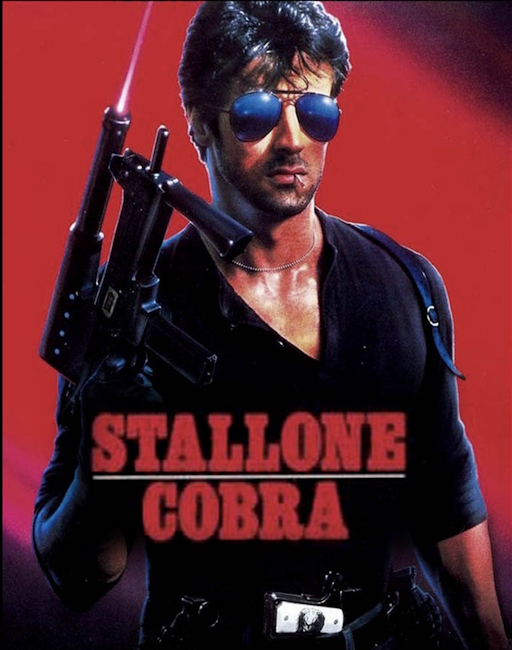
This police thriller follows Lieutenant Marion Cobretti of a specialized Los Angeles unit whose methods for dealing with violent criminals push the limits of the law. Assigned to protect a fashion model from a gang of sadistic cultists calling themselves the “New Order,” the hero unleashes an all-out war on the city’s streets. The story is an uncompromising portrait of a lone cop who would rather deliver a death sentence on the spot than bother with due process, using a customized submachine gun equipped with a laser sight.
The film’s aesthetic became a defining template of the VHS-era action movie, aggressively combining rapid-fire editing with a neo-noir visual style. The lieutenant’s mirrored aviator sunglasses, matchstick in the corner of his mouth, black shirts tucked into jeans, and vintage 1950 Mercury were instantly adopted by street culture. Despite a wave of hostility from critics who attacked the film for excessive violence and simplistic dialogue, it performed strongly at the box office and gained a cult following on home video.
Stallone built the project almost entirely around his own screen persona, using ideas that producers had previously rejected for “Beverly Hills Cop.” He deliberately created an exaggeratedly cool, cynical cop who stood in sharp contrast to the softer law-enforcement heroes of classic detective movies. The film’s commercial success rested heavily on the actor’s name: audiences came to theaters not for intricate storytelling, but to watch Stallone deliver hard-edged one-liners and brutally wipe out the villains on screen.
“Demolition Man” (Demolition Man, 1993)
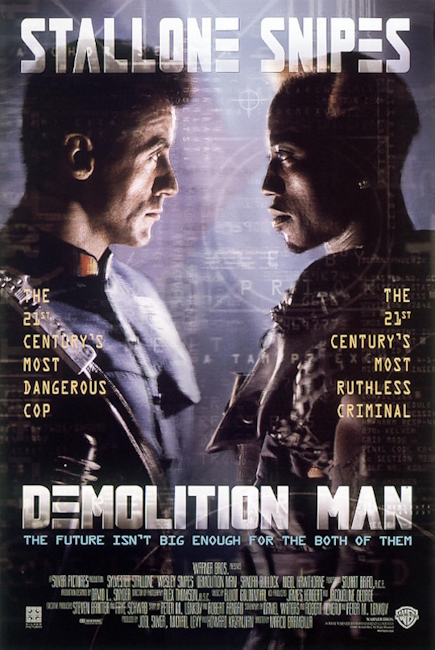
This science-fiction action movie throws John Spartan, a hard-nosed police officer from 1996, into a supposedly perfect but completely sterile future society. After being cryogenically frozen, the character wakes up in 2032 to capture the psychopathic Simon Phoenix, who has escaped. Beneath the explosive action spectacle, the filmmakers tucked in a sharp social satire about extreme political correctness, the surrender of individual freedoms for security, and a society where salt, sex, alcohol, and profanity are strictly prohibited.
The film’s uniqueness lies in its prophetic tone and its skillful balance between hard-hitting shootouts and strong situational comedy. The contrast between a crude cop from the 20th century and the polished residents of the futuristic city of San Angeles produces scenes that became enduring memes. The three-shell system, machines for issuing fines for profanity, and contactless greetings became permanent fixtures of pop culture, making the film one of the genre’s smartest entries.
Stallone’s involvement played a fundamental role in the success of the filmmakers’ satirical concept. He displayed excellent self-awareness, allowing the movie to poke fun at his established image as a straightforward muscle-bound action hero with a machine gun. His on-screen chemistry with the deranged Wesley Snipes and his comic interactions with Sandra Bullock’s character pushed the project well beyond the boundaries of an ordinary action movie. Stallone proved that he could be more than a relentless instrument of revenge and could also handle comedy with a strong sense of timing.
“Judge Dredd” (Judge Dredd, 1995)
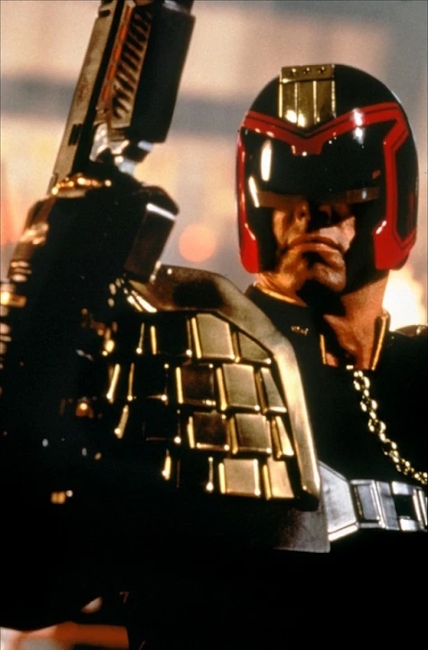
This adaptation of the brutal British comic book takes viewers to the dystopian Mega-City One, where justice is enforced by an elite corps of Judges who combine the powers of police officers, jurors, and executioners. The most uncompromising of them, Joseph Dredd, becomes the victim of a government conspiracy and is exiled to a radioactive wasteland. The movie stands out for its massive cyberpunk sets, cutting-edge computer effects for its time, and elaborate makeup, creating a detailed and overcrowded future world.
The film received a mixed response because of its uneven tone, caused by the studio’s attempt to appeal to every segment of the audience. The serious fascist satire and dark atmosphere of the source material were repeatedly interrupted by ill-fitting comic moments and exaggerated performances from supporting characters. Even so, the aggressive visual style, Gianni Versace’s uniform design, and extensive animatronic effects made the movie a visual standout despite its rough spots in the story.
Stallone’s influence on the project was enormous and, in many ways, controversial. Using his superstar status, he pushed through script changes and removed Dredd’s helmet, an absolute taboo in the comics that enraged fans. Yet Stallone’s massive jawline, trademark contemptuous squint, and booming “I am the law!” permanently etched the character into movie history. The actor’s imposing presence turned his version of Dredd into a cult figure for millions of viewers around the world, many of whom had never even heard of the original graphic novels.

Welcome to Poznayu.com!
My name is Alex, and I founded this project together with a team of like-minded professionals. At Poznayu.com, we create in-depth reviews, explore fascinating facts, and share well-researched, reliable knowledge that helps you navigate complex topics with confidence.
Our mission is simple: to explain complicated ideas in clear, accessible language. We believe that high-quality information should be available to everyone. Every article we publish is designed to provide practical value, actionable insights, and trustworthy analysis you can rely on.
Join our growing community of curious readers. Your feedback matters — share your thoughts in the comments, ask questions, and suggest topics you’d like us to cover next.