Torchlight Infinite is a free action RPG that runs smoothly on both PC and mobile devices, letting you use the same account across all your gadgets. The game gives you deep character progression, seasonal content, and classic loot-driven gameplay in a bright isometric world where every new season brings fresh mechanics and challenges.
Many players keep returning because you can quickly put together a strong build without wasting hours on boring grinding. If you’re looking for a fast-paced ARPG with no heavy commitments, it’s worth taking a closer look.
Game Description

Torchlight Infinite is an isometric online action RPG developed by the Chinese studio XD Inc. It launched in 2022 and continues to receive regular major updates. The game is fully cross-platform — your progress syncs between the Steam PC version and the mobile apps on iOS and Android. You choose a hero from several classes and dive into a vibrant world filled with pets, loot, and seasonal events.
On PC you get classic keyboard-and-mouse controls, while the mobile version offers smooth touch controls with optional auto-battle and auto-loot. The visuals are bright and stylized like the original Torchlight games but enhanced with modern effects and excellent optimization. The game is completely free to play, though it includes cosmetic and convenience purchases.
- The developers are XD Inc. (part of XD Entertainment), who acquired the Torchlight IP in 2025.
- The series was originally created by Runic Games — a team of former Blizzard North developers (Max and Erich Schaefer) who worked on the original Diablo and Diablo II.
- David Brevik, the creator of the first Diablo, even joined as a consultant for Torchlight Infinite, which helped preserve the authentic ARPG feel.
Seasonal Content

Torchlight Infinite is built entirely around a seasonal model.
Every season lasts about three months and brings completely new content: an updated Netherrealm system with fresh modifiers, new bosses, new talents, and new mechanics. Progress from the previous season moves to the Eternal Realm where you can farm peacefully, but the main rewards and leaderboards are only available during the active season.
Seasons heavily influence the meta and keep players coming back. The developers regularly adjust balance, introduce powerful new combinations, and sometimes completely rework certain mechanics. For many players, these seasonal updates are the main reason to return — each new season feels like a fresh game with new challenges and exciting build experiments.
Campaign
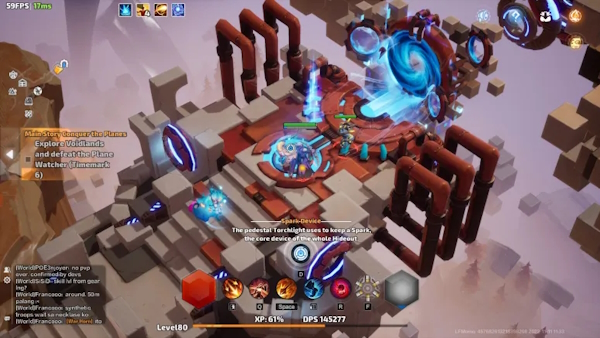
The campaign in Torchlight Infinite revolves around the fight against ancient forces and is divided into several acts with different locations and bosses. The story follows heroes who wield the power of gods and is delivered through dialogues and short cutscenes. Each act introduces new enemies and gradually teaches you the game’s mechanics.
The narrative doesn’t aim for epic depth but serves as a solid background for leveling and loot hunting. Your first playthrough takes about 15–20 hours, while subsequent runs can be sped up by skipping dialogues. Seasonal updates sometimes add new story elements, making the campaign interesting even for veterans.
Overall, the campaign helps you get comfortable quickly and smoothly transitions into the real endgame. It doesn’t drag on for too long but gives enough context and rewards so you feel real progress. It’s perfect for players who want to reach the good stuff fast.
Gameplay

The gameplay of Torchlight Infinite is built around fast combat and constant loot collection. You run through maps, destroy hordes of enemies, and pick up gear that instantly changes your character’s power. Fights are dynamic, packed with visual effects, and let you feel strong from the very beginning.
The mechanics give you complete freedom to experiment with builds without ever needing to start over. You can swap skills at any moment and immediately see the results. This is especially convenient on mobile, where auto-battle helps with routine farming but never takes away control during important fights.

Controls are perfectly adapted for both platforms: classic on PC and comfortable touch with customizable settings on smartphones. The game never forces you into hours of boring grinding and constantly showers you with rewards, keeping the fun alive even during regular map runs.
Skill System

The skill system in Torchlight Infinite is one of the most flexible in the genre. Every hero receives unique traits and talents that unlock as you level up and allow you to create completely different builds. Skills come as gems that can be freely combined, enhanced, and swapped without any penalties.
The talent tree branches in multiple directions and provides powerful passive bonuses that radically change your playstyle. You can build a tank, a damage dealer, or a support character without being locked into one class. The system feels like the best parts of the genre but is made much simpler and more beginner-friendly.

Experimenting with skills is encouraged at every stage. Every new gem or talent is immediately noticeable in combat, and seasonal updates constantly add fresh combinations.
This is one of the main reasons players spend hundreds of hours in the game.
Let’s dive a bit deeper into the skill system in Torchlight Infinite. The skill system is built around gems and is one of the most flexible in the genre.
- Active skills (Skill Gems) are slotted into special slots and can be completely swapped out at any time. They’re enhanced by Support Gems — modifiers that add new effects like extra projectiles, increased damage, or completely altered skill behavior (and more). These are the skills you actually use in combat (one way or another).
- Every hero also gets a unique Hero Trait — a passive class feature that defines the main playstyle and unlocks gradually. In other words, there’s also a passive skill tree.
- Pets and the passive talent tree deserve special mention. Pets have their own active skills and auras that seriously impact combat and can be upgraded separately. The massive talent tree is divided into three branches plus a neutral zone — you spend talent points here to radically change your build.
Thanks to this freedom, you can completely rebuild your character for a new playstyle in just a couple of minutes, without starting the game over.
Endgame

The endgame of Torchlight Infinite revolves around the Netherrealm — a system of maps with ever-increasing difficulty and random modifiers. Every season introduces new mechanics, bosses, and rewards that make you want to come back and try new builds. Here you can farm rare loot and truly test the limits of your character.
The crafting system lets you create genuinely powerful gear. You combine items, add modifiers, and extract legendary powers to perfect your build. It takes time and resources, but the satisfaction when it all comes together is huge.
Seasonal events and leaderboards add a competitive edge. The endgame is designed for months of play and is constantly updated so even veterans stay engaged. This is one of the strongest parts of the game and the main reason many players stick around long-term.
Where the Mechanics and Gameplay Ideas Came From

The core ideas in Torchlight Infinite are taken from the classic Torchlight series and Diablo.
The developers kept the bright style, pets, and fast loot but made everything more modern and mobile-friendly. This makes the game familiar to old fans and accessible to newcomers.
Many mechanics are clearly inspired by Path of Exile. The gem system, deep talent tree, and complex crafting are direct nods to PoE, but simplified and much more approachable. The team took the best parts and adapted them for a free-to-play model without unnecessary complexity.
Some elements also come from Diablo Immortal and Lost Ark. The mobile optimization, seasonal content, and convenient auto-battle help keep players engaged on smartphones. The result is a successful mix of proven ideas that works equally well on PC and mobile.
Why the Game Isn’t Popular in Russia and CIS Countries

In Russia and the CIS countries, Torchlight Infinite never became mainstream mainly because of strong competition from Path of Exile 2 and Diablo Immortal. Players prefer more heavily promoted titles with active Russian-speaking communities and regular streams. The game’s marketing in the region was almost non-existent, so many people don’t even know it exists.
The in-game purchases turn off players who are dealing with economic difficulties. People aren’t willing to spend money on cosmetics or convenience when there are completely free alternatives with similar gameplay. The free-to-play model works much better in regions with higher purchasing power.
Sanctions and payment issues also played a big role. Many players run into difficulties when trying to top up their account, and Russian-language support is almost non-existent. As a result, the game remains niche even among ARPG fans and doesn’t get the attention it deserves.

My name is Alex Morrison — a gaming analyst and author from the Dallas–Fort Worth region. I specialize in analyzing game mechanics, technologies, and the dynamics of modern video games. I graduated from the University of Texas at Arlington with a degree in game design and interactive media, and I have spent more than ten years studying the development and evolution of game worlds.
In my work, I combine technical expertise with hands-on experience to explain complex processes in a clear, structured, and professional way.


