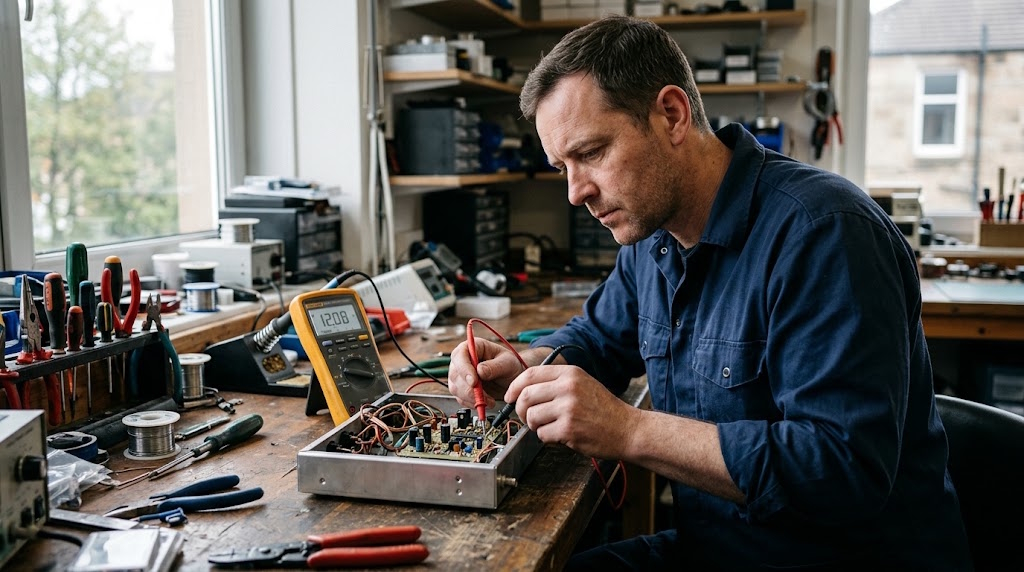
Ohm’s law is a fundamental principle of electrical engineering that describes the relationship between current, voltage, and resistance in an electrical circuit. Understanding this basic rule makes it easy to calculate circuit parameters for everything from simple DC devices to complex AC systems.
The Basics of Ohm’s Law for DC Circuits
Electrical processes are often easier to understand with a plumbing analogy: voltage is the pressure created by a pump, current is the actual volume of water flowing through the system, and resistance is the narrowness of the pipe or any blockage inside it:
- If the pump produces little pressure and the pipe is narrow, you will not get a strong flow no matter how hard you try.
- This linear relationship was described by Georg Ohm: the higher the voltage and the lower the resistance of a conductor, the more current flows through it.
For a section of a circuit, the classic form of the law is expressed by I = U / R, where I is current measured in amps, U is voltage measured in volts, and R is resistance measured in ohms.
The practical value of this equation is that it lets you calculate the load on wires accurately and avoid short circuits or fires. As resistance approaches zero, current rises to critical levels, quickly melting insulation.
- The first straightforward example of Ohm’s law is a standard car battery and an incandescent headlight bulb. The battery supplies a steady 12 volts, while the bulb’s filament has a precisely defined resistance engineered so the current heats the tungsten until it glows without burning it out. If we install a bulb with lower resistance, current exceeds the allowable level and the filament burns out almost instantly.
- The second example involves charging a modern smartphone with a cheap, low-quality cable. Such a wire contains critically little copper, which sharply increases its electrical resistance compared with the original cable. With the same steady 5 volts from the power adapter, the higher value of $R$ in the denominator proportionally reduces the resulting current $I$, causing the phone’s battery to charge painfully slowly.
- The third situation demonstrates Ohm’s law in automotive seat-heating systems. The heating element is a long conductor with relatively high resistance that deliberately restricts electron flow. The energy that has difficulty passing through this barrier is released as heat, while the vehicle’s electrical system carefully controls voltage so the temperature remains comfortable and safe for the person using the seat.
For DC circuits, calculations remain straightforward and predictable because electric charge moves continuously in a single direction.
There are no hidden physical effects distorting the measurements, so the classic formula works flawlessly, making it possible to design everything from electronic wristwatches to high-capacity electric vehicle traction batteries.
How Ohm’s Law Works in AC Circuits
In a household electrical outlet, electrons do not flow continuously in one direction. Instead, they oscillate back and forth at a frequency of 50 cycles per second, which fundamentally changes the physics of the process.
For AC, the standard electrical resistance of materials alone is not enough for precise calculations. Additional forces arise that oppose changes in the direction and magnitude of current, creating what is known as reactive impedance.
Because of these effects, the classic formula changes, and the denominator now takes the circuit’s total impedance into account, represented by the letter Z. The equation becomes I = U / Z, where impedance combines the conductor’s familiar resistance with capacitive and inductive reactance.
Returning to the water analogy, this is no longer just a straight pipe. It is a pulsing hose with flexible walls and heavy turbines inside that must constantly speed up and slow down.
- A good first example is the electric motor in a typical household vacuum cleaner or refrigerator compressor. The motor windings act as inductors that strongly resist AC when the motor starts, while their magnetic field affects overall energy consumption as the rotor spins up. That is why the lights in a room can briefly flicker when a vacuum cleaner is switched on—the starting current can temporarily exceed the rated current several times because of inductive effects.
- The second example shows how resistance behaves in an AC circuit using a conventional household iron or electric kettle. The heating element is simply a nichrome coil without inductors or capacitors, so it does not create strong magnetic fields or store electrical charge. In an iron, impedance $Z$ is practically equal to active resistance $R$, so Ohm’s law behaves just as directly as it does with DC, converting the energy into straightforward heating without losses from a reactive component.
- The third example involves computer switching power supplies and LED lamp drivers, where large capacitors are widely used. In an AC circuit, a capacitor behaves like a flexible spring, continuously storing and returning charge to the circuit while creating capacitive reactance. If this physical parameter is ignored when designing the circuitry, the phase shift between voltage and current can lead to overheating in supply wires and rapid failure of sensitive household electronics.
The main technical complexity—and elegance—of AC is that voltage and current often do not line up in time, operating out of sync because of reactive components.
In this case, Ohm’s law accounts for the vector nature of these physical quantities, requiring power engineers to maintain the proper power factor for electrical equipment. Without an accurate mathematical understanding of total circuit impedance, it would be impossible to build modern high-voltage power systems supplying entire metropolitan areas.

I’m Irina Petrova-Levin, a graduate of the Moscow Technical University of Communications and Informatics (MTUCI), where I earned my degree in Information Technology. My professional journey has been deeply rooted in JavaScript, PHP, and Python, driven by a profound fascination with how modern technology shapes our everyday lives. I strive to explain complex processes in a clear and accessible way without ever sacrificing accuracy or missing the core of the matter.
Now based in Dallas since 2019, my work reflects a unique synthesis of Eastern European engineering depth and the dynamic American tech mindset. This blend allows me to bridge two distinct technological traditions.
My goal is to deconstruct the real mechanisms behind the devices and systems we use daily. In my articles, I aim to deliver information that is not only practical and structured but also reveals the hidden logic of how our world actually works.