The theoretical possibility of instantly moving a person through space has long moved beyond the realm of science fiction and is now actively debated by physicists, neuroscientists, and philosophers.
Academic discussions, along with debates on specialized platforms such as Reddit, X, and dedicated YouTube channels, focus not on magic but on the fundamental laws of quantum mechanics and General Relativity.
Scientists do not view teleportation as physically moving matter from point A to point B, but rather as transmitting enormous amounts of data or manipulating the metric of space itself.
Below, we examine the three most widely discussed scientific concepts, each of which faces its own technological barriers that remain insurmountable for now.
Over the next 15–20 years (by 2040–2045), the international scientific community could develop a fully integrated global quantum internet and technologies for high-precision bioprinting of human organs.
- A quantum network could be built around hybrid solid-state repeaters and satellite communication links, making it possible to reliably teleport the quantum states of complex systems while providing absolute data protection.
- At the same time, combining artificial intelligence with multiphoton bioengineering could make it possible to scan and recreate fully functional tissues and individual organs from a patient’s cells using a personalized digital blueprint, addressing the donor shortage and marking the first real step toward a cybernetic integration of biology with digital carriers.
Quantum Teleportation: Transferring an Information State
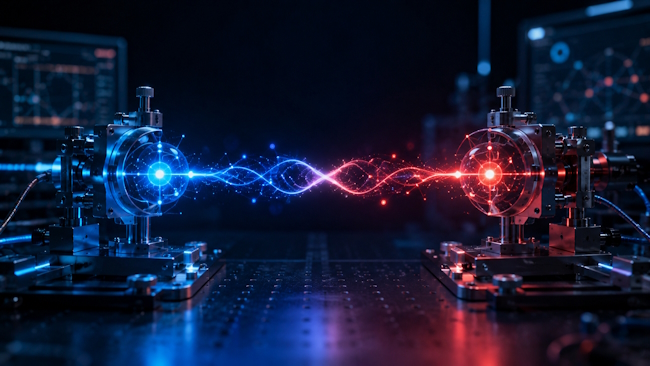
This method is based on the experimentally established phenomenon of quantum entanglement, in which two particles become linked so strongly that a change in the state of one is instantly reflected in the other, regardless of the distance between them.
In the context of human teleportation, the concept does not involve transmitting the atoms of the body themselves. Instead, a scanning device would need to capture the exact quantum state of every particle in the human body, transmit that information through classical communication channels, and reconstruct the original from local matter at the receiving station.
The main physical barrier is the no-cloning theorem. The laws of quantum mechanics state that an exact copy of an unknown quantum state cannot be created without destroying the original in the process. To obtain a perfectly accurate blueprint of a human body for teleportation, the scanner would have to completely disintegrate the person being transported. Any error in the scan could disrupt molecular bonds, producing not a living passenger but biological matter with a destroyed cellular structure.
The second unresolved challenge is the astronomical computational scale involved. An adult human body contains roughly 7×10²⁷ atoms, each characterized by numerous parameters such as spin, momentum, and energy level. Transmitting such an immense data set, even with a hypothetical faster-than-light internet of the future, would take far longer than the age of the universe. Storing a blueprint of a single person would require more storage than all the hard drives ever produced on Earth.
Within the scientific community, this approach is considered the most physically grounded at the microscopic level. Yet applying it to macroscopic objects remains permanently constrained by humanity’s overwhelming information and computational limits.
Macroscopic Wormholes: Controlling Spacetime
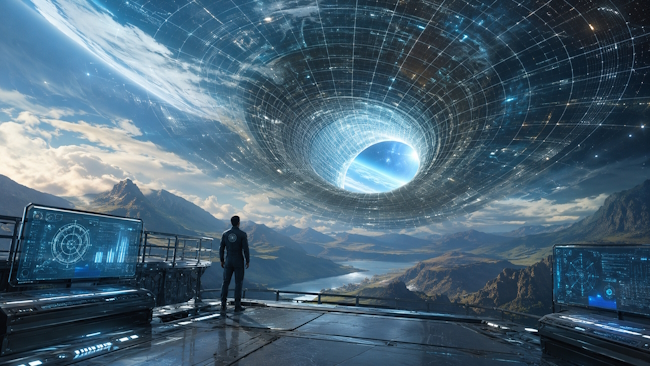
The second major approach is based on the equations of Albert Einstein’s General Relativity, which allow for the possible existence of Einstein–Rosen bridges, or wormholes.
Unlike the quantum approach, this method would not require destroying and reconstructing the original. In this scenario, a teleportation device would warp spacetime itself, connecting two distant points in the universe through a topological tunnel. A person would literally step into a locally curved metric and emerge on another planet without physically crossing the distance between them.
The difficulty lies in the gravitational instability of such tunnels. Any macroscopic wormhole would tend to collapse instantly under its own gravity, without allowing even a photon of light to pass through. To keep the throat of a spacetime bridge open for human passage, physicists would need exotic matter with negative energy density. To date, science has neither learned how to synthesize such matter nor produced convincing evidence that it exists outside mathematical models.
Even if humanity learned how to stabilize wormholes, a passenger would still face extreme conditions inside the tunnel. Enormous tidal forces could tear biological tissue apart at the atomic level within fractions of a second, while Hawking radiation accumulating at the wormhole’s boundaries could burn the object before it even entered. Safe transit would require protective fields capable of isolating a human capsule from the effects of distorted gravity.
Theoretical physicists actively discuss the Alcubierre metric and wormholes as the only teleportation concepts that could preserve a traveler’s original body intact throughout the journey.
Digital Scanning and Bioprinting: A Cybernetic Approach
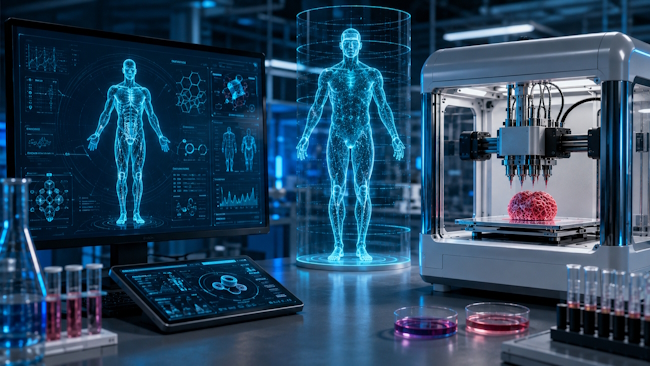
The third concept shifts the problem from quantum physics into the fields of neuroscience and tissue engineering.
This method, often discussed by transhumanists, proposes dividing teleportation into two separate processes: digitizing consciousness and 3D-printing a biological host. The departure terminal would scan the brain’s entire connectome—a complete map of neural connections, synaptic weights, and biochemical gradients. The body would then be disposed of, while the resulting digital code representing the person would be transmitted by radio or laser to a receiving station.
Once the data arrives, the destination terminal would upload the consciousness into a previously grown or printed clone body, or into a synthetic cybernetic avatar. The advantage of this approach is that it avoids the need to copy a person at the quantum level. Classical data transmission would be sufficient, without violating the laws of physics, and could allow backup copies of the traveler to be created in case the signal is lost during transit. In this paradigm, the biological body is treated solely as replaceable hardware.
The biggest bottleneck is the lack of a deep understanding of how the human mind works. Modern science can map the neurons of the worm C. elegans, but scanning a hundred billion human neurons dynamically without killing the patient in the process remains beyond what is currently possible. It is also unknown whether reproducing the brain’s physical architecture alone would preserve the full spectrum of emotions, memories, and self-awareness.
This approach generates some of the fiercest debates online because it relies on the projected development of neural networks and biotechnology, forcing society to reconsider the value of the physical body.
Teleportation and the Problem of the Soul: The Consciousness Continuity Paradox
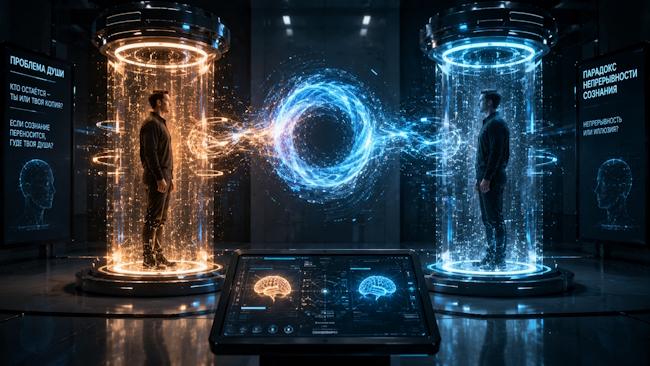
The emergence of a destructive teleportation system based on scanning and reconstruction inevitably brings fundamental physics into conflict with metaphysics, reviving the ancient philosophical Ship of Theseus paradox.
If a quantum scanner completely disintegrates a person’s body in Moscow and a printer assembles an exact atomic copy on Mars, the central question is this: Does the same person wake up on the Red Planet?
From an outside observer’s perspective, the person who steps out of the chamber would have the same personality, habits, and memories. For the traveler, however, the transmission process could be the final moment of their existence, while an entirely new entity opens its eyes at the destination—a perfect clone convinced that it is the original.
From the standpoint of strict materialism, which dominates neuroscience, consciousness is an emergent property of a complex neural network, much like an operating system running on a biological processor. If the structure of the brain were reproduced with absolute precision down to the last electron, the personality would be reproduced as well, preserving the illusion of a continuous stream of consciousness. Under this framework, there is no classical immortal and indivisible “soul.” What religious and philosophical traditions call the soul becomes a unique information pattern that can be recorded, copied, erased, and transmitted through fiber-optic cables without losing its essence.
The situation changes dramatically under dualism—the theory that the soul exists as a nonmaterial substance independent of physiological processes.
No quantum scanner or electromagnetic field detector can capture a metaphysical construct. When the body is disintegrated at the point of departure, the soul, deprived of its biological anchor, leaves it. As a result, the person reconstructed at the other end of the journey becomes what philosophers call a “zombie”: a biological machine that mechanically imitates the original’s reactions, laughs at old jokes, and remembers childhood, but is completely devoid of an inner subjective light and genuine self-awareness.
Successfully creating such a teleportation system would become the first empirical test in human history for the existence of the soul. If a transported person not only retained their memories but could also demonstrate continuity of their deepest sense of self (although subjective experience cannot be objectively measured), it would deliver a devastating blow to idealist worldviews. A working teleportation system would not necessarily deny the value of human identity, but it could permanently strip the concept of the soul of its mystical aura, moving it from the realm of unknowable divine design into the realm of a complex but fully reproducible information architecture.

I’m Irina Petrova-Levin, a graduate of the Moscow Technical University of Communications and Informatics (MTUCI), where I earned my degree in Information Technology. My professional journey has been deeply rooted in JavaScript, PHP, and Python, driven by a profound fascination with how modern technology shapes our everyday lives. I strive to explain complex processes in a clear and accessible way without ever sacrificing accuracy or missing the core of the matter.
Now based in Dallas since 2019, my work reflects a unique synthesis of Eastern European engineering depth and the dynamic American tech mindset. This blend allows me to bridge two distinct technological traditions.
My goal is to deconstruct the real mechanisms behind the devices and systems we use daily. In my articles, I aim to deliver information that is not only practical and structured but also reveals the hidden logic of how our world actually works.