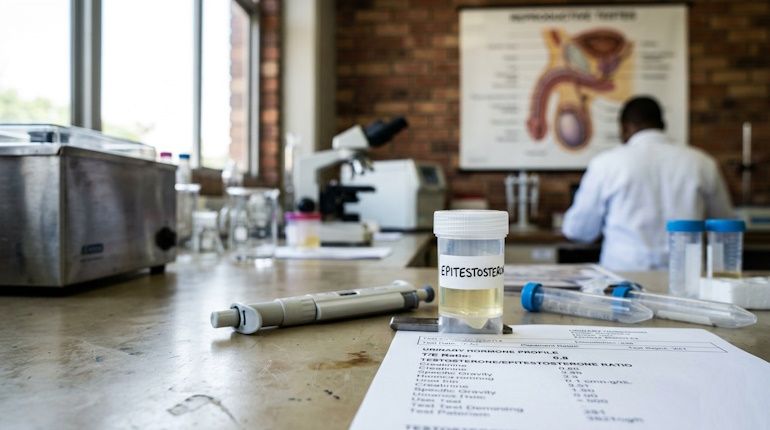
Most men are certain: if their testosterone is within the normal range, then their men’s health is perfectly fine. However, doctors are increasingly encountering a paradox: the patient complains of exhaustion, low libido, and depression, yet the lab results show “good” numbers.
The culprits are factors invisible to the naked eye: an excess of epitestosterone, mutations in the SHBG protein, or disruptions in hormone metabolism.
In this article, drawing on modern medical data and my personal experience in sports pharmacology, I will explain how to recognize these hidden threats and why standard blood tests often lie.
In plain English: Epitestosterone — the shadow hiding the problem
Imagine that a clever double of testosterone lives in your body. It looks almost identical, but it is useless: it provides no strength, doesn’t affect libido, and doesn’t build muscle. This is epitestosterone.
Normally, its levels are several times lower than the active hormone. But if for some reason epitestosterone becomes too high, it begins to trick laboratory tests and doctors. You get your blood tested for testosterone — everything looks great. But you feel completely broken. This is because the fake double has taken the place of the real hormone, and lab analyzers cannot tell them apart.
Another trap is the SHBG protein. This is a transporter that carries testosterone through the blood. If there is too much of it, it binds the hormone and prevents it from working.
The testosterone is there, but it is “locked up.” And if you have a genetic mutation that causes SHBG to function incorrectly, the situation becomes even more complicated.
Let’s break everything down in order.
Epitestosterone: what it is and why doctors stay silent about it
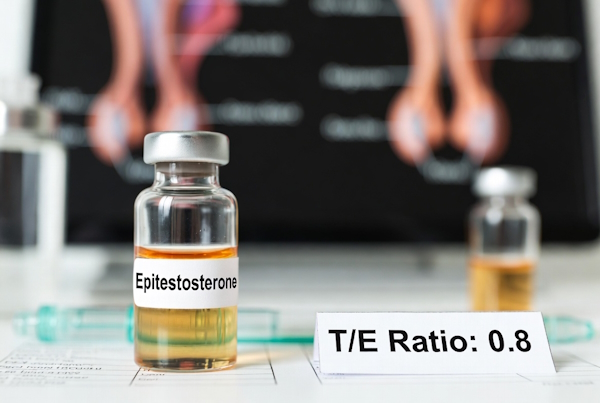
Epitestosterone is a stereoisomer of testosterone, differing from it by the spatial arrangement of the hydroxyl group at the 17th carbon atom. In simple terms: it’s the same molecule, just turned the other way. Because of this, it cannot activate androgen receptors. Epitestosterone possesses no anabolic activity (more on this in the final chapter), but it has a binding affinity for the same proteins and enzymes as its active sibling.
Normally, the ratio of testosterone to epitestosterone (T/E) in human urine is approximately 1:1. In healthy men, it fluctuates from 0.5 to 2.
If epitestosterone is sharply elevated, it could be a sign of a genetic metabolic trait, an adrenal tumor, or the use of aromatase inhibitors.
Local sports anti-doping laboratories use the T/E index to detect exogenous testosterone: if it exceeds 4, it is suspicious. But they rarely see the reverse situation — when epitestosterone is sky-high while testosterone is normal.
Why don’t standard clinics investigate epitestosterone?
Because a urine steroid profile analysis is expensive, requires chromatography-mass spectrometry, and is not included in standard insurance protocols. Doctors in public institutions don’t even consider such a diagnosis.
The paradox: a man can have a five-fold excess of epitestosterone, and no one will pay attention because they only look at testosterone in the blood. Meanwhile, this excess could be an inborn error of metabolism that is treatable.
Urine analysis for epitestosterone: a new word in diagnostics?
A traditional blood test for testosterone does not distinguish between free and bound hormones, let alone epimers.
For an accurate metabolic assessment, a 24-hour urine analysis using liquid chromatography-mass spectrometry (HPLC-MS/MS) is required. It shows not only the levels of testosterone and epitestosterone but also their ratio, as well as metabolites of androstenedione, dihydrotestosterone, and cortisol.
Such an analysis allows for the identification of enzymopathies: for example, 5-alpha-reductase deficiency, disruption of 17-beta-hydroxysteroid dehydrogenase, or excessive glucuronidase activity. These are not exotic cases, but real genetic failures found in thousands of men.
- In the US and Europe, such studies are already part of the diagnostic protocols for idiopathic hypogonadism.
- In other world, only a few private laboratories know about them.
Is it worth it for an average person with unclear symptoms?
Yes, if your blood testosterone is normal but you feel unwell and standard therapy isn’t helping. Unfortunately, public clinics do not order such an analysis. You have to seek out private preventive medicine centers. But this may be the only way to identify the hidden cause of androgen deficiency, especially in young men who are told: “You’re healthy, go home.”
Hypogonadism with normal testosterone and high SHBG
SHBG (Sex Hormone-Binding Globulin) is a transport protein synthesized by the liver. The higher its concentration, the more testosterone ends up bound and biologically inactive.
With a high SHBG level, total testosterone may be within the normal range, while free (working) testosterone is catastrophically low.
Clinically, this manifests with all the symptoms of hypogonadism: decreased libido, erectile dysfunction, loss of energy, depression, and osteopenia.
Why might SHBG be elevated?
The reasons include hyperthyroidism, prolonged fasting, anorexia, liver cirrhosis, estrogen-containing drugs, as well as genetic variants.
For some men, high SHBG is the sole reason for their poor health. But a standard blood test for total testosterone will not show the problem. You must check albumin and SHBG and calculate free testosterone using formulas (for example, Vermeulen’s).
If free testosterone is low and total is normal, classic therapy with clomiphene or hCG often fails.
Moreover, these drugs can further increase SHBG, worsening the situation. The only effective method becomes testosterone replacement therapy (injections of enanthate or undecanoate).
But you need to understand that pills and gels also absorb poorly when SHBG is high. The gold standard is parenteral administration.
Intermediate conclusion
The main problem is that high epitestosterone is not a consequence of high SHBG, but an independent metabolic trait (“incorrect” utilization of testosterone or its precursors). Lowering SHBG in this situation is pointless because epitestosterone does not bind to this protein in significant amounts and will continue to exert its anti-androgenic effect.
If you have both sky-high epitestosterone and high SHBG, you need to address the cause rather than fighting the symptoms, for example, through SARMs. Go to an endocrinologist — you need an expanded analysis (T/ET ratio, androgen metabolites, possibly enzyme genetics), rather than experiments with selective modulators that could completely unbalance an already broken hormonal axis.
Experienced athletes have understood correctly, I hope. Yes, testosterone enanthate injections can help, as they create high “blanket” concentrations of the hormone that override the anti-androgenic effect of epitestosterone, saturating androgen receptors even if your own metabolism is disrupted.
However, such treatment should be prescribed by a sports doctor after a full diagnosis, not at your own risk.
SHBG gene mutations: how to identify them and what are the clinical signs
The SHBG gene (which encodes SHBG) has several dozen polymorphisms that affect the level and function of the protein. The most studied are rs727428, rs5934505, and rs10822184.
Carriers of certain genotypes may have either an abnormally high SHBG or, conversely, a very low one (the latter is more common with obesity and type 2 diabetes). In addition, there are rare mutations that change the receptor’s affinity for androgens or the stability of the molecule.
- Signs of an SHBG mutation: hypogonadism that does not respond to standard stimulation, lack of effect from hCG, and normal or even elevated total testosterone with clear symptoms of deficiency.
- Diagnostics — DNA sequencing of the SHBG gene.
In Russia, it can be done in some genetic laboratories, but an andrologist or endocrinologist must provide the referral. The price ranges from 25 to 50 thousand rubles depending on the depth of sequencing.
Clinical case from my practice:
- A 35-year-old man with libido “at zero,” depression, and a lack of morning erections.
- Total testosterone — 20 nmol/L (normal).
- SHBG — 120 nmol/L (normal up to 70).
- Calculated free testosterone — 0.18 nmol/L (lower limit 0.25).
- Clomiphene treatment for 3 months yielded no effect.
- A genetic test revealed a homozygous mutation rs727428.
After starting testosterone enanthate injections, the condition normalized in 6 weeks. Without genetic analysis, this patient would have continued to suffer and be treated unsuccessfully.
Why clomiphene and hCG are not suitable for SHBG mutations and epitestosterone excess?
Many doctors prescribe clomiphene (Clomid) the old-fashioned way to increase testosterone.
Let me remind you that this drug blocks estrogen receptors in the hypothalamus, stimulating the production of gonadotropins. But with high SHBG or an excess of epitestosterone, clomiphene is useless. It does not affect the binding capacity of the protein and does not lower the level of the epimer. Moreover, it can increase SHBG, worsening the free testosterone ratio.
hCG (human chorionic gonadotropin) stimulates the Leydig cells in the testes, forcing them to produce testosterone and, simultaneously, epitestosterone. If the patient already has disrupted metabolism of the latter, hCG will worsen the imbalance. Both testosterone and its useless double will increase, and the ratio may remain poor. It’s like trying to pour gas into a car with a punctured tank — the fuel is there, but it doesn’t reach the engine.
The only thing that really helps in these cases is direct testosterone replacement therapy. Injections create high concentrations of the hormone that “break through” SHBG binding and saturate receptors despite high epitestosterone levels.
Dosages are selected individually, under the control of the free fraction. It is important that such therapy requires regular monitoring of hematocrit, lipids, and PSA.
But this doesn’t mean you should just inject a bit of testosterone and just stay on TRT (as if you were over 60). It won’t work like that here.
That is, no, 100 mg of the longest testosterone ester (testosterone undecanoate) per month is an inadequately low replacement.
- First, the frequency of its administration during therapy is once every 10–14 weeks, not every month.
- Second, the starting dose for replacement therapy is 750–1000 mg (3–4 ml) at one time, and the maintenance dose is 750–1500 mg every 10–14 weeks.
- Such micro-doses will not create the necessary concentration to override the anti-androgenic effect of epitestosterone.
First — find a doctor who doesn’t dismiss complaints but prescribes an expanded examination. Most often, this is a specialized sports doctor who manages bodybuilders or a specialized endocrinologist in a private clinic. Minimum: total testosterone, SHBG, albumin, calculation of free testosterone, estradiol, prolactin, TSH. If possible — analysis of 24-hour urine for the steroid profile (testosterone, epitestosterone, T/E ratio). This costs money, but it’s cheaper than years of useless office visits.
Second — exclude adrenal and testicular tumors (ultrasound, MRI as indicated).
Third — if a genetic cause is suspected, take a test for SHBG mutations and steroidogenesis enzymes. If high SHBG or disrupted epitestosterone metabolism is confirmed, there are few treatment options. As already stated, hCG and clomiphene do not work. Direct testosterone replacement therapy is the only proven method.
Don’t be afraid of injections. Modern esters (testosterone enanthate, cypionate, undecanoate) allow for maintaining stable levels with shots every 1–4 weeks. Well-being improves in 3–6 weeks, and side effects are minimal with proper monitoring.
The main thing is not to self-medicate, not to buy drugs on the black market, and to get tested regularly. If there is no prescription, then as an alternative, find a trusted online resource with gear for bodybuilders.
Epitestosterone and its anabolism
Epitestosterone does not possess anabolic activity and does not work in bodybuilding like testosterone — moreover, it acts in exactly the opposite way, as an endogenous anti-androgen, blocking the effects of testosterone in the body.
It is a spatial isomer of testosterone, differing from it only by the orientation of one hydroxyl group, yet this is enough to deprive it of the ability to bind with androgen receptors and trigger protein synthesis in the muscles.
In fact, in laboratory studies, epitestosterone suppressed the androgenic effects caused by testosterone. In anti-doping control, the ratio of testosterone to epitestosterone in urine is used precisely to detect exogenous testosterone: if epitestosterone is not artificially increased along with it, doping is suspected.
Therefore, in bodybuilding, epitestosterone is completely useless and even potentially harmful. Its elevated endogenous level or artificial administration will only reduce the availability of androgen receptors for real anabolic agents.
No serious basis for its use in strength sports or bodybuilding exists — it is merely a laboratory marker of testosterone metabolism, not an independent anabolic agent.
Conclusion
Epitestosterone, SHBG, and their mutations are not exotic cases, but the real cause of suffering for thousands of men.
The problem is that most doctors are not familiar with these concepts, and standard blood tests give a false sense of well-being. Urine steroid profile analysis and genetic testing could save many families from breaking up, but they remain a rarity in post-Soviet countries.
Until state clinics begin to apply these methods, the responsibility lies with the patients themselves.
Awareness, persistence, and a readiness to pay for quality diagnostics — this is what will help restore health. Don’t believe it if you are told “everything is fine” when you feel bad.
The table below will help you quickly assess the picture:
| Parameter / Situation | What it is / What is happening | How to identify / Diagnostics | Clinical significance and actions |
| Epitestosterone (ET) | Inactive isomer of testosterone, endogenous anti-androgen. Normally 2–5 times less than testosterone. | 24-hour urine analysis by HPLC-MS/MS for steroid profile (T/ET ratio). | High ET (even with normal T) may lead to hypogonadism symptoms. |
| Elevated ET (sky-high) | Metabolic “breakdown” (genetic or enzymatic); possible adrenal tumor. ET occupies receptors, blocking active T. | Urine T/ET analysis (normal 0.5–2.0). If ET is high — ratio is decreased (less than 0.5). | hCG and clomiphene do not help. Treatment — direct testosterone replacement therapy (injections). |
| High SHBG | Transport protein binds testosterone, making it biologically unavailable. | Blood test: total T, SHBG, calculation of free T (by Vermeulen). | Cause: hyperthyroidism, fasting, genetics. With low free T — direct TRT. |
| SHBG gene mutation (rs727428 etc.) | Genetic variant causing abnormally high SHBG or change in androgen affinity. | DNA sequencing of SHBG gene (paid genetic test). | Patients have normal total T but low free. Treatment — only testosterone injections, not hCG/clomiphene. |
| Combo: high ET + high SHBG | Double blow: active T is bound by SHBG, and receptors are occupied by ET. Deficiency symptoms are severe. | Expanded blood test (total T, SHBG, albumin) + urine steroid profile. | Testosterone replacement therapy (injections) in doses sufficient to “break” binding and saturate receptors. |
| Ineffectiveness of clomiphene/hCG | These drugs stimulate the production of both testosterone and epitestosterone, worsening the imbalance. | Control of symptom dynamics and T/ET levels after 3 months of therapy. | Useless in cases of high SHBG and/or high ET. |
| Direct testosterone replacement therapy | Injections (enanthate, undecanoate) create high hormone concentrations that “break through” binding and override ET’s anti-androgenic effect. | Prescription by a doctor after diagnostics. Doses are selected individually. | The only proven method for correcting symptoms in these forms of hypogonadism. |
The first step should always be an analysis for free testosterone (calculated or direct dialysis) and the exclusion of high SHBG. If standard methods do not help, it is reasonable to dig deeper into the urine steroid profile and SHBG genetic testing.
Look for doctors who think modernly and use evidence-based medicine.
Your men’s health is in your hands.

Dmitry Volkov – is the author of our bodybuilding section is a practicing sports medicine physician based in Dallas, Texas, with 21 years of hands‑on experience in sports pharmacology. At 42, he combines deep academic knowledge with real‑world expertise gained from coaching athletes of all levels — from amateurs to seasoned competitors. He earned his medical degree from a leading Texas institution and spent years working in sports medicine clinics and private practice.
His primary focus is hormonal regulation of muscle growth, the use of anabolic steroids and peptides, and post‑cycle recovery. He understands modern protocols inside out because he consults real people every day, helping them avoid side effects and achieve safe results. His approach is rooted in evidence‑based medicine, yet remains grounded in the realities of both amateur and professional sports.
In his articles, he aims to debunk myths and deliver clear, scientifically sound recommendations. Every piece of content is vetted not only by medical knowledge but also by years of clinical observation. He firmly believes that responsible pharmacology requires a solid grasp of biochemistry, respect for one’s body, and regular medical monitoring — and he works hard to convey these principles in a way that is both accessible and actionable for his readers.