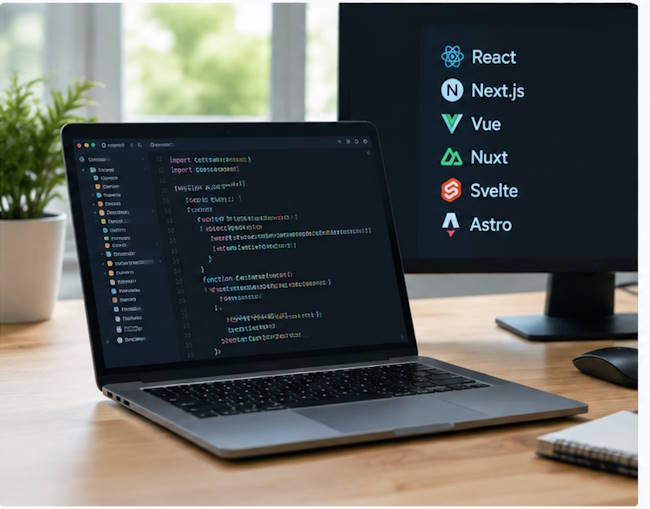
In 2026, web development continues to evolve rapidly. New CSS capabilities are making responsive design more flexible, server-generated UI is becoming increasingly important, and JavaScript frameworks have expanded their support for server-side rendering.
Modern Web APIs and networking technologies are also gaining traction. Most browsers have adopted HTTP/3, while applications are gaining access to more platform capabilities through PWAs, edge computing, and cloud services.
These trends improve page load times and make user experiences more adaptable, but they also require developers to keep up with new standards and architectural approaches.
This article explores the top 5 web development trends in 2026 and offers practical recommendations for developers.
In 2026, web development is increasingly focused on performance, interactivity, and AI integration.
WebAssembly, WebGPU, modern Web APIs, progressive web apps (PWAs), and AI tools are shaping the web’s most important areas of development.
Modern Frameworks and Universal UI Rendering
Popular JavaScript frameworks, including React, Vue, and Svelte, have significantly expanded their server-side rendering and static site generation capabilities over the past few years.
For example, React 18 introduced concurrent rendering and Server Components, while frameworks built around React, such as Next.js 13+, and other frameworks, including Nuxt 3+, have made server-side rendering a standard part of their workflows. This approach offers significant SEO benefits and improves initial page rendering because HTML is generated ahead of time, reducing the time it takes for a page to load.
However, these systems have also become more complex. Developers need to configure build processes and split code intelligently to preserve the performance benefits of faster rendering.
Using established solutions such as Next.js, SvelteKit, and Astro is generally recommended because they handle many low-level configuration details.
New CSS Capabilities and Responsive Design
Between 2024 and 2026, CSS gained several long-awaited features.
Container queries (@container) let developers apply styles to a component based on the dimensions of its parent container rather than just the viewport. This removes some of the limitations of media queries and makes responsive components easier to build.
Subgrid allows nested CSS Grid layouts to inherit track definitions from their parent grids, simplifying the creation of complex layouts.
The :has() pseudo-class is now supported by modern browsers and lets developers select elements based on whether they contain specific descendants, as in article:has(.highlight). Together, these CSS features provide more flexible tools for responsive layouts and animations, including Scroll-Driven Animations and View Transitions.
The example below uses a container query to change text color when a component’s width exceeds 500px:
These features also have limitations. Some newer capabilities have not been available across every browser, although support in Chrome, Firefox, and recent versions of Safari has largely addressed this by 2026. They also require developers to rethink some established design practices. Even so, learning these CSS features makes it possible to build flexible, modular interfaces without relying on excessive JavaScript workarounds.
WebAssembly and WebGPU: Computing and Graphics in the Browser
WebAssembly (Wasm) has become an established part of the web development stack.
Languages that compile to Wasm, including C/C++ and Rust, can run in the browser at near-native speeds. This is particularly useful for demanding workloads such as computation, multimedia processing, and machine learning model execution. In recent years, the Wasm ecosystem has added threads, SIMD, and WASI, expanding its capabilities.
WebGPU, a newer standard that provides JavaScript access to GPU capabilities, gives web applications access to modern graphics hardware for rendering and general-purpose GPU computing (GPGPU) without many of WebGL’s legacy limitations. WebGPU support has arrived in Chrome and Edge, with support also available in Firefox and expected in Safari. This makes it possible to accelerate tasks such as 3D rendering and neural network training directly in the browser.
This example loads a Wasm module and calls one of its exported functions. These technologies offer high performance and allow some server-side processing to move to the client, including machine learning inference.
The trade-offs include more difficult debugging of Wasm code, larger binary modules, and the need for polyfills in older browsers. WebGPU development can also be challenging, particularly when working with shaders and related graphics programming concepts.
Modern Web APIs and PWAs
Between 2024 and 2026, the web platform gained a wide range of new APIs.
For example,
Native File System API (File System Access API) allows web applications to read and write files on a user’s device with permission, using methods such as window.showOpenFilePicker().
WebAuthn 3 supports built-in two-factor authentication using biometrics and hardware security keys.
Background Fetch, Media Session API, and WebXR for augmented reality have also advanced, with support varying across current browsers.
At the same time, Progressive Web Apps (PWAs) continue to evolve. Modern browsers and operating systems let users install websites like apps, work offline through service workers, and receive push notifications. Together, these capabilities bring web applications closer to the functionality of native apps.
Here’s a simple example of service worker registration:
navigator.serviceWorker.register('/sw.js');
Web APIs unlock useful capabilities, including access to hardware resources, customizable caching, notifications, and offline functionality. However, developers must account for security requirements, since most of these features are available only over HTTPS.
Browser support also varies, and some capabilities may not work in private browsing mode or require explicit user permission. Camera access, for example, requires the appropriate authorization.
Networking Technologies and Infrastructure
The web’s evolution is happening on the server side as well as in the browser. One of the most important trends is the adoption of HTTP/3, which is built on QUIC.
By the end of 2024, HTTP/3 had become a standardized protocol, and more than 95% of users were using browsers that supported it, including Chrome, Firefox, and Safari 16+. HTTP/3 addresses limitations of older protocols and reduces latency through multiplexing and 0-RTT connection establishment, helping pages load faster on poor connections. Popular web servers, including Nginx, Apache, and IIS, also added HTTP/3 support between 2023 and 2024.
CDNs and edge computing are also becoming more widespread. Application code, including Node.js or Wasmtime workers, can run on CDN edge servers through platforms such as Cloudflare Workers and AWS Lambda@Edge. This reduces content delivery latency and allows workloads to be distributed more efficiently. Jamstack is also gaining traction, combining static site generation with APIs to simplify scaling.
The main drawbacks include the complexity of configuring newer protocols and infrastructure, along with the need for DevOps knowledge.
Even so, industry specialists point out that these technologies can reduce server costs and improve responsiveness over the long term.
Pros and Cons of the Top 5 Web Development Trends
Trend
Pros (Facts)
Cons (Facts)
Frameworks and Server-Side Rendering
Better SEO and faster initial page loads with Next.js, Nuxt, and SvelteKit; React 18+ and Vue 3 support SSR/SSG.
More complex builds and configuration, including bundle splitting and SSR logic; a learning curve for new APIs such as Server Components and hydration.
New CSS Features (Container Queries, Subgrid, (), Animations)
Responsive components without JavaScript; CSS Grid Subgrid and container queries simplify layout work; () expands selector capabilities.
Initially limited browser support, largely resolved across modern browsers by 2026; developers must learn new syntax and patterns.
WebAssembly and WebGPU
Browsers execute Wasm code at near-native speeds, accelerating multimedia and computation; WebGPU enables gaming and machine learning in the browser.
Large libraries and complex debugging; new skills required for shaders and linking; availability still varies by environment, including Safari versions.
New Web APIs and PWAs
Access to operating system features such as file storage, biometrics, and multimedia; offline access and notifications through PWAs; cross-platform support.
Browser support is inconsistent; for example, File System Access is available in Chromium-based browsers but not Safari; HTTPS and user permissions are required.
Networking and Infrastructure (HTTP/3, Edge)
HTTP/3 reduces latency significantly; standardized in 2022 and enabled in browsers used by 95% of users by 2026; edge CDNs speed up content delivery.
Requires server software updates, such as Nginx 1.25+ and Apache 2.5+; some hosting platforms had incomplete support in 2024–2025.
Recommendations for developers:
Learn new standards early. Start testing CSS Container Queries and Subgrid in pilot projects. This will prepare you to use them more widely in production.
Use established frameworks. For universal rendering and SSR, choose Next.js, Nuxt, or SvelteKit instead of building custom solutions. These frameworks already support modern capabilities in React 18+, Vue 3, and Svelte.
Optimize performance. Move demanding workloads, such as image processing, to WebAssembly or use WebGPU when GPU acceleration is beneficial. Always maintain a JavaScript fallback where needed.
Experiment with PWAs and edge computing. Structure your project as a PWA by configuring a manifest and service worker for offline functionality. Explore Cloudflare Workers and AWS Lambda@Edge. Even a straightforward Jamstack implementation with static site generation can significantly improve performance.
Update your infrastructure. Move servers and proxies to HTTP/3 when practical to improve performance without changing application code. Monitor browser and server releases so you can adopt new capabilities promptly, including WebAuthn for authentication and new service worker features.
I’m Ethan Carter, an American developer and technical writer with more than 20 years of experience in systems and application programming. My core specialty is low-level development in Assembler: 22 years of hands-on work, including deep experience in code optimization, CPU architecture, and performance-critical solutions. I also hold a PhD in Assembler and have spent more than 18 years working with ASP.NET, building enterprise web systems, APIs, and scalable backend solutions.
In addition, I have 9 years of experience in C++ and C#, along with 7 years of hands-on microcontroller programming in Assembler. Thanks to this mix of academic background and practical engineering experience, I can write about software architecture, low-level optimization, and modern development in a way that makes complex technical topics clear for a professional audience.