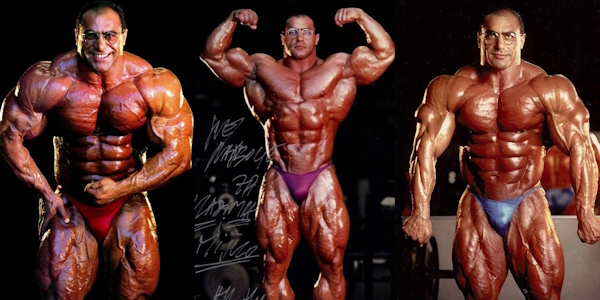
Nasser El Sombati is an athlete with a distinctive training approach: every muscle group is worked with precise technique and intentional torso drive. His programs pair heavy compound lifts to maximally load large muscle groups with isolation work using controlled ranges to refine detail. This method effectively develops back, chest, arms, shoulders (all deltoid heads), trapezius, abs and calves, producing a balanced and functional physique. Attention to detail, amplitude variation and controlled body swing are what make Nasser’s training both effective and unique.
Nasser El Sombati’s pressing and pulling templates are logically arranged: first the large multi-joint movements that deliver overall volume and a growth stimulus, then the specialized techniques that finish target muscles. Workouts aim for maximal loading and deep stretch, which is evident in the technical features of each exercise. Nasser trains so that strength and mass come through high working weights, controlled peak contraction, and deliberate stretching. In every movement there is a clear logic: compounds first for maximal load and systemic stimulus, then targeted moves to amplify peak contraction and finish the muscle.
Remarks: we will not cover sets, reps or exact weights (these are personal variables and should not be copied).
For each workout we used the corresponding YouTube video with time stamps as the basis for analysis.
Notes on Nasser El Sombati’s overall logic.
The method is built on the rule “more weight — reduced range where necessary — greater range where safe.” He uses torso inertia and controlled swinging to increase working weight and peak tension while avoiding extreme negative stretches in vulnerable joint positions. This style is effective for mass gains if the lifter has good core stability and practiced technique; novices must proceed cautiously and build these skills gradually.
Technique and purpose of individual moves.
Technique and intent in Nasser’s exercises are aimed at a single objective: maximal working weight plus extended time under tension and deliberate stretching. The mix of “hard” compound lifts and “fine” isolation moves delivers both strength and aesthetics — provided the technique is learned carefully and the athlete has appropriate training background.
In conclusion: preference for free weights.
In his training Nasser clearly favored free weights. Almost all his movements — bar and dumbbell presses, bent-over rows and swings — are performed with controlled amplitudes and body drive that cannot be replicated on fixed machines. Free weights let him recruit stabilizers, follow natural bar paths and load target muscles maximally while maintaining high intensity and exercise variability.
Day: Lats (Back), Biceps, Triceps, Chest
Barbell Bent-Over Row (Lats, Back) Nasser performs this movement with a strong swing at the top of the range and a slight overall torso tilt, enhancing the peak contraction of the lats and creating a powerful finishing “pull.” The smaller torso angle reduces lower back strain and allows the delts and lats to work more “vertically” together.
T-Bar Row The distinctive feature is a slight squat at the bottom and a small torso lean. Nasser uses the torso angle to pre-stretch the muscles and create leverage, producing a strong explosive pull at the top. The squat adds kinetic momentum, enabling heavier weight while maintaining control over the bar path.
Seated Cable Row to Stomach Nasser leans his torso back at the zero point of the range (when the hands reach the stomach), generating a controlled swing to maximize peak lat contraction and extend the negative phase. This increases time under tension in a key position and helps fatigue the middle back fibers effectively.
Z-Bar Curl (Biceps) A hallmark is the pronounced swing during the lowering phase, incorporating strong torso momentum and heavy weight. This allows Nasser to recruit the entire shoulder girdle and achieve extreme biceps stretch at the bottom. This “cheat-style” technique builds the ability to lift significantly heavier loads but requires precise bar control to avoid injury.
Seated Overhead Dumbbell Extension (Triceps) Nasser moves the dumbbells slightly back at maximum stretch but doesn’t fully lock out in the positive phase. This maintains constant tension on the long head of the triceps while reducing stress on the elbow joint. The technique provides deep stretch and controlled “finishing” of the muscle group.
Flat Dumbbell Bench Press (Chest) Nasser keeps the elbows closer to the body, lowering the dumbbells along a more vertical path, as Ronnie Coleman used to do. This shifts emphasis to the lower chest and allows extremely heavy loading under strict path control. The style generates strong chest compression and a powerful muscular response.
Workout Summary (Back + Arms + Chest):
Nasser places compound pulls first to generate a central anabolic signal and accumulate working weight.
He then applies “bridging” techniques — swings, slight squats, torso momentum — to intensify peak contraction and stretching.
Transitioning to semi-isolation and isolation movements for biceps and triceps closes the session, maintaining high total volume and heavy load on the target “meat” of the muscles.
Day: Deadlift, Back, Abs, Calves
Deadlift Nasser performs the deadlift with a partial range of motion: his torso bends roughly 45 degrees, and the bar rests on supports at the bottom, while the top phase involves full torso extension. Limiting the negative range reduces lower back injury risk with heavy loads and focuses the effort on the upper posterior chain during explosive extension.
Seated Cable Row to Stomach As in the previous session, Nasser leans his torso back at the zero point, achieving a strong lat contraction while keeping the hands at the stomach. This enhances the peak engagement of the back after heavy deadlifts and boosts vascularity and muscle pump.
Bent-Over Dumbbell Row Key features: a deep torso tilt at the bottom and about 45 degrees at the top; the dumbbell travels straight from the shoulder to the chest. This path maximizes lat isolation and minimizes biceps and forearm involvement, concentrating the load on the central mass of the back.
Dumbbell Pullover on Incline Bench (Upper Back and Chest Finish) Nasser fully extends backward in the negative phase to stretch the lats and chest under controlled eccentric tension. This exercise serves as a finisher for the upper back and chest, increasing stretch and overall muscle engagement.
Partial Pull-Ups with Very Narrow Grip and Added Weight Short range of motion with extra weight creates a concentrated contraction in the lats and lower traps without requiring full range of motion. This provides a strong peak stimulus in the target position.
Weighted Hyperextensions Nasser targets the spinal erectors and glutes by adding weight, reinforcing posterior chain strength and hip stability—essential for safe deadlifts and overall power.
Lying Leg Raises on Bench with Dumbbell Short range of motion emphasizes the upper portion of the rectus abdominis and control, while the added weight increases intensity without over-stretching the hip flexors.
Seated Crunch Machine (Partial Range) Focuses on contraction and isolation of the upper abs with controlled movement. Partial range allows for high volume and frequency without overloading the lower back.
Seated Calf Raise Short repetitions with weight target the soleus, increasing calf density and improving capacity to handle heavy static loads.
Workout Summary (Pulls, Abs, Calves): This session combines posterior chain strength and stability: a partial but explosive deadlift paired with targeted pulling and isolation work strikes a balance between safety and progressive overload.
Abs and calves serve as accessory groups, enhancing overall recovery capacity and stability under heavy loads.
Day: Biceps, Forearms, Traps, Triceps
Alternating Dumbbell Curl (Standing, Supinated Grip) Nasser starts with this movement because it allows him to use heavy dumbbells while engaging the torso as a stabilizer, generating a strong overall anabolic signal for the arms. Using a slight body swing and lifting the dumbbells in an already supinated position reduces forearm involvement in supination and emphasizes the elbow flexors and peak contraction of the biceps.
Z-Bar Curl Nasser uses two approaches: with moderate weight, he performs strict reps in full range to maximize muscle volume; with heavy weight, he allows body swing and torso momentum to handle the overload and deepen the stretch at the bottom. This trains both strength and CNS adaptation to heavy resistance.
Single-Arm Dumbbell Curl on Preacher Bench This exercise isolates the long head of the biceps and eliminates body momentum: seated position and limited preacher range force the biceps to work in a “clean” mode. Nasser uses it as a technical finisher after heavier compound movements.
Incline Dumbbell Curl with Body Support (“Arnold” Variation) The incline provides extra stretch on the long head, while the body support minimizes cheating; this variation gives a different vector of resistance and complements classic curls. Changing the angle hits fibers differently and increases overall biceps volume.
Reverse Barbell Curl (Forearms) Performed in full range with rest-pause between sets, this increases total time under tension for the forearms and improves grip endurance. Rest-pause allows maintaining high load while adding neuromuscular stimulation.
Standing Behind-the-Back Barbell Wrist Curl (Forearms) Partial range—lifting the bar with the fingers—targets the final contraction phase of the forearms and finger flexors. This develops grip density and strength, important for pressing and pulling exercises.
Standing Narrow-Grip Upright Row Targets the upper traps and delts, serving as a bridge to trap-focused work; Nasser performs it in full range for maximal trap contraction. Narrow grip shifts emphasis slightly to the medial traps and shoulder stabilizers.
Dumbbell Shrugs Nasser performs strict vertical shoulder raises without rotation to avoid momentum swings and keep the focus on the trapezius. Simple but heavy movement produces strong fiber compression and enhances upper back thickness.
Seated Z-Bar French Press (Triceps) Performed with full range and narrow grip to maximize long head stretch and full elbow extension. Inclined bench setup changes the angle of resistance and enhances long head recruitment through increased stretch at the top.
Nasser’s approach is logical: heavy, multi-joint lifts first for high load and CNS stimulation, followed by isolation and specific variations to finish each muscle.
Combining full range where safe and controlled partial range in vulnerable positions allows heavy work while minimizing overtraining or injury risk.
This sequence delivers a strong growth stimulus, peak contraction, and localized muscular fatigue.
Shoulder Training Compilation
This breakdown of Nasser El Sombatti’s shoulder routines (different sessions, not a single day) explains the logic behind exercise order, technical nuances, and the adaptation each movement provides.
Nasser focuses on combining maximum feasible working weight with targeted peak contraction, so many exercises are performed with partial range of motion or controlled body swing.
The sequence moves from multi-joint presses to isolation raises and finishes with detailed variations for rear delts and traps, delivering a primary anabolic stimulus followed by targeted burnout. Heavy incline dumbbell presses build overall volume and engage shoulder stability, while raises and lateral movements target specific deltoid heads in different planes. Incorporating shrugs and upright presses later allows high-intensity work on traps and upper delts without compromising the effectiveness of foundational presses.
Incline Dumbbell Press Nasser uses very heavy weight with a spotter to push through the peak load in the concentric phase. This strategy produces strong compression in the front delts and lower clavicular region while maintaining the ability to handle heavy loads.
Standing Dumbbell Lateral Raises He slightly bends the torso on the downward phase and fully extends on the lift, generating a pronounced swing even with lighter weight. Full range from 0 to 90° and controlled momentum enhances peak contraction of the middle delts and increases time under tension at the top.
Seated Incline Lateral Raises (Rear Delts) Nasser uses heavy weights with partial range and torso swing to maintain load while creating strong upper-phase compression. Partial range reduces excessive stress on the rotator cuff and focuses effort on the rear delts.
Reverse Pec Deck (Seated Rear Delt Flys) He increases weight to the point where assistance is needed to pass peak load in a controlled phase. The machine provides a fixed path, allowing safe, high-fatigue work for the rear delts with heavy loads.
Barbell Shrugs Performed with partial range, focusing on isometric compression of the upper traps at the top. Short-range heavy shrugs maximize density and thickness of the trapezius.
Narrow-Grip Upright Barbell Press Provides clean load on the upper delts and upper traps through full range. The narrow grip shifts emphasis medially and reduces radial involvement. For Nasser, it enhances the upper portion of the shoulder complex after lateral movements.
Behind-the-Head Barbell Press on Incline Bench Full range execution creates strong stretch in the front and middle delts during the negative phase. Full range under strict control helps improve shoulder flexibility and increases overall upper-body mass.
Cable Reverse Flys (Overhead to Down, Rear Delts) This machine movement precisely targets rear delts with a long range and constant tension at the top. It finishes the rear delt workload, emphasizing peak contraction without momentum.
Shoulder Training Summary:
Nasser’s compilation blends powerful compound presses to build volume and neuromuscular adaptation with a series of raises and flys for detailed development of each deltoid head.
Using partial range and controlled swing where safe allows handling heavy loads while maintaining targeted time under tension in peak positions.
The result develops both strength and shape: front delts and clavicular region gain compression from presses, middle delts receive volume from standing raises, and rear delts and traps get focused burnout via machine flys and shrugs. This method demands confident technique and adequate recovery but provides rapid progress in shoulder density and size when executed correctly.
Dmitry Volkov – is the author of our bodybuilding section is a practicing sports medicine physician based in Dallas, Texas, with 21 years of hands‑on experience in sports pharmacology. At 42, he combines deep academic knowledge with real‑world expertise gained from coaching athletes of all levels — from amateurs to seasoned competitors. He earned his medical degree from a leading Texas institution and spent years working in sports medicine clinics and private practice.
His primary focus is hormonal regulation of muscle growth, the use of anabolic steroids and peptides, and post‑cycle recovery. He understands modern protocols inside out because he consults real people every day, helping them avoid side effects and achieve safe results. His approach is rooted in evidence‑based medicine, yet remains grounded in the realities of both amateur and professional sports.
In his articles, he aims to debunk myths and deliver clear, scientifically sound recommendations. Every piece of content is vetted not only by medical knowledge but also by years of clinical observation. He firmly believes that responsible pharmacology requires a solid grasp of biochemistry, respect for one’s body, and regular medical monitoring — and he works hard to convey these principles in a way that is both accessible and actionable for his readers.