Mass culture and crime dramas have firmly blurred the distinction between professionals who work at crime scenes and those who examine the bodies of the deceased, merging them into what appears to be a single profession.
As a result, in everyday perception, a pathologist, forensic pathologist, and CSI are often portrayed as doing essentially the same job.
In reality, these are three distinct specialties with different educational backgrounds, areas of expertise, and professional goals.
- The key distinction is where medicine ends and criminal investigation begins: the first two are physicians with different medical specialties, while the third works with physical evidence as part of a criminal investigation.
A pathologist is first and foremost a physician whose primary job is to study disease at the tissue level.
Contrary to the common stereotype, most of this specialist’s working time is spent dealing with living patients rather than dead bodies. Pathologists examine biopsy samples, organs removed during surgery, and tissue specimens. They make definitive diagnoses, including in suspected cancer cases, identifying the type of tumor and how malignant it is so that treating physicians can select appropriate therapy.
When a pathologist performs an autopsy, the work generally takes place within the hospital system and involves people who died from natural causes, including severe or chronic diseases. The purpose of the autopsy is not to search for evidence but to confirm or challenge the clinical diagnosis made while the patient was alive. The physician evaluates how accurate the treatment was, identifies medical errors, and studies how a particular disease process led to death, helping medicine reduce the risk of similar fatal outcomes in the future.
A forensic pathologist is also a medical doctor, but this specialty becomes involved when a death is suspected to be violent, sudden, or otherwise unnatural.
This physician participates in an investigation when a person dies in a traffic crash, is killed, dies by suicide, or dies suddenly outside a medical facility. The forensic pathologist’s job is to determine the cause of death, establish the time of death, assess characteristics of the weapon or other instrument involved, determine the trajectory of a projectile or wound, and identify poisons or toxic substances in tissues, translating medical findings into evidence that can be used in a legal investigation.
An important part of forensic pathology that many people rarely see involves examining living individuals. In cases involving physical assault, domestic violence, workplace injuries, or sexual crimes, the forensic physician documents injuries and determines the severity of the harm. Without an official medical report describing the nature, location, and apparent age of those injuries, investigators cannot properly establish the legal significance of the alleged offense or present the medical evidence in court.
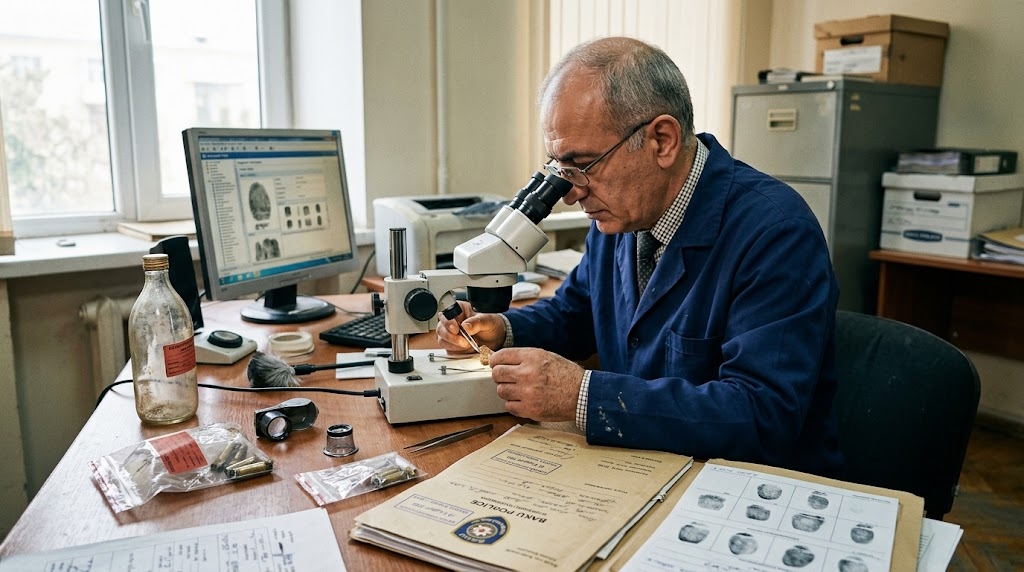
A CSI or forensic scientist differs fundamentally from both physicians because this professional focuses on physical evidence rather than medical diagnosis or treatment.
They do not perform medical autopsies, diagnose diseases, or determine the severity of injuries. Their subject of examination is the physical scene and the material traces left by a suspect, victim, or weapon on different surfaces. Their work involves locating, documenting, collecting, and examining evidence that may not be visible to the naked eye.
Forensic work in the United States is divided into multiple specialized fields: fingerprint examination focuses on latent prints, firearms and toolmark examination deals with guns, ammunition, and related marks, footwear and tire-track analysis examines impressions, and questioned-document examination addresses potentially forged or altered documents. While a forensic pathologist tells investigators what happened to the victim’s body, forensic specialists help determine what object was involved, who may have handled it, and how people moved through the scene. Together, these findings allow investigators to reconstruct the sequence of events and establish the evidence connecting a suspect to the crime.
In Russia, the basic separation of functions also exists, but the professional structure and terminology are different:
- Clinical diagnosis and the examination of deaths from disease are handled by pathologists and other medical specialists, while postmortem examinations of people who died from disease are performed within the medical system.
- Investigations of violent, suspicious, or otherwise unnatural deaths are handled by forensic medical experts (судебно-медицинские эксперты) within the state forensic medical examination system.
- Collection, documentation, and laboratory examination of physical evidence are handled by forensic specialists (криминалисты), who work within law-enforcement structures and forensic laboratories and are not physicians.

Welcome to Poznayu.com!
My name is Alex, and I founded this project together with a team of like-minded professionals. At Poznayu.com, we create in-depth reviews, explore fascinating facts, and share well-researched, reliable knowledge that helps you navigate complex topics with confidence.
Our mission is simple: to explain complicated ideas in clear, accessible language. We believe that high-quality information should be available to everyone. Every article we publish is designed to provide practical value, actionable insights, and trustworthy analysis you can rely on.
Join our growing community of curious readers. Your feedback matters — share your thoughts in the comments, ask questions, and suggest topics you’d like us to cover next.