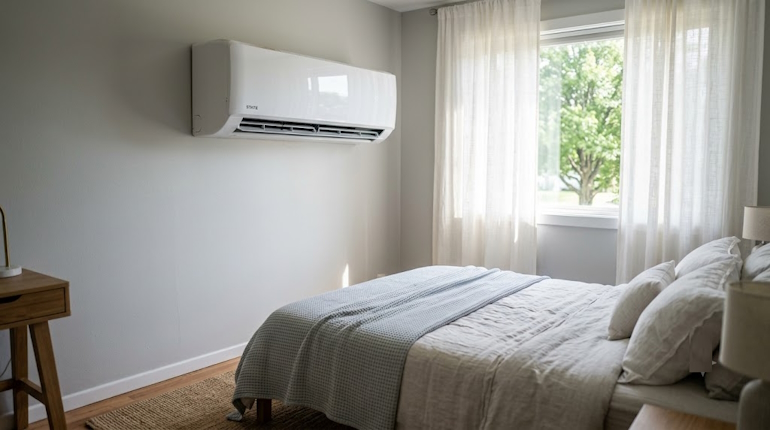
We’re breaking down why summer brings a sudden spike in cold symptoms and whether air conditioners are actually to blame.
As it turns out, the real culprit behind that lousy feeling is almost always a viral infection, not a blast of cold air. Properly setting up your AC and understanding how your immune system works can help you steer clear of summer colds.
So, how do you safely cool down your space during a heatwave without putting your health at risk?
Why Your AC Unit Doesn’t “Give You” a Cold
In the summer, many people are terrified of turning on their air conditioning, convinced that the icy breeze blowing from the plastic box on the wall is making them cough and sneeze.
To put it simply, cold air itself doesn’t contain any bacteria or viruses capable of infecting you.
- An air conditioner works like a regular fan that simply cools down the indoor air. If there are no bugs in that air or already in your system, you won’t get sick just from feeling a bit chilly.
- The real enemies are the germs and viruses we pick up on public transit, in the office, or at the grocery store. Cold air simply makes it harder for our bodies to fight them off temporarily.
Medical science fully backs this up, pointing to a reflex blood vessel constriction triggered by sudden temperature swings as the real reason we get sick in the summer.
When you walk straight from 85°F outdoor heat into a room cooled down to 65°F, the blood vessels in your nose and throat instantly constrict to preserve core body heat. This constriction slows down blood flow to your mucous membranes for about ten to twenty minutes, meaning fewer protective immune cells get there. Primary care physicians emphasize that if a virus has already settled in your airways at that exact moment, your weakened local defense system won’t destroy it in time, which triggers a full-blown upper respiratory tract infection.
Quite often, people make the mistake of confusing a genuine respiratory infection with localized muscle inflammation, known medically as myositis.
Myositis occurs when a direct stream of icy air hits a warm body, causing a sudden spasm and inflammation in the muscle fibers—leaving you with a literally locked-up neck or lower back. In these situations, popping antiviral meds is completely useless because the root cause is physical, not infectious.
To clearly understand the difference between these two summer issues, check out this breakdown of symptoms and treatments:
| Characteristic | Viral Infection (Common Cold) | Myositis from Chilling |
| Primary Cause | Viral exposure coupled with lowered immunity | Localized blood vessel and muscle spasm from drafts |
| Main Symptoms | Runny nose, sore throat, cough, fever | Sharp pain in a specific muscle, restricted mobility |
| Medical Care | Plenty of fluids, symptom relief, rest | Warm, dry compresses, anti-inflammatory ointments |
| Recovery Time | 5 to 7 days | 2 to 4 days with proper care |
At the same time, studies show that ditching air conditioning entirely during a heatwave can actually do far more harm to your body.
Research has established that people actually get sick significantly less often when staying in a comfortable, cool environment around 72–75°F because their bodies aren’t under massive stress from overheating. On the flip side, if your bedroom temperature climbs past 77°F at night, your deep sleep cycles get severely disrupted. This directly tanks the activity of your immune cells and wears down your nervous system. Consequently, an air conditioner isn’t the cause of illnesses—it’s an essential tool for maintaining a healthy indoor climate, as long as you use it wisely.
To make sure your cooling equipment stays a reliable ally rather than a trigger for dormant viruses, you need to follow a strict setup routine. Experts have mapped out a clear protocol for safely running your cooling units during the summer heat.
Follow these mandatory rules for smooth, harm-free room cooling:
-
Set the thermostat so the difference between outdoors and indoors is no more than 10 to 12 degrees Fahrenheit, avoiding a shocking temperature drop.
-
Lower the temperature gradually, dropping it on the remote by a degree or two every fifteen minutes so your blood vessels have time to adapt.
-
Direct the unit’s louvers straight up toward the ceiling or against an empty wall, keeping desks and beds completely out of the direct blast zone.
-
Set the fan speed to low or medium to create a gentle, evenly diffused airflow.
Finally, a massive part of preventing summer illnesses comes down to routine maintenance and keeping your indoor air quality healthy.
Many people forget that a mini-split system doesn’t pull fresh oxygen from the outside; it continuously recirculates the exact same indoor air, gradually stripping away its humidity. If you skip basic hygiene, the indoor unit quickly turns into a breeding ground for dangerous mold and highly concentrated household allergens. Keep this checklist of mandatory maintenance steps in mind:
-
Pop out and wash the mesh pre-filters under warm water yourself every two to three weeks of heavy use.
-
Air out the cooled room by cracking the windows for ten minutes every two to three hours to replenish oxygen levels.
-
Run a household humidifier to keep the mucous membranes in your nose and throat safely hydrated.

I’m Dr. Michael Carter, a 43-year-old American physician and medical researcher. I earned my MD from the University of Michigan Medical School and later completed an MPH at the Johns Hopkins Bloomberg School of Public Health, with a focus on public health and clinical research.
I began my medical career at University of Michigan Health, where I worked in clinical practice and contributed to research on chronic disease prevention and the effectiveness of medical interventions. I later continued in academic medicine, focusing on internal medicine, metabolic health, preventive care, and the analysis of clinical data.
My research interests include chronic disease, cardiovascular risk factors, metabolic disorders, disease prevention, and the evaluation of medical evidence. I’m particularly interested in the quality of clinical research, the evidence behind treatment approaches, and how medical findings are interpreted and applied in real-world practice.