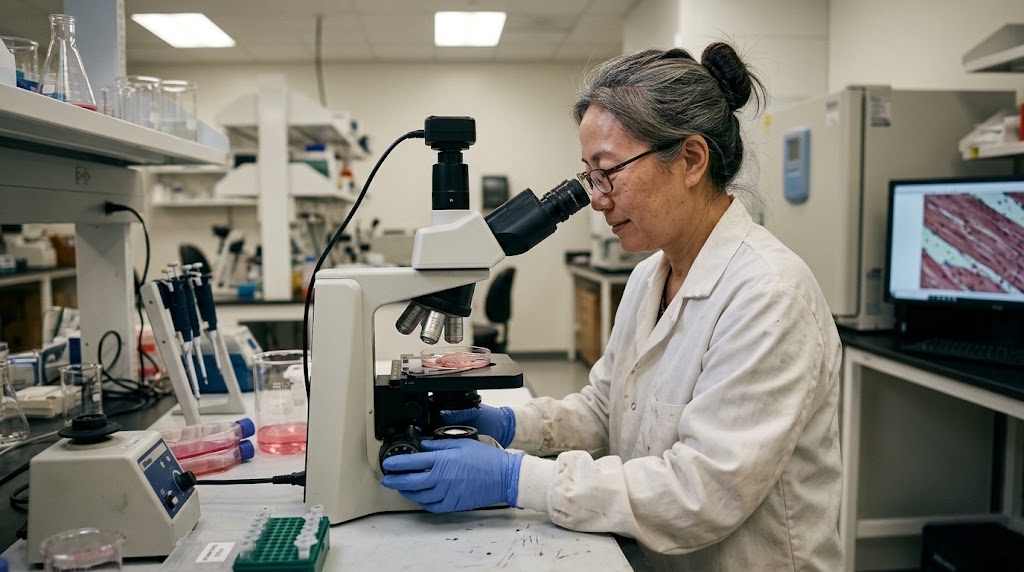
August 26, 2026, the journal Nature Aging published the results of a study by specialists from the Institute of Zoology of the Chinese Academy of Sciences who developed a fundamentally new approach to cell therapy. The researchers succeeded in creating functional subcutaneous muscle grafts known as myografts.
In the experiment, laboratory mice received a subcutaneous injection of a suspension containing about six million pre-differentiated muscle cells embedded in a supportive biocompatible gel. The implanted material did not remain a passive cell cluster: the cells organized themselves into functional tissue, developed an internal microvascular network for autonomous nourishment, and began contracting continuously without nerve stimulation or physical exercise.
The key to understanding the significance of this advance lies in modern physiology: skeletal muscle is not simply a biomechanical engine but the body’s largest endocrine organ.
When muscle fibers contract, they produce and release a broad range of biologically active substances called myokines into the bloodstream. These molecules transmit regulatory signals to internal organs and tissues. The continuous pulsing of the subcutaneous graft mimics key biochemical markers of physical activity, causing the body to respond systemically as though it were receiving regular, controlled aerobic exercise.
Metabolic and Systemic Effects: From Muscle Mass to Brain Health
Testing the technology in mouse models of sarcopenia, age-related changes, and obesity produced a pronounced therapeutic response.
The continuously active muscle implant increased total lean body mass and improved the contractile capacity of the animals’ own muscular system. At the same time, key metabolic markers moved toward normal: insulin resistance decreased, the lipid breakdown profile improved, and blood glucose levels stabilized, indicating a systemic shift in metabolism.
The effects of the released myokines extended well beyond muscle and fat balance, reaching structures far from the injection site. The researchers observed positive changes in bone tissue through stimulation of osteogenesis and slower bone resorption. In the liver, the mice showed less fatty degeneration and fewer inflammatory processes.
In addition, metabolic changes were detected in the central nervous system: circulating signaling molecules stimulated the expression of neuroplasticity factors that support brain function during aging.
Therapeutic Potential: From Bioreactors to Fighting Sarcopenia
Beyond mimicking exercise, the authors demonstrated that muscle grafts could be used as a personalized “living factory” for producing proteins.
By genetically modifying the injected cells, the researchers induced the tissue to synthesize targeted therapeutic proteins directly into the recipient’s bloodstream. This approach turns the implant into an autonomous bioreactor capable of supplying the body with deficient enzymes, hormones, or growth factors for months without the need for continuous injections.
The primary target population for the future technology is patients who are physically unable to exercise. This includes older adults with severe sarcopenia, people with progressive muscular dystrophy, severely injured patients confined to bed for prolonged periods, and people with cancer cachexia. For these groups, recreating the endocrine profile of physical activity may slow tissue breakdown and maintain basal metabolism at a level needed to preserve life and functional autonomy.
Limitations, Risks, and Clinical Reality: Why It’s Too Early to Cancel the Gym
Claims in the popular press that the technology could let people “build muscle while lying on the couch” greatly distort the scientific meaning of the experiment.
The subcutaneous graft does not strengthen ligaments, train neuromuscular coordination, increase the density of motor units in the major skeletal muscles, or develop the cardiovascular system the way a full workout does. The engineered biological structure acts as a chemical emulator of physical activity, not a complete anatomical and physiological replacement for it.
Moving the technology from the laboratory into clinical practice will require solving a complex set of bioengineering problems. Scaling the implant to human size will require effective vascularization, prevention of hypoxia in the inner tissue layers, and control of the recipient’s immune response. Long-term risks also need to be studied in detail, including the potential oncogenicity of continuously dividing cells, the possibility of fibrosis, and the body’s ongoing resource expenditure to sustain continuous graft contraction.
Until all phases of clinical trials are completed, the technology remains an experimental approach in regenerative medicine.
A lyrical aside: building muscle while lying on the couch is still possible, just at a different price. You can simply “shoot” testosterone enanthate at 500 mg and take 50 mg of methandienone.
The comparison between anabolic-androgenic steroids (AAS) and subcutaneous muscle grafts involves two fundamentally different biochemical mechanisms, although the fact that pharmacological support can stimulate protein synthesis without exercise has indeed been confirmed by research. And by me personally, as a sports endocrinologist and coach. In short, here is what actually happens:
- Exogenous androgens bind directly to receptors in the skeletal muscles throughout the body, trigger gene transcription, and increase nitrogen retention, resulting in some gain in lean body mass even in the absence of mechanical stress.
- Unlike steroids, a subcutaneous myograft does not make existing biceps or quadriceps grow through systemic hormone receptors — it is a separate engineered fragment of tissue that functions as a local biological stimulator and continuously releases signaling molecules.
The second key difference lies in the systemic consequences and intended use:
- Taking AAS without training increases muscle fiber size but does not develop the capillary network, ligaments, or cardiovascular system, while also suppressing the body’s own endocrine system and carrying risks of cardiotoxicity and liver damage.
- Myograft technology is designed not for aesthetic muscle gain in healthy people but for immobilized patients and those with severe sarcopenia: a small pulsating tissue under the skin sends a biochemical “noise” signal of physical activity (myokines) into the bloodstream, supporting normal insulin sensitivity and slowing organ deterioration in people who are physically unable to move.

I’m Dr. Michael Carter, a 43-year-old American physician and medical researcher. I earned my MD from the University of Michigan Medical School and later completed an MPH at the Johns Hopkins Bloomberg School of Public Health, with a focus on public health and clinical research.
I began my medical career at University of Michigan Health, where I worked in clinical practice and contributed to research on chronic disease prevention and the effectiveness of medical interventions. I later continued in academic medicine, focusing on internal medicine, metabolic health, preventive care, and the analysis of clinical data.
My research interests include chronic disease, cardiovascular risk factors, metabolic disorders, disease prevention, and the evaluation of medical evidence. I’m particularly interested in the quality of clinical research, the evidence behind treatment approaches, and how medical findings are interpreted and applied in real-world practice.