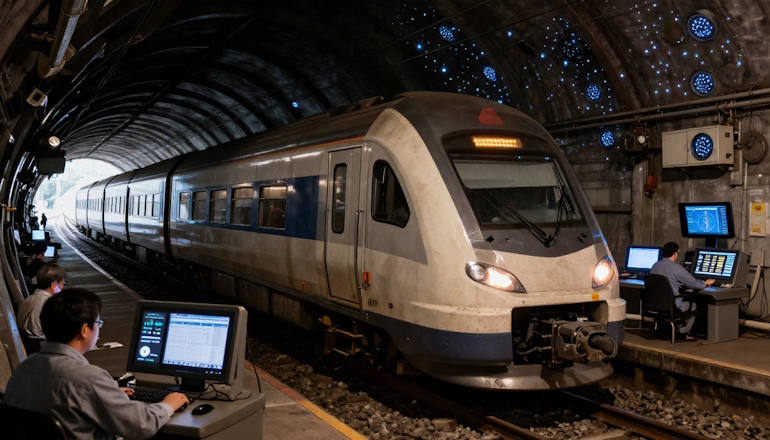
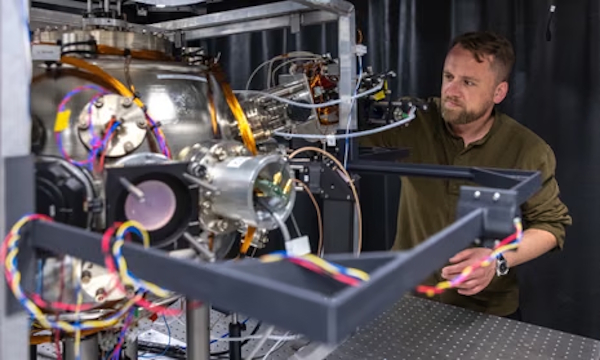
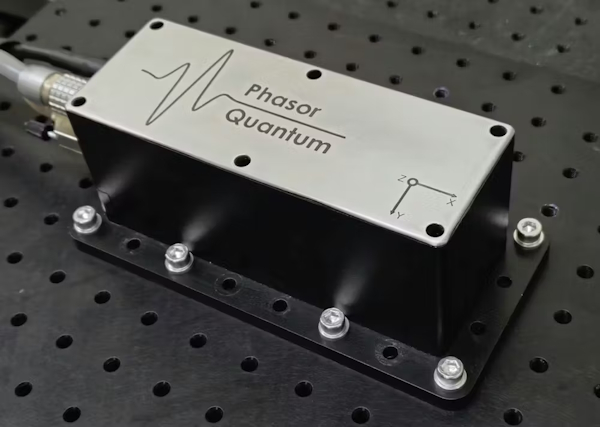
Quantum navigation is not science fiction, and it is not a one-click replacement for GPS. It is a set of technologies that help determine position, speed, and direction without relying constantly on satellites, which makes it especially useful where the signal is weak, jammed, or simply unavailable. In the UK, these solutions have already moved beyond the lab and into transport trials: a quantum sensor was installed on a moving train, and in 2024 flight tests of a quantum navigation system with an inertial sensor and atomic clocks were also carried out there.
What Is Quantum Navigation?
Put simply, quantum navigation is a way to “feel” motion with very high precision.
Traditional navigation often depends on satellites, while quantum sensors try to measure the motion of the object itself: acceleration, rotation, changes in the gravitational field, or time. That is why this technology is being considered as a backup for trains, airplanes, underground routes, and other places where satellite navigation becomes unreliable.
This is not built around one device, but around an entire class of solutions: quantum accelerometers, gyroscopes, magnetometers, gravimeters, and ultra-precise atomic clocks. Some measure acceleration and rotation, others help build magnetic or gravitational maps of the area, and others keep time with extreme stability. In transportation, that combination is especially interesting because it offers a way to build a more resilient positioning system instead of depending on a single data channel.
The practical value of the technology is easiest to see in places where regular signals fail first: tunnels, underground spaces, inside buildings, underwater, or in dense urban environments. British research groups have been saying directly that quantum sensors can significantly improve location tracking in these conditions, while also strengthening inertial navigation and map-matching against real terrain.
But one thing is important to understand: this is not yet a finished mass-market system for everyone. According to official and industry assessments, quantum inertial sensors are still at the early prototype stage, and many applications still need to be tested further in real-world conditions. So right now the goal is not to “remove GPS from the world map,” but to create a more resilient hybrid navigation system where quantum components support classical ones.
In the UK, that logic is already being tested in practice. The government and research infrastructure are investing in quantum solutions for positioning, navigation, and time synchronization, and the transport sector is seen as one of the main areas of use. This is not random interest in a trendy topic. It is an attempt to prepare in advance for a system that will keep working where satellites fail or become vulnerable.
How Can Quantum Navigation Be Better Than GPS, and Where Are Its Weak Spots?
The biggest advantage of quantum navigation is independence from satellite signals.
GPS and other GNSS systems can be blinded, jammed, or simply lost in tunnels, indoors, in dense city blocks, or in interference-heavy areas.
Quantum solutions, especially inertial and magnetic-gravitational ones, are designed exactly as a backup layer: a more resilient navigation layer that does not depend on an external radio signal.
The second advantage is resistance to interference and spoofing. For transportation and defense scenarios, that is critical: if a system does not need a satellite signal every second, it is harder to take down with ordinary electronic warfare. That is why official UK statements describe quantum PNT systems as an additional layer of security and resilience, not as a decorative add-on to existing navigation.
But the weak points are still more numerous than marketing decks suggest.
Quantum inertial sensors are still at an early prototype stage, and real-world deployment still has to solve issues of size, power consumption, cost, reliability, installation, and platform integration.
Even when a sensor delivers excellent measurements, practical value can still be limited not by physics, but by how well the device is engineered into a usable product.
There is also another limitation: quantum navigation is almost certainly not going to replace GPS entirely. It is more likely to become part of a combined system where satellites, inertial sensors, terrain maps, and quantum sensors all work together. That is the more realistic scenario, because it provides accuracy, resilience, and a fallback channel if something fails. That is how researchers and transport programs in the UK are viewing the technology today.
Welcome to Poznayu.com!
My name is Alex, and I founded this project together with a team of like-minded professionals. At Poznayu.com, we create in-depth reviews, explore fascinating facts, and share well-researched, reliable knowledge that helps you navigate complex topics with confidence.
Our mission is simple: to explain complicated ideas in clear, accessible language. We believe that high-quality information should be available to everyone. Every article we publish is designed to provide practical value, actionable insights, and trustworthy analysis you can rely on.
Join our growing community of curious readers. Your feedback matters — share your thoughts in the comments, ask questions, and suggest topics you’d like us to cover next.