Let’s break down a two-year beginner program built around barbells and dumbbells, examine exercise biomechanics, and look at a beginner’s long-term progression.
Load progression in this program follows the principle of double progression: first, you increase training volume within a set rep range, then you increase the weight.
For example:
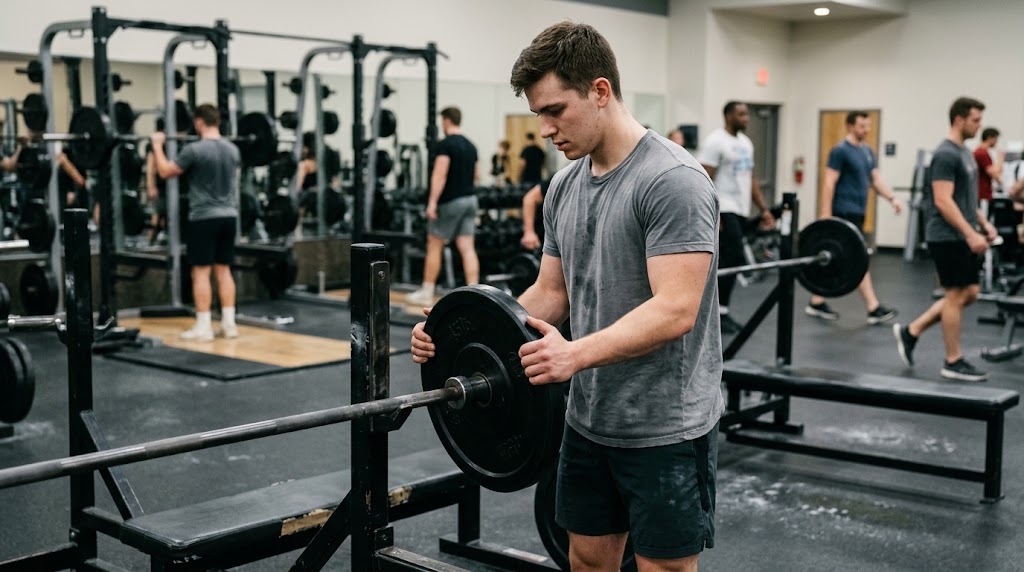
Choose a target rep range (for example, 8–10 reps) and a fixed working weight that allows you to perform 3 sets of 8 while keeping 1–2 reps in reserve (RIR 1–2) and avoiding sloppy failure.
From workout to workout, aim to add one rep to each set. Once you can confidently complete 3×10 with flawless technique, increase the weight by the smallest available increment at the next session — 2.5 kg for heavy compound lifts such as squats and bench presses, or 1–1.5 kg using small plates for shoulder exercises and rows.
When linear progress inevitably runs into a strength plateau, do not sacrifice biomechanics just to squeeze out another rep. Follow the planned deload week by reducing working weights by 15–20% and cutting volume, then restart the cycle with gradual increases. This lets you methodically move past previous bests without injuring the joints or overstressing the nervous system.
Free weights do not forgive mistakes and force the body to work as one integrated system.
Unlike machines with a rigid, fixed movement path, barbells and dumbbells require constant control of balance through space. A beginner’s brain has to build new neural connections as hundreds of small stabilizing muscles and the entire musculoskeletal system engage almost instantly.
For example, a single compound squat or bench press can load up to 80% of the body’s muscle mass in one set. That produces a huge systemic response, strengthens the joints, and teaches the nervous system to recruit muscle fibers efficiently in a way no cable machine can replicate.
What I mean is:
Isolation machines train a single muscle in an artificial vacuum.
Free weights build genuine functional strength and establish a massive foundation for years to come.
Barbell Bench Press
Barbell Bench Press on a Flat Bench is a fundamental compound exercise that builds the foundation of the shoulder girdle and the entire front side of the upper body.
Proper technique requires firmly retracting the shoulder blades, creating a natural upper-back arch, and driving hard through the feet into the floor, turning the movement into a full-body strength test. For a beginner, the bench press matters not only as a hypertrophy tool but also as a primary exercise for developing the mind-muscle connection and maintaining shoulder-joint stability under axial and shear loading.
Anatomically, the primary target is the pectoralis major, with greater emphasis on its powerful sternocostal portion.
The key synergists are the anterior deltoid and triceps, which handle the final lockout phase. The serratus anterior, latissimus dorsi, and deep core muscles act as stabilizers, keeping the torso firmly positioned on the bench throughout the movement.
Barbell Bent-Over Row With Overhand and Underhand Grips
Bent-Over Barbell Row is a foundational horizontal pulling movement that builds thickness and definition throughout the dense musculature of the back.
Changing the grip significantly alters the loading pattern: an overhand grip (pronated) places more emphasis on the upper traps, rhomboids, and rear delts, while an underhand grip (supinated) shifts more focus toward the lower portions of the lats and substantially increases the biceps’ leverage. The lifter must hold the torso in a static bent-over position through isometric tension in the hamstrings and glutes, which also develops core stability.
The primary movers are the latissimus dorsi, rhomboids, and middle and lower portions of the trapezius.
The rear delts, brachialis, and biceps provide additional dynamic assistance. Powerful spinal erectors keep the spine rigid while the torso remains bent under constant load.
Seated Barbell Overhead Press
Seated Barbell Overhead Press isolates the work of the shoulder girdle, eliminating cheating and leg drive that can be used during standing presses.
A seated position with firm bench-back support reduces shear stress on the lower back, allowing beginners to focus on pressing the weight overhead along a strictly vertical path. The exercise develops proper humeral movement mechanics within the shoulder joint and builds dense, muscular shoulders.
The primary muscles doing the work are the anterior and lateral deltoid heads, along with the upper clavicular portion of the pectoralis major.
At the top of the movement, the triceps become heavily involved in extending the elbow, while the upper trapezius helps secure and stabilize the weight overhead.
Barbell Squats
Barbell Back Squats are a key strength-training exercise that produces the body’s strongest systemic anabolic and neuromuscular response.
For a beginner, the squat becomes a primary test of ankle and hip mobility as well as the rigidity of the spinal stabilizers. Proper squat depth (until the thighs reach parallel to the floor) ensures an even distribution of force between the knees and hips without dangerously shifting the load onto the ligaments.
The main loading falls on the quadriceps and gluteus maximus. The adductors, hamstrings, and soleus also contribute significantly as synergists.
The rectus abdominis and obliques, together with the deep spinal extensors, form a rigid muscular brace that keeps the weight from pulling the torso forward.
Barbell Upright Row to the Chest
Barbell Upright Row Along the Torso (Standing Barbell High Pull to the Chest) is intended to place focused emphasis on the lateral deltoids, which contribute to the visual width of the shoulders.
The key technical point for a beginner is to raise the weight only to about mid-chest level while driving the elbows out to the sides and upward, without bringing them above shoulder-joint level. Limiting the range of motion in this way protects the glenoid labrum and rotator cuff from impingement.
The main load is handled by the lateral deltoid, working together with the anterior deltoid and upper trapezius.
The brachioradialis, brachialis, and biceps assist by flexing the elbows.
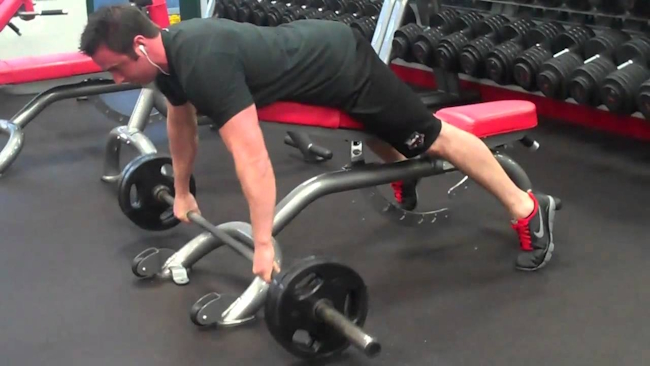
Barbell Row to the Upper Chest on an Incline Bench
Incline Bench Barbell Row largely removes axial loading from the lower back because the chest is firmly supported.
I included the photo specifically because many people are simply unfamiliar with this exercise.
Pulling the weight toward the upper chest or throat makes the upper shoulder girdle work from an angle that is difficult to target with conventional compound rows. Because the lifter cannot use momentum from the torso, this exercise is ideal for correcting posture and building the rear delts.
The primary target muscles are the rear delts, teres minor and teres major, and infraspinatus.
The rhomboids and middle trapezius contract strongly alongside them, pulling the shoulder blades together at peak contraction.
Single-Arm Dumbbell Row
One-Arm Bent-Over Dumbbell Row With Bench Support lets you train each side of the body separately and correct strength imbalances.
Supporting one knee and one hand on the bench reduces pressure on the intervertebral discs, allowing controlled work through a larger range of motion. The lifter can deeply stretch the lat at the bottom and contract it maximally at the top by driving the elbow back.
The main focus is the latissimus dorsi along its full length. The rear delt, rhomboid, teres major, and forearm flexors also contribute.
The abdominal muscles work in a deep anti-rotation role, preventing the torso from twisting.
Summary Table of Working Muscles
For clarity, I put all of the working muscles into a single table. Also pay attention to the assisting muscles and stabilizers:
Exercise
Primary Target Muscles
Assisting Muscles and Stabilizers
Barbell Bench Press
Pectoralis major
Anterior deltoid, triceps, serratus anterior
Bent-Over Barbell Row
Latissimus dorsi, rhomboids
Rear delt, trapezius, biceps, spinal erectors
Seated Overhead Press
Anterior and lateral deltoids
Triceps, upper trapezius, upper chest
Barbell Squats
Quadriceps, gluteus maximus
Adductors, hamstrings, abs, spinal erectors
Upright Row to the Chest
Lateral deltoid, upper trapezius
Anterior deltoid, brachialis, brachioradialis
Incline Bench Row to the Upper Chest
Rear delts, rhomboids, infraspinatus
Middle/lower trapezius, teres major, biceps
Bent-Over Dumbbell Row
Latissimus dorsi
Rear delt, teres major, biceps, core muscles
Benefits of Training Three Times a Week
A training protocol performed three times a week using the exercises above fits the physiology of a beginner especially well.
For a beginner, the key driver of growth is not a huge amount of work for a muscle group in one session, but the frequency with which muscle protein synthesis is stimulated, remaining elevated for about 48–72 hours after a session. Distributing compound movements across three weekly workouts allows large muscle groups to be trained at an effective frequency without overloading the central nervous system and while providing enough time for the joints and connective tissues to recover fully.
In addition, this exercise selection eliminates unnecessary volume and keeps the focus on mastering fundamental movement patterns: pressing, pulling, and squatting.
Repeatedly practicing these demanding biomechanical movements while fresh accelerates intermuscular coordination. The lifter learns to recruit fast-twitch muscle fibers efficiently, supporting steady linear increases in working weights without slipping into chronic overtraining.
Pharmacological Support
Two years of foundational training builds a strong joint and connective-tissue base while thoroughly establishing technique on the major movements.
With this foundation, the body is already ready to move on to higher-volume splits and handle pharmacological loads without immediately increasing the risk of injury when weights jump.
If a lifter still decides to add minimal-harm pharmacological support (although this is not pharma in the usual sense), I typically prescribe the combination of Cardarine (GW501516) + MK677.
The combination provides good endurance from Cardarine, deep sleep, a constant appetite, and faster recovery through elevated IGF-1 from MK-677:
Over two years, a beginner can reasonably expect increases in size and strength without interfering with the HPG axis, but an “everlasting cycle” protocol is critically dangerous. Here’s why:
Six months of continuous MK-677 will reliably destroy insulin sensitivity and push you into prediabetes — a one-month break will categorically not be enough to normalize blood sugar.
Such extremely long Cardarine cycles also carry direct carcinogenicity and toxicity risks, so instead of ending up with a lean physique, you can easily end up bloated with water and with a damaged metabolism.
Classic PCT is not required for testosterone because these drugs do not suppress the HPG axis, but even with a schedule such as 3 months on and 1.5 months off, strict monitoring of blood glucose and insulin is still necessary.
Two-Year Horizon: Weight Progression and Anatomical Expectations
Based on my own practice, I can describe what a beginner can expect after two years of following the program consistently.
Over two years of systematic progressive overload, a beginner moves from learning the mechanics of each exercise to building a serious athletic foundation.
During the first year, progress comes primarily from nervous-system adaptation: working weights in the squat and bench press may increase by 70–100%, while reps stabilize at around 8–12 clean repetitions with 1–2 reps left in reserve. The key is not to force heavier weights at the expense of range of motion, but to keep a detailed training log and track progress in short microcycles.
By the end of the second year of consistent training, an athlete can expect a substantial change in body composition: an increase of 8–12 kg of lean muscle mass along with greater bone and ligament density. With average genetics and proper nutrition, working-weight benchmarks for 8–10 repetitions generally reach the following levels: bench press — 1.0–1.2 times body weight, squats — 1.3–1.5 times body weight, bent-over row — 0.9–1.1 times body weight.
This kind of foundation supports balanced development, a pronounced V-shaped physique, and strong posture.
Dmitry Volkov – is the author of our bodybuilding section is a practicing sports medicine physician based in Dallas, Texas, with 21 years of hands‑on experience in sports pharmacology. At 42, he combines deep academic knowledge with real‑world expertise gained from coaching athletes of all levels — from amateurs to seasoned competitors. He earned his medical degree from a leading Texas institution and spent years working in sports medicine clinics and private practice.
His primary focus is hormonal regulation of muscle growth, the use of anabolic steroids and peptides, and post‑cycle recovery. He understands modern protocols inside out because he consults real people every day, helping them avoid side effects and achieve safe results. His approach is rooted in evidence‑based medicine, yet remains grounded in the realities of both amateur and professional sports.
In his articles, he aims to debunk myths and deliver clear, scientifically sound recommendations. Every piece of content is vetted not only by medical knowledge but also by years of clinical observation. He firmly believes that responsible pharmacology requires a solid grasp of biochemistry, respect for one’s body, and regular medical monitoring — and he works hard to convey these principles in a way that is both accessible and actionable for his readers.