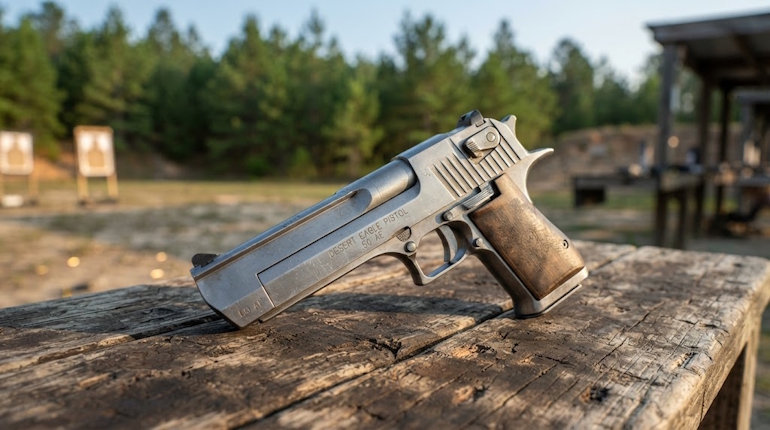
The real-world purpose of the Desert Eagle handgun is starkly different from the legendary myth created by Hollywood movies and the video game industry.
Here, we break down the actual intended applications behind this massive Israeli-American powerhouse, why elite special operations units bypass it entirely, and where its true practical value lies.
Engineers never designed this large-caliber firearm for urban firefights; instead, they built it for highly specialized shooting tasks demanding extreme muzzle energy. Cutting through the Hollywood hype reveals the true engineering purpose behind this iconic hand cannon.
The U.S. military strictly rejects the Desert Eagle due to its complete tactical impracticality in combat scenarios, where reliability, low weight, and magazine capacity are paramount. Tipping the scales at over four and a half pounds unloaded, it weighs more than double the standard-issue SIG Sauer M17 while holding only 7 to 9 rounds compared to a standard 17-round magazine. Its gas-operated rifle action is hypersensitive to field dirt, trench dust, and powder residue, leading to immediate jams in harsh environments. Furthermore, massive recoil prevents rapid follow-up shots, an immense muzzle flash blinds shooters in low light while washing out night vision gear, and excessive Magnum penetration poses severe ricochet hazards during close-quarters room clearing.
Design Features and Firearm Architecture
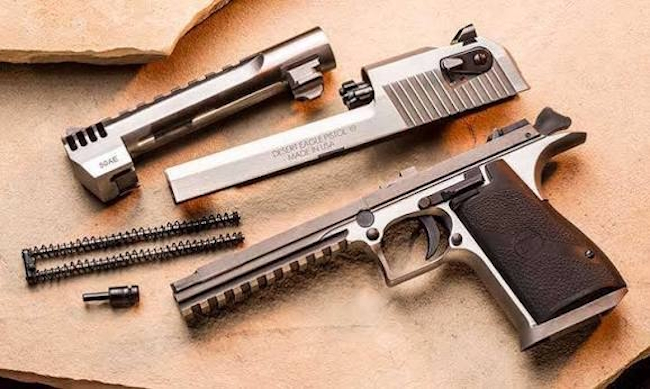
What makes the Desert Eagle unique is an operating system borrowed from gas-operated rifles rather than traditional handguns.
Instead of standard short-recoil or blowback designs found in conventional handguns, this pistol uses a gas-piston mechanism with a rotating bolt locking system. Designers at Magnum Research and Israel Military Industries engineered this heavy-duty system for one specific goal: taming the tremendous chamber pressure and recoil of Magnum revolver cartridges. The beefy steel frame and fixed barrel act as essential counterweights, without which controlling the handgun safely would be nearly impossible.
True Purpose: Hunting and Target Shooting
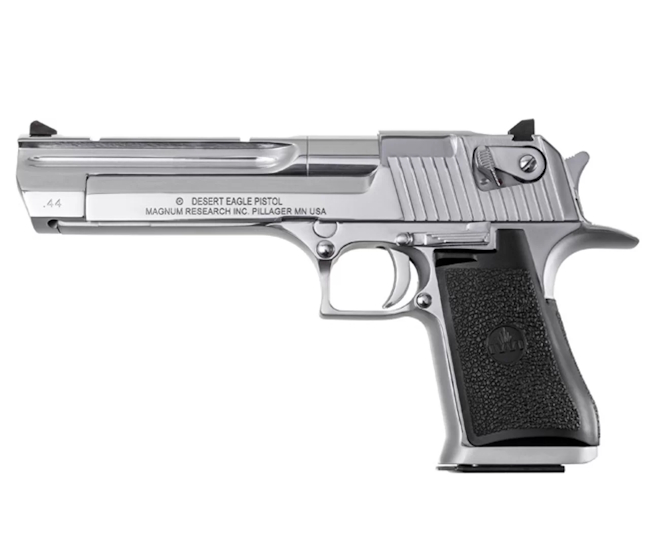
In reality, the primary practical niche for the Desert Eagle has always been handgun hunting and metallic silhouette target shooting.
In the United States, where the handgun hunting concept originated, taking big game with heavy Magnum rounds has a rich history, but revolvers are inherently limited by slower reloads and cylinder capacity. The Desert Eagle delivered rifle-like firepower in a semi-automatic platform, enabling hunters to take down game confidently at ranges up to 100 yards. Examining its hunting applications highlights several distinct advantages over traditional field firearms:
-
Delivering maximum stopping power during close encounters with dangerous big game, such as wild boar or bears, in thick cover.
-
Enhancing maneuverability through dense brush and heavy timber where long hunting rifles constantly snag on foliage.
-
Allowing secure mounting of optics and red dot sights directly onto the rigid, non-tilting fixed barrel.
Debunking the Tactical Myth
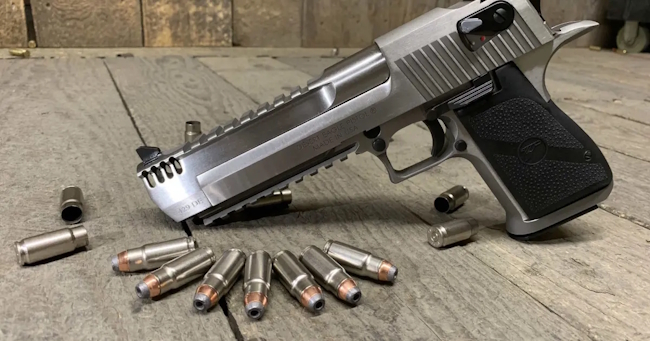
Despite its intimidating looks, no standard military force or police SWAT unit in the world has ever adopted the Desert Eagle as an official service sidearm.
In combat situations, its chief drawbacks are prohibitive weight, low magazine capacity, blinding muzzle flash, and high susceptibility to fouling. When exposed to mud, sand, or grit, its intricate gas-operated action routinely malfunctions—a dealbreaker for any combat sidearm.
Comparing the Desert Eagle to a standard duty pistol clearly highlights the divide between a combat sidearm and a specialized hunting or target gun.
| Feature | Tactical Duty Pistol (e.g., Glock 17) | Desert Eagle (.50 Action Express) |
| Unloaded Weight | ~22 oz (~1.38 lbs) | 4.4+ lbs |
| Magazine Capacity | 17 rounds | 7 rounds |
| Primary Role | Combat, self-defense, law enforcement | Hunting, target shooting, range fun |
| Dirt & Foul Tolerance | High; reliable in extreme conditions | Low; gas system requires pristine clean conditions |
Calibers and Ballistic Potential
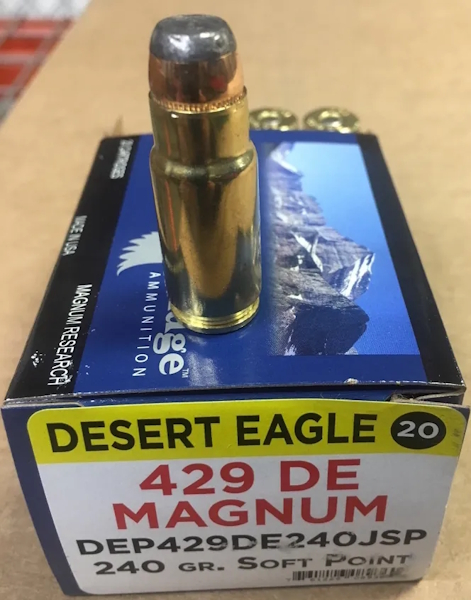
A modular caliber design and massive stopping power drive both the commercial success and engineering legacy of the Desert Eagle platform.
Engineers originally built the handgun around the .357 Magnum, later expanding to .44 Magnum before reaching legendary status with the massive .50 Action Express (.50 AE). The modular design lets owners swap calibers in seconds at the range by changing the barrel, magazine, and bolt assembly. Generating over 1,500 ft-lbs of muzzle energy (2,000+ Joules), the .50 AE cartridge produces energy on par with rifle rounds, earning the gun its reputation as a hand cannon.
Range Shooting and Plinking
Beyond hunting, many owners purchase the Desert Eagle simply for range shooting, target plinking, and pure adrenaline. Firing a .50 AE round delivers a blast, muzzle flash, and recoil impulse unmatched by any standard handgun. On the firing line, it serves as a bold status symbol and a tough test of grip technique.
Owning one means holding a unique piece of firearms engineering—one that punishes weak grip control and demands solid technique to prevent limp-wristing malfunctions.
Pop Culture and Media Impact
Popular culture played a decisive role in establishing the iconic status and commercial success of the Desert Eagle on the civilian market.
In the 1990s, Hollywood directors wanted the biggest, most intimidating handgun for action heroes and villains, and the Desert Eagle’s hard-edged profile fit the bill perfectly. Iconic appearances in films like Predator 2, The Matrix, and Snatch, along with games like Counter-Strike, skyrocketed civilian sales and cemented its reputation in pop culture. This transition from niche field tool to global media icon followed a clear trajectory:
-
Designing a specialized firearm exclusively for handgun hunters and metallic silhouette target shooters.
-
Adoption by film studios seeking an imposing visual prop to build larger-than-life action characters.
-
Widespread inclusion in video games, where programmers assigned it massive stopping power while minimizing realistic downsides like weight and heavy recoil.
Desert Eagle vs. Magnum Revolvers
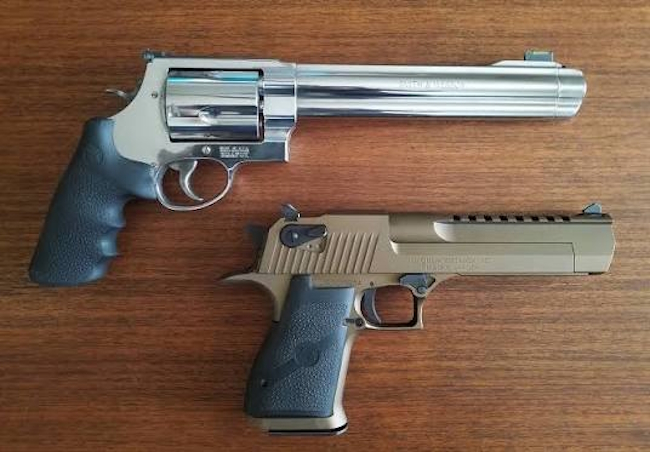
Comparing the Desert Eagle to high-powered hunting revolvers like the Smith & Wesson Model 500 or long-barreled Magnum revolvers highlights key differences in design and ballistics.
Heavy-caliber hunting revolvers excel when pursuing dangerous game like grizzly bears, moose, or large predators, often serving as sidearms in backcountry wilderness areas.
Unlike the semi-automatic Desert Eagle, heavy revolvers deliver exceptional mechanical reliability, avoiding feed jams or gas-system carbon buildup. Their solid frame design handles immense pressures that would overwhelm semi-automatic actions, giving them an advantage in raw muzzle energy and penetration with extreme loads.
The table below compares key ballistic specs and intended uses across major large-caliber handgun systems.
| Firearm Model & Caliber | Bullet Diameter | Muzzle Velocity | Max Muzzle Energy | Primary Hunting Target |
| Desert Eagle (.50 AE) | .50 in (12.7 mm) | ~1,475 fps (450 m/s) | ~1,600 ft-lbs (2,200 J) | Large boar, deer, medium game |
| S&W Model 500 (.500 S&W Mag) | .50 in (12.7 mm) | ~2,060 fps (630 m/s) | ~3,000+ ft-lbs (4,100 J) | Grizzly bear, moose, Cape buffalo |
| S&W Model 29 (.44 Mag, Long Barrel) | .429 in (10.9 mm) | ~1,540 fps (470 m/s) | ~1,200 ft-lbs (1,650 J) | Deer, wild hogs, wolves |
Bottom Line: The Real Desert Eagle
Ultimately, the Desert Eagle is not a combat sidearm in any tactical sense of the word:
-
It is a specialized hunting and target firearm, a unique mechanical achievement, and a prime example of how Hollywood can shape public perception of firearms.
-
Its true niche belongs in the field for hunting game and at the shooting range, where high muzzle energy takes precedence over tactical agility and low weight.
-
This four-pound steel hand cannon remains one of the most iconic firearms ever produced—never winning a war, yet capturing global attention.

Welcome to Poznayu.com!
My name is Alex, and I founded this project together with a team of like-minded professionals. At Poznayu.com, we create in-depth reviews, explore fascinating facts, and share well-researched, reliable knowledge that helps you navigate complex topics with confidence.
Our mission is simple: to explain complicated ideas in clear, accessible language. We believe that high-quality information should be available to everyone. Every article we publish is designed to provide practical value, actionable insights, and trustworthy analysis you can rely on.
Join our growing community of curious readers. Your feedback matters — share your thoughts in the comments, ask questions, and suggest topics you’d like us to cover next.