On February 28, 2026, Israel and the United States launched joint strikes on Iran, moving the conflict into an open phase of full-scale combat operations. The Israeli operation Roaring Lion and the American Epic Fury have already triggered explosions across Tehran, Isfahan and other key cities.
In this article we examine the real picture on the ground, the military balance of forces, and what the coming months may actually bring.
The strikes began in the morning local time and quickly spread across several Iranian regions. Israeli and U.S. forces concentrated on military sites, command posts, and missile-program infrastructure. Tehran responded with ballistic-missile salvos aimed at Israel and American bases in the Persian Gulf, setting off air-raid sirens and interception systems.
This escalation follows months of tense negotiations that produced no compromise. Iran continued uranium enrichment and support for its proxy militias, actions that Israel and the United States viewed as direct threats. Today’s events are the logical continuation of the short June 2025 war, when nuclear facilities were already targeted.
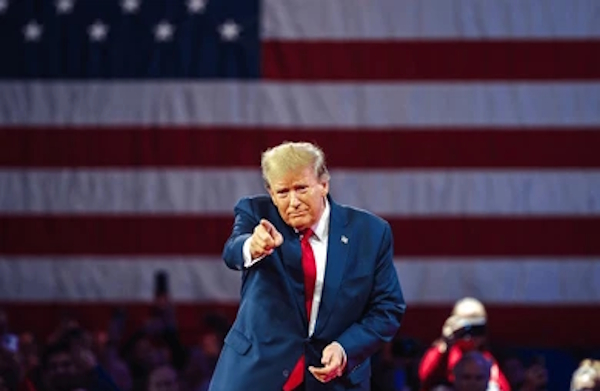
While exact casualty and damage figures are still limited, one thing is clear: both sides are prepared for a sustained exchange of blows. Iran has pledged a strong response, and President Trump has openly urged Iranians to overthrow their regime.
Key Iranian Figures — Killed
Trump Announces Elimination of Key Iranian Regime Figures.
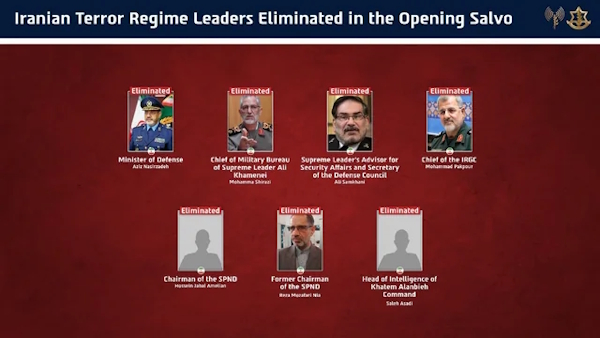
Israel and the United States carried out precise strikes on Iranian military targets, killing seven top regime figures in a single coordinated operation.
Among them are the closest advisor to Supreme Leader Ayatollah Ali Khamenei, Ali Shamkhani, and the commander of the Islamic Revolutionary Guard Corps, Mohammad Pakpour.
Among those killed:
Ali Shamkhani, the Supreme Leader’s chief advisor who for years coordinated national security and foreign policy.
Mohammad Pakpour, commander of the IRGC — he headed Iran’s most powerful military force.
Saleh Asadi, head of intelligence.
Mohammad Shirazi, head of the military bureau.
Aziz Nasirzadeh, defense minister.
Hossein Jabal Amelian, head of the defense innovation and research organization.
Reza Mozaffari-Nia, former head of the nuclear weapons program.
These men formed the real backbone of the regime. Each one was responsible for critical areas — from missile programs to internal security. Their sudden loss leaves the entire system without experienced leadership exactly when external pressure is at its peak.
The elimination of seven key regime figures, including Ali Shamkhani and IRGC commander Mohammad Pakpour, will create a serious leadership vacuum and temporary paralysis in the chain of command. In the coming weeks Tehran will face chaos in coordination between the IRGC, regular army and intelligence services, a sharp rise in internal power struggles among surviving factions, and a noticeable drop in operational effectiveness. This will seriously weaken the ability to respond quickly to new strikes and may trigger a chain reaction of mistakes at the very moment when the country is under maximum pressure.
We assess the probability of the regime falling in the next 1–2 months at 35–45 %. The system is still holding thanks to its repressive apparatus and deep ideological hardening, but such a direct blow to the head has already badly damaged legitimacy and control. If the air strikes continue, the economy collapses completely and mass protests erupt on the streets, then by summer 2026 the chances of deep collapse or regime change could easily rise above 60 %.
Most likely this is not an instant end, but the beginning of a long and painful agony for the current Iranian regime.
Israel’s Military Power and Technological Advantage
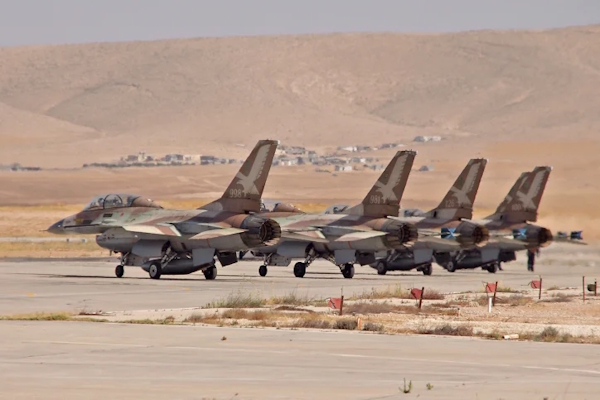
Israel possesses one of the most modern militaries in the region, where quality superiority over sheer numbers is decisive. Its Air Force operates hundreds of advanced fighter jets that enable precise deep strikes. Multi-layered air-defense systems have repeatedly proven effective against missile threats.
The ground forces are compact yet highly motivated and well-trained. Reserves can be mobilized within hours, giving Israel the ability to scale up rapidly. Superior intelligence and cyber capabilities allow preemptive targeting and significantly reduced own losses.
Compared with Iran, Israel has fewer tanks and artillery pieces, but it compensates through precision, coordination and technology. This edge is clearly visible in the current operation, enabling strikes with minimal risk to pilots.
What Trump Has Assembled Around Iran and the U.S. Role
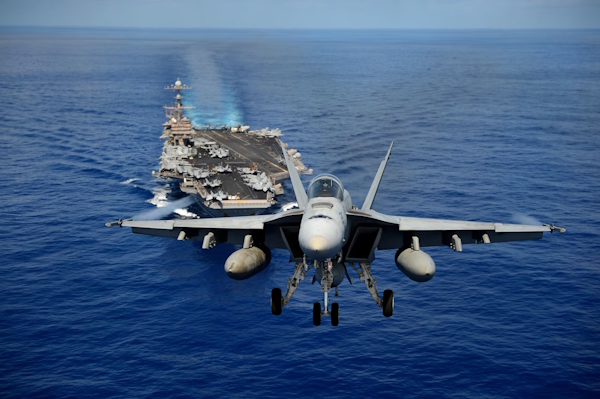
President Trump has positioned substantial U.S. forces in the region, including multiple carrier strike groups and additional air squadrons. A broad Arab coalition similar to previous conflicts has not materialized. Gulf states are largely adopting a wait-and-see posture and have already felt the impact of Iranian retaliatory missiles.
American support for Israel is direct — joint planning, intelligence sharing and active participation in strikes. The United States has taken responsibility for suppressing Iranian air defenses and naval assets, leaving Israel to focus on high-value command targets. This division of labor helps manage risk and maintain sustained pressure.
Even without large-scale regional backing, American military power alone creates a decisive advantage. Trump has spoken openly not only about destroying Iran’s missile capabilities but also about giving the Iranian people a chance for internal change. Such rhetoric intensifies pressure while raising the stakes.
The Power of U.S. Carrier Strike Groups
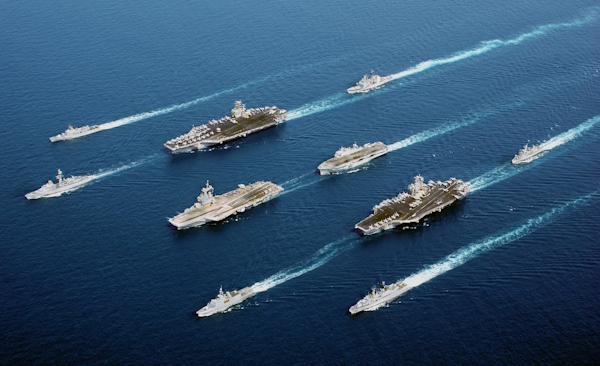
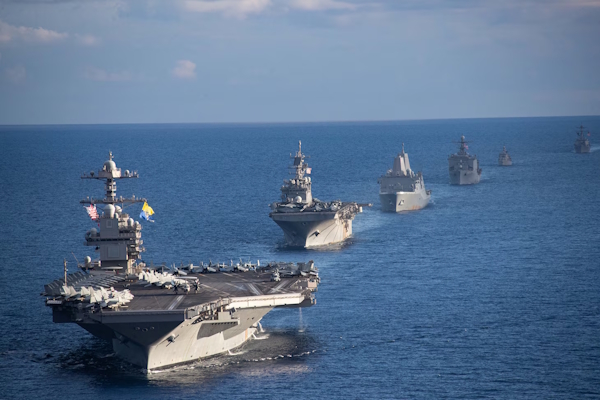
The United States operates carrier strike groups as a universal tool for power projection. Each group combines an aircraft carrier with its full air wing, air-defense cruisers and destroyers, multi-mission attack submarines, and replenishment tankers. This mix delivers simultaneous air superiority, land strikes, anti-ship warfare, and intelligence collection—all with high mobility and minimal dependence on shore bases.
In essence, a carrier strike group is a floating airbase complete with its own defense and logistics systems, able to operate hundreds of nautical miles from the nearest land facility.
The three combat-ready carrier strike groups now positioned near Iran create a serious tactical and operational buffer. They support continuous air operations, distribute missions across strikes, combat air patrols, and reconnaissance, and can back large-scale naval blockades or amphibious actions if required. With aircraft rotation and at-sea replenishment, these three groups give commanders the option for sustained presence and multi-domain campaigns—some assets stay on station while others rotate in, ensuring long-term endurance. The presence of three CSGs also strengthens deterrence: the adversary must account for threats from multiple directions and spread its forces, sharply increasing its own logistical and operational costs.
Yet even three carrier strike groups are not invincible. Modern anti-access/area-denial (A2/AD) strategies—long-range anti-ship missiles, coastal missile batteries, and stealthy submarines—pose real dangers, especially in confined waters. Logistics demands, the need for extra air cover, and political limits (port access rights and allied airspace use) further constrain freedom of action. Success depends on seamless integration with coalition forces, intelligence, and land-based support.
In short, three U.S. carrier strike groups are a powerful and flexible power-projection instrument, but one that demands smart tactics, strong support, and honest recognition of its vulnerabilities.
Goals of the U.S. and Israel in This Conflict
The top priority is preventing Iran from acquiring nuclear weapons.
After the 2025 clashes Tehran tried to rebuild its programs; current strikes aim to set those efforts back years.
Missile production and naval forces are also key targets because they threaten shipping lanes and regional partners.
Israel sees Iran as an existential danger and acts preventively. For the United States, maintaining the regional balance and limiting Iran’s proxy influence is essential. Regime change is not officially the stated goal, but Trump’s wording strongly implies that weakening the current government would help everyone.
Are these goals fully reachable? Infrastructure strikes can delay nuclear and missile work for years, but erasing hidden knowledge and facilities is extremely difficult. Political change will ultimately hinge more on internal Iranian dynamics than on outside military pressure.
Iran’s Capabilities and Its Response
Iran holds a large arsenal of ballistic missiles and drones that can reach distant targets. Its regular army and paramilitary forces give it the ability to drag out the conflict through attrition. Proxy groups remain tools for asymmetric counterattacks.
However, the regime is already strained by the previous war, sanctions, and domestic unrest. Command structures have been hit by precision strikes. So far retaliatory missile salvos look mostly demonstrative, but they could escalate into major attacks on oil infrastructure.
Iran hopes for outside help, yet major military aid from big powers has not appeared. Tehran is largely relying on its own resources and a strategy of endurance.
Our View of What Is Happening
This conflict did not come out of nowhere—it is the result of years of genuine confrontation where each side believes its actions are defensive. Israel and the United States are protecting their vision of regional security; Iran is defending its sovereignty and influence. Today’s strikes show that diplomatic patience has ended and force has taken over.
We see a classic pattern: the side with technological superiority tries to solve the problem with one decisive blow, while the more resilient but less advanced side tries to prolong the fight and find weaknesses.
Right now the advantage sits with the U.S.-Israel coalition, but wars rarely follow the script exactly.
Internal instability inside Iran could prove decisive. If protests flare up during the strikes, the regime will face pressure from both sides. Yet history teaches that outside aggression often unites a nation around its leaders, at least in the short run.
Forecast for Conflict Development
Expect a continued air campaign in the coming weeks.
The U.S. and Israel will systematically destroy identified targets while Iran replies with missiles and activates proxies.
A full-scale ground invasion remains highly unlikely due to enormous risks and lack of political backing.
The conflict may settle into a prolonged phase of strikes and counter-strikes where economics and international diplomacy grow in importance. Oil prices are already climbing, pushing many players toward de-escalation.
Our forecast: the most intense phase will last two to six weeks. After that, a mediated ceasefire becomes probable once Iran suffers major damage to its military infrastructure.
Approximate End Date and Goal Achievability
Based on patterns from earlier escalations, active combat could ease by May or June 2026. Both sides will have used up part of their stockpiles and will face growing international pressure. A complete end to hostilities is unlikely; a new frozen status quo on revised terms is more realistic.
Goals on the nuclear program look achievable in the medium term—development can be pushed back several years. Completely eliminating missile capabilities is unrealistic, but substantially degrading them is possible. Regime change remains the toughest objective and will depend far more on internal Iranian processes than on external force alone.
In the end the conflict will most likely produce a new balance: Iran significantly weakened yet still able to retaliate. This may bring temporary calm, but it will not erase the region’s deep contradictions.
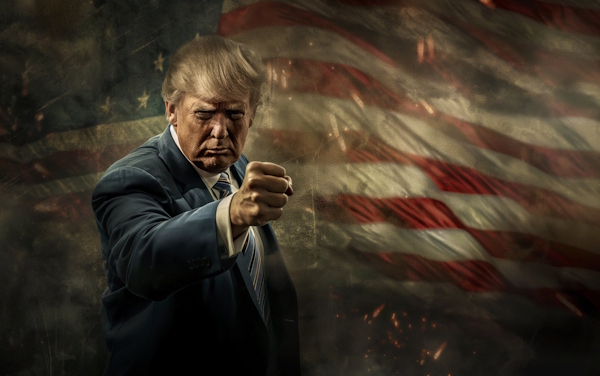
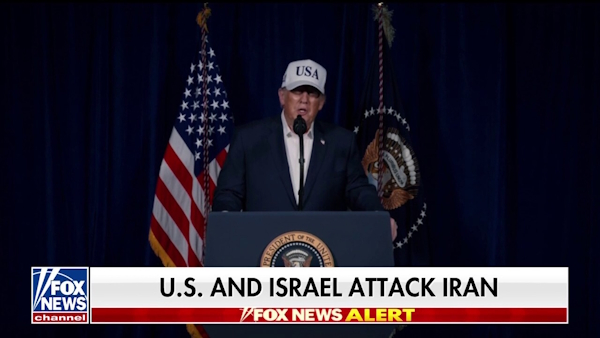
Donald Trump’s Speech (February 28, 2026)
In his address on February 28, 2026, Donald Trump delivered a characteristically blunt, confident, and unmistakably aggressive speech, officially announcing the start of “major combat operations” by the United States against Iran.
He justified the strikes as a necessary step to eliminate the immediate threat from what he called a “terrorist regime.” Trump went through the full history of Iranian attacks on American interests over the past decades and once again declared in no uncertain terms that Iran will never be allowed to obtain nuclear weapons.
The most powerful moment was his direct appeal to the Iranian people. Trump essentially called on them to overthrow their current government, saying “the hour of your freedom has arrived.” He advised civilians to stay in shelters during the strikes and then take their country into their own hands once the operation is over. The speech combines fierce military resolve, sharp accusations against the regime, and a clear attempt to split Iranian society — the classic Trump blend of raw power and psychological pressure, where he showcases overwhelming American strength while planting doubt inside Iran.
Constructing the Image of the Enemy Trump doesn’t simply say “we have started a war.” He carefully builds the picture of absolute evil. In his words Iran is not a country but a “brutal regime” that has spent 47 years chanting “Death to America” and running a “campaign of bloody terror.” This framing leaves no room for doubt: the target is not the Iranian people — it is evil itself, something that cannot be negotiated with and can only be destroyed.
Emotional Triggers and Historical Memory The speech is packed with specific events that hit Americans hard: the killing of Marines in Beirut, the attack on the USS Cole, and American deaths in Iraq. But the strongest move is tying everything to October 7 and Hamas. By openly calling Hamas an “Iranian proxy” and reminding people of American lives lost, Trump draws a straight line: “Iran is responsible for the horrors you have seen with your own eyes.” This is an extremely effective way to rally public support.
Escalating the Threat The speech builds intensity step by step. It starts with past terrorism, moves to ongoing attacks on Americans, and ends with the nuclear threat. The phrase about “missiles that will soon be able to strike Europe and even America” shifts the conflict from “somewhere far away in the Middle East” to a direct existential danger for every American and European. This is textbook rhetoric: to start a big war, you must convince people it is inevitable and better to act now than wait for the enemy to strike first.
Language of Strength and Inevitability Pay attention to the verbs: “we are wiping them off the face of the earth,” “we are destroying,” “we are denying them any possibility.” There is no room for doubt or hesitation. This is the language of a winner who has already decided the outcome. The message “No one should challenge the strength of the United States Armed Forces” is a warning not only to Iran but to every other major power watching.
Dividing the Regime from the People This is a standard but very important technique. Trump promises the Iranian people “the hour of freedom” and urges them to “take back your government” while the bombs are falling. On one hand, it frames the operation as a liberation mission. On the other, it places the responsibility for regime change squarely on the Iranian population, which psychologically lightens America’s burden for what comes after the war.
What Comes Next for the Region
The region is already feeling the effects: closed airspace, disrupted supply chains, and rising tensions across neighboring countries.
Gulf states are walking a tightrope — afraid of Iran yet unwilling to openly back the strikes. Russia and China are watching closely but have not stepped in with active military support so far.
For ordinary people in Israel and Iran this means fresh fears, economic hardship, and a lot of uncertainty. Long-term peace can only come through genuine dialogue, but right now we are still very far from that point.
In my view, the most important thing right now is to keep a clear, calm perspective and not get swept up in emotions. War is always a tragedy, even when one side believes it is necessary. We will keep following events closely and hope that reason eventually wins over force.
Welcome to Poznayu.com!
My name is Alex, and I founded this project together with a team of like-minded professionals. At Poznayu.com, we create in-depth reviews, explore fascinating facts, and share well-researched, reliable knowledge that helps you navigate complex topics with confidence.
Our mission is simple: to explain complicated ideas in clear, accessible language. We believe that high-quality information should be available to everyone. Every article we publish is designed to provide practical value, actionable insights, and trustworthy analysis you can rely on.
Join our growing community of curious readers. Your feedback matters — share your thoughts in the comments, ask questions, and suggest topics you’d like us to cover next.