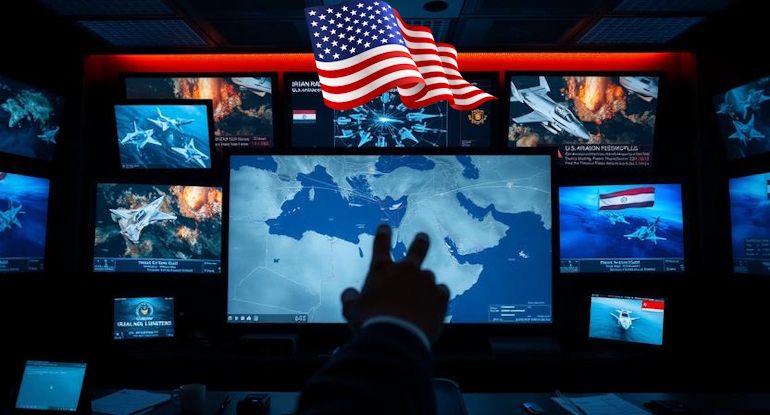
The military defeat of Iran in 2026 serves as a definitive case study on how technological superiority and a sophisticated strategy can dismantle a seemingly formidable military power. Contrary to popular belief, the outcome of the conflict was not determined by the coalition’s overwhelming numbers, but rather by a qualitative gap in military doctrine and technology that the coalition masterfully exploited on the battlefield.
By late April 2026, after seven weeks of combat, it became clear: the Iranian military machine hadn’t just been stalled—it was destroyed at a strategic level. Iran’s Air Defense, Air Force, and Navy were either completely obliterated or rendered entirely non-operational. This collapse across all key domains was no accident; it was the result of the calculated and ruthless execution of the U.S. and Israeli coalition’s strategy.
Dismantling Air Defenses, Air Force, and Navy: The “Wedge” Tactic
The key to breaching Iranian defenses was the massive deployment of precision-guided munitions and SEAD (Suppression of Enemy Air Defenses) tactics. A highly detailed report from the University of Minnesota noted that the USS Abraham Lincoln carrier strike group, operating approximately 700 km off the Iranian coast, launched initial Tomahawk cruise missile strikes well before carrier-based aircraft even reached their targets.
The Air Campaign and Air Defense: During the first month of the operation, the U.S. struck over 1,500 air defense targets, wiping out roughly 80% of Iran’s systems. The Israeli Air Force (IAF) conducted a series of surgical strikes against command centers in Western Iran, completely paralyzing air defense management along strategic corridors.
The Navy: U.S. submarines, destroyers, and aircraft neutralized over 100 Iranian vessels within the first weeks of the war, including almost every major surface combatant equipped with anti-ship weaponry.
By the end of the first month of intensive strikes, air sorties against Iranian military installations became a routine task for coalition pilots with minimal risk. Iran lost not only the ability to strike ships in the Persian Gulf but also the capacity to defend its own airspace. This created a bridgehead for the subsequent total destruction of military assets by ground forces. For the first time in decades, the Iranian command found itself in a position where it had no answer to the technological might of its adversary.
Only Two Carriers and Russia’s Strategic Windfall
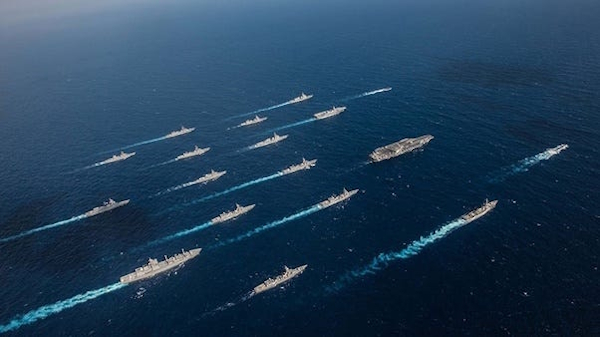
The campaign utilized two Carrier Strike Groups (CSGs) employing a strategy of multi-layered, coordinated strikes.
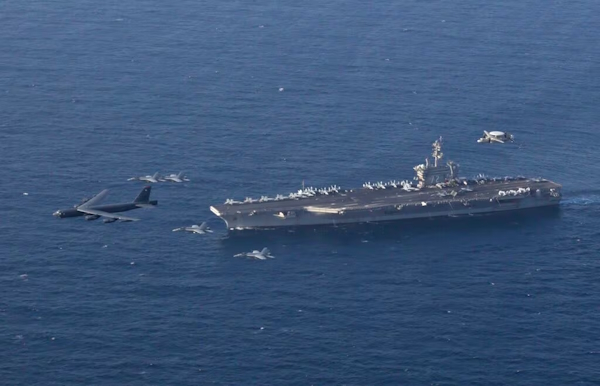
The first echelon—comprised of Tomahawk cruise missiles launched from destroyers and Israeli Air Force strikes—neutralized key communication nodes and early warning systems. The second, more powerful echelon consisted of carrier-based jets and strategic bombers, which delivered the primary blow. This deprived the Iranian command of situational awareness (effectively “blinding” them) and the ability to manage decentralized forces, turning their air defense into isolated pockets of resistance that were systematically eliminated.
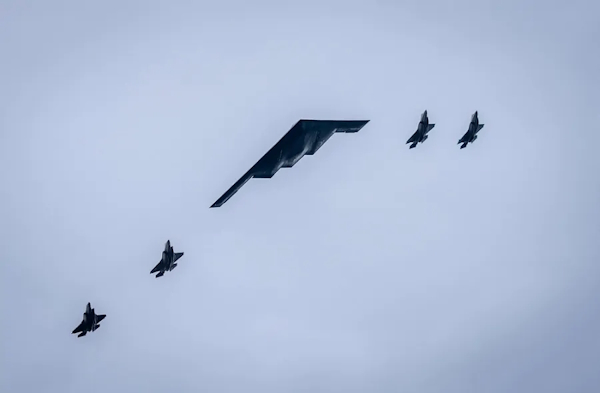
The application of precision-guided munitions and SEAD/DEAD (Destruction of Enemy Air Defenses) technologies was pivotal. Over 50 advanced fighters, including F-22s and F-35s, were tasked with hunting mobile SAM (Surface-to-Air Missile) units, while EA-18G Growlers jammed radar signatures. Iran’s air defense, built around Soviet-era systems (S-300, Tor) and domestic “Bavar” units, could not withstand the massive “swarms” of low-cost kamikaze drones used as decoys to deplete their ammunition. Within the first few weeks, 80% of the air defense infrastructure was gone, ensuring total air superiority.
To defend against Iranian anti-ship and ballistic threats, the coalition utilized a combined, tiered defense. Fighters provided the outer perimeter, intercepting launch platforms, while the inner perimeter was secured by the Aegis Combat System (Standard Missiles 2/3/6) on escort ships and Israel’s David’s Sling and Arrow systems. Once the ground-based tracking stations were suppressed, the effectiveness of Iranian strikes plummeted. The few missiles that managed to leak through failed to penetrate the multi-layered missile defense. Target vessels were destroyed within the opening weeks. Consequently, the Iranian Navy lost all influence over the war, and the leadership was left with zero options for retaliation.
Which Aircraft Carriers Were Involved?
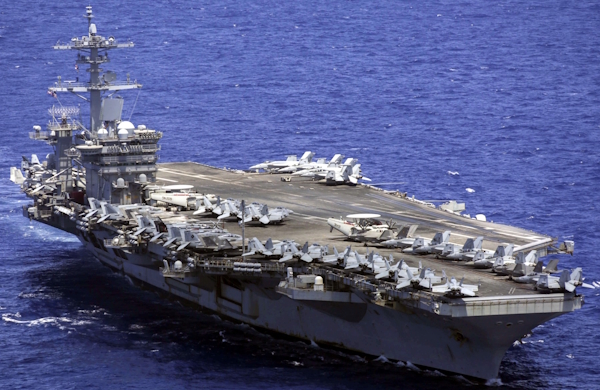
The primary strike group was led by the USS Abraham Lincoln (CVN-72), a Nimitz-class carrier that was already stationed in the Arabian Sea to launch the initial salvos. It was joined by a second group led by the USS Gerald R. Ford (CVN-78), arguably the most powerful carrier strike group in the world. Essentially, Washington assembled an invasion fleet comparable to the task forces of the Persian Gulf War. Deploying two such groups to a single theater isn’t just a show of force—it is a functional application of it. The combined power of the air wings, supported by AWACS, reconnaissance aircraft, and aerial refuelers, operated as a seamless, lethal assembly line, neutralizing any target within a 1,000 km radius.
Russia’s Benefit from the Conflict
While the U.S. and Israel engaged in combat in the Middle East, Russia found itself in the unique position of being a “silent” strategic beneficiary. Moscow wasn’t just observing; it was collecting tangible economic and political dividends.
The Main Beneficiary: U.S. officials and Western experts identified Russia as one of the primary winners of this crisis. Moscow avoided direct involvement, allowing the U.S. to “dominate” while quietly reaping the rewards.
The Energy Boom: The primary gain was the record-breaking surge in oil prices due to the blockade of the strait. Russia’s revenues jumped to $760 million per day, and by the end of 2026, the budget could see a surplus of $84 billion over initial projections. This instantly solved budget deficit issues and heavily funded their military machine.
Dismantling the Sanctions Regime: In an effort to curb the global energy crisis, the U.S. was forced to ease sanction pressure on Russia to allow its oil into the market. This was a direct blow to years of Western sanctions policy. Russian oil flowed into Asia, particularly to India.
Strengthening Military-Political Alliances: The conflict consolidated the anti-Western alliance between Moscow and Tehran. Russia didn’t just sympathize; it established a barter system: Russian weaponry for Iranian technology and support. This turned Iran into an even more dependent military-technical satellite.
Diplomatic Dominance: Russia acted as an “honest broker,” offering negotiations and strengthening ties with Gulf monarchies. This expanded its influence in the Middle East while the U.S. remained bogged down. Simultaneously, Russia gained a freer hand on the European front.
Ultimately, the Middle East conflict proved to be a triumph of Russian “managed geopolitics”: war funding, weakened sanctions, and new markets—all achieved by the hands of others while the West was busy putting out fires elsewhere.
Top 5 Factors and Consequences of Iran’s Military and Political Collapse
Technological Superiority: Algorithms vs. Legacy Hardware The coalition bet heavily on next-gen drone swarms, stealth aircraft, and hypersonic weapons. Kamikaze drones and low-altitude missiles were used by the hundreds to saturate aging Soviet air defenses. U.S. Electronic Warfare (EW) suppressed radar arrays, and F-35s struck key communication hubs, leaving the command “blind.”
Economic Blockade: A War of Attrition Political collapse didn’t happen immediately after the bombings, but rather three weeks in, when the Iranian economy—stripped of export capabilities (including shadow fleet shipments)—went into a tailspin. Massive resources were wasted on futile attempts to rebuild air defenses and produce ineffective missiles.
Managed Chaos: Separatist Outbreaks In the opening days, various groups seeking independence from Tehran mobilized. Taking advantage of the chaos and the overextension of government security forces, these groups seized critical infrastructure in the provinces. This left the central government with a dilemma: pull troops from the front to suppress rebellions or leave the interior undefended.
Demoralization and the Loss of Elite Command The loss of dozens of key IRGC commanders in the opening hours deprived the military of a unified command center. For professional soldiers, it became clear that fighting with outdated equipment against a high-tech foe was suicide. Mass desertions and the breakdown of regional corps were exacerbated by reservists refusing to report for duty.
Political Isolation: Neighbors Turn Away, Citizens Revolt Tehran’s failure to draw Arab states into a full-scale war against the U.S. was a strategic catastrophe. Iran could not “cut” transport arteries or strike neighbors’ energy infrastructure without risking immediate retaliation. Amid the military failures, mass protests broke out, evolving into the declaration of transitional autonomous regions.
The Bottom Line: What’s Next?
Iran suffered a crushing defeat, losing its Navy and Air Defenses. However, the fragility of this U.S.-Israeli “victory” lies in the fact that a country weakened by internal strife becomes a perfect incubator for rogue terrorist groups. The region is entering an era not of state-on-state conflict, but of chaotic violence where the old rules no longer apply.
If you’re interested in the specifics of the technologies that turned the tide or a week-by-week battle analysis, let me know, and I can provide more detailed information.
Welcome to Poznayu.com!
My name is Alex, and I founded this project together with a team of like-minded professionals. At Poznayu.com, we create in-depth reviews, explore fascinating facts, and share well-researched, reliable knowledge that helps you navigate complex topics with confidence.
Our mission is simple: to explain complicated ideas in clear, accessible language. We believe that high-quality information should be available to everyone. Every article we publish is designed to provide practical value, actionable insights, and trustworthy analysis you can rely on.
Join our growing community of curious readers. Your feedback matters — share your thoughts in the comments, ask questions, and suggest topics you’d like us to cover next.