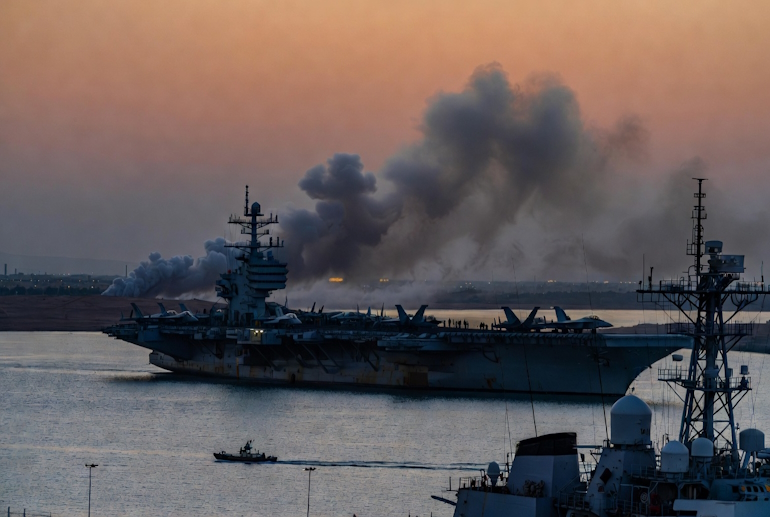
Following another ceasefire collapse and sharp statements from President Trump about being ready to “blow Iran to hell,” the situation in the region escalated dramatically.
US strikes on Iranian targets in the Persian Gulf region have already caused significant losses on both sides, but the main confrontation is only beginning.
In the event of a transition to a real full-scale war, Washington is capable of inflicting heavy damage on Iran, but the price of such a conflict will prove extremely high for all participants.
Related articles on this topic:
US Military Might in a Hypothetical Full-Scale Conflict
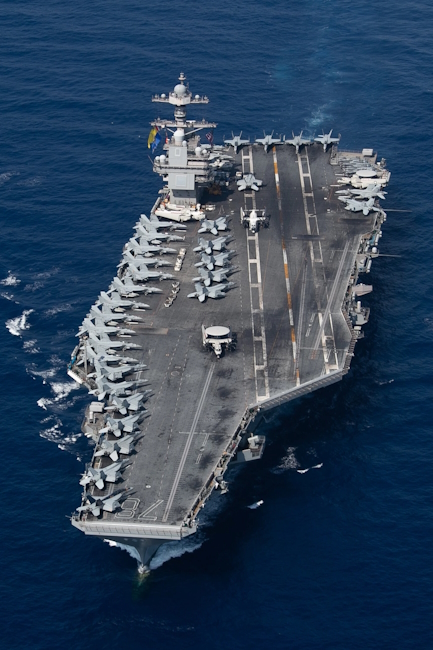
- In the photo above – aircraft carrier: USS Gerald R. Ford (CVN-78)—the newest and most advanced aircraft carrier in the US Navy.
US armed forces possess overwhelming superiority in the air, at sea, and in precision strikes.
In the event of escalation, the US can deploy several carrier strike groups, hundreds of combat aircraft from regional bases, Tomahawk cruise missiles, and strategic bombers. The primary focus will be placed on destroying Iranian air defense systems, missile complexes, nuclear program facilities, and infrastructure around the Strait of Hormuz.
This approach has already demonstrated effectiveness in previous exchanges of strikes: a significant portion of the Iranian navy and launchers has been knocked out. At the same time, the US minimizes its own losses through standoff weapons, avoiding massive ground involvement for now.
When is a US ground operation possible, and what might it look like ?
A ground operation in the full sense of the word remains unlikely in the near future.
Iran is a vast country with mountainous terrain, complex logistics, and a million-man army ready for a prolonged guerrilla war. US commanders understand the risks of repeating an Iraq or Afghanistan scenario, so any ground actions will be extremely limited.
If such an operation does take place, it will more likely take the form of surgical raids by special forces and Marines to seize key islands in the Strait of Hormuz or support allied forces. The core strength will consist of elite units like Navy SEALs, Rangers, and the 82nd Airborne Division.
The objective will be disabling critical facilities and forcing Tehran to capitulate rather than occupying territory. The consequences for Iran would be catastrophic: destruction of remaining infrastructure, regime collapse, and chaos in the country.
Involvement of US NATO Allies
Most European NATO allies are demonstrating restraint. Direct military involvement in a conflict with Iran is undesirable for them—there is no consensus within the alliance, and risks to European energy security are too high.
Certain countries (the UK, France) can provide limited support in the form of intelligence, logistics, or patrolling in the Persian Gulf, but full combat engagement is unlikely.
Bases in Turkey, Jordan, Kuwait, and the UAE will remain central to the US operation, though using them is already causing regional friction. NATO as an organization is staying on the sidelines for now, focusing on the European theater.
What happens if the US gathers its entire carrier and submarine fleet near Iran ?
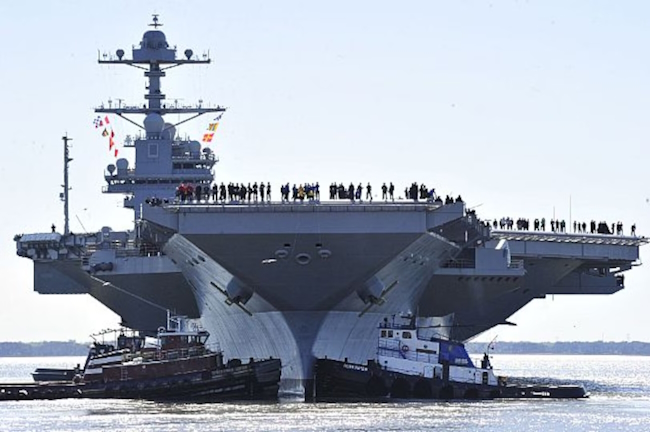
The US can unquestionably establish overwhelming superiority in the air and at sea, completely locking down the Strait of Hormuz and fully paralyzing Iranian oil exports. Hundreds of carrier aircraft and thousands of submarine-launched cruise missiles will allow the US to destroy most of Iran’s air defenses (which are already nearly wiped out), navy (already crushed), and missile bases within days.
Iran will find itself completely isolated, with rapidly depleting stockpiles and no capability to wage an effective naval counter-campaign.
How the US Can Overwhelm Iran in a Full-Scale War
The US is capable of overwhelming Iran through absolute superiority in the air and at sea.
With several carrier strike groups, hundreds of combat jets (F-35, F-18, F-22), and thousands of Tomahawk cruise missiles, Americans can suppress Iran’s air defense system (which is already suppressed) in days, destroying most of its missile complexes, depots, and drone manufacturing plants.
Support from Israel will play a special role, having already demonstrated its capability to launch precision strikes against nuclear facilities and command centers deep inside Iranian territory. Britain, in turn, can bolster the operation with its submarines and intelligence, helping intercept Iranian vessels and close off the Strait of Hormuz.
Combined, such a coalition is capable of paralyzing the Iranian economy and war machine, stripping Tehran of the ability to sustain a prolonged war. The main emphasis will be on standoff strikes and blockades to avoid a large-scale ground operation.
Iran will respond asymmetrically—with mines, drones, and anti-ship missiles—but given the current balance of forces, its capabilities will deplete rapidly.
What does the presence of several US amphibious assault ships near Iran signal ?
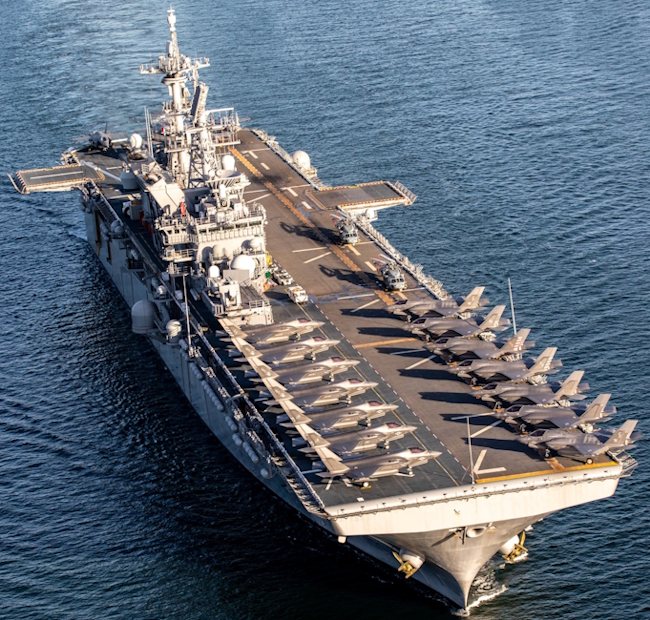
- In the photo above – amphibious assault ship: USS Tripoli (LHA-7)—an America-class ship, the most modern amphibious assault ship in the US Navy (along with USS America LHA-6).
This points to serious preparations for potential amphibious operations or the forcible seizure of key islands and assets in the Strait of Hormuz.
These specialized vessels carry Marines, helicopters, heavy equipment, and landing craft, enabling swift raids without embarking on a full ground campaign.
This fleet composition signals readiness for a hybrid scenario—ranging from blockades to precision strikes from the sea followed by landings. This is a serious signal to Iran regarding a potential expansion of the conflict beyond air and missile strikes.
Position of Russia and China
Russia and China are unlikely to enter a direct military conflict on Iran’s side. Both nations condemn US actions, offer diplomatic backing, and, according to some reports, limited technical assistance (intelligence, drone components). However, full-scale intervention carries far too much risk for them:
- Russia is tied down on other fronts and is not prepared for a new theater.
- China is more interested in stable energy supplies and avoids a direct clash with Washington.
- Ultimately, Tehran will receive political and indirect support, but no rescue from superior US power.
A full-scale US war against Iran will lead to severe destruction of Iranian infrastructure and heavy casualties and material losses on the Iranian side, while also triggering serious economic consequences for the entire world—soaring oil prices, supply chain disruptions, and risks of further escalation.
For Washington, such a scenario serves as leverage, but it won’t be a walk in the park.
The outcome will largely depend on how quickly Tehran is willing to enter new negotiations on US terms.

Welcome to Poznayu.com!
My name is Alex, and I founded this project together with a team of like-minded professionals. At Poznayu.com, we create in-depth reviews, explore fascinating facts, and share well-researched, reliable knowledge that helps you navigate complex topics with confidence.
Our mission is simple: to explain complicated ideas in clear, accessible language. We believe that high-quality information should be available to everyone. Every article we publish is designed to provide practical value, actionable insights, and trustworthy analysis you can rely on.
Join our growing community of curious readers. Your feedback matters — share your thoughts in the comments, ask questions, and suggest topics you’d like us to cover next.